
Rabbi Chaim Loschak and Mushkie Have Arrived

I’m having a conversation with Rabbi Chaim Loschak – founder with his wife Mushkie of Montecito Chabad – and it’s impossible not to notice that he is bouncing his right leg at a frequency suggestive either of two strong cups of coffee, or the anticipatory effect on his physiology of a frenetic day ahead. I’m bouncing my own left leg with equal vibratory energy, as is my habit. Neither of us is jittery with nerves, but the fact is the rabbi and I are waggling minutely as we chat, like two guys conversing through a smallish seismic event. I ask if he had a look at the questions I’d proposed to ask.

“It’s been a little hectic. I can’t say I did the proper prep that I would rather have done. My personality is to over prepare.” He pauses. “I guess I don’t want to sound punny over here, but I figured I may have to wing this.”
The rabbi has made me guffaw.
As I write this, preparations are being made for the menorah lighting at the Upper Village’s Corner Green on Tuesday evening, December 16. This now-yearly public tradition in the village was instituted by newly arrived Rabbi Loschak and his wife, Mushkie, in 2022. To my surprise, though the private lighting of the menorah has been ongoing for over 2,000 years, this public, civic occasion of communally lighting the menorah is a much more recent innovation dating to the ‘70s. The 1970s.
“The Lubavitcher Rebbe, blessed memory, started this whole concept of public menorah lightings in the ‘70s,” Rabbi Loschak says. Rabbi Loschak explains to me at length this towering, heart-centric figure of 20th century Judaism. Rabbi and Mushkie Loschak’s founding of Montecito Chabad and the menorah lighting ceremony draw from his teachings and example. “His idea was to add more light to the Jewish world, and to the world at large. It’s like you have a spark of divinity within you that’s perfect and wholesome, and if we could channel that for positivity, it’s a really powerful thing. And I’ve seen that personally here.”
He explains to me his inaugural experience arranging that first Montecito menorah lighting event, warming to the story as he unspools it. In the telling, he sounds about as house-husband-competent as I am and I’m guessing our wives could share some laughs over this.
“I was putting up the menorah on Coast Village Road and it was me, Beth Sullivan, and Robert Miller from the Coast Village Association,” he says. “They were helping, and they’re both much more handy than I am, to say the least! And I was just thinking to myself, this is really beautiful, because I’m Jewish, they’re not, and this gathering is for everyone, a symbol of unity and light.”
The local support has continued to manifest apace.
“This year our menorah lighting is being sponsored by someone who’s not Jewish – Pat and David Wadors.” Having worked with Pat for some years at Procore, I’m both struck by this and not in the least surprised.
“They’re fostering it together,” Rabbi Loschak says. “David is a good friend. There’s so many people that I’ve met that have that similar sentiment. It just shows how beautiful our community is, and how welcoming.”
A Californian Comes Home
Rabbi Chaim Loschak, born in Goleta Valley Cottage Hospital, was living in Brooklyn when he came back for a visit. “Before I moved back here, I came to see if there could, and should, be more of a local Jewish Chabad presence or community here in Montecito. I met with many people. Time-wise, this was actually Hanukkah four years ago.” And how was Brooklyn?
“I went to New York a decent amount growing up. I have family there and friends. Then I lived there for seven and a half years. Obviously living there was a different experience.” He did find his heart there. “My wife is South African, and I am Californian, and we both met in New York, in Brooklyn.”
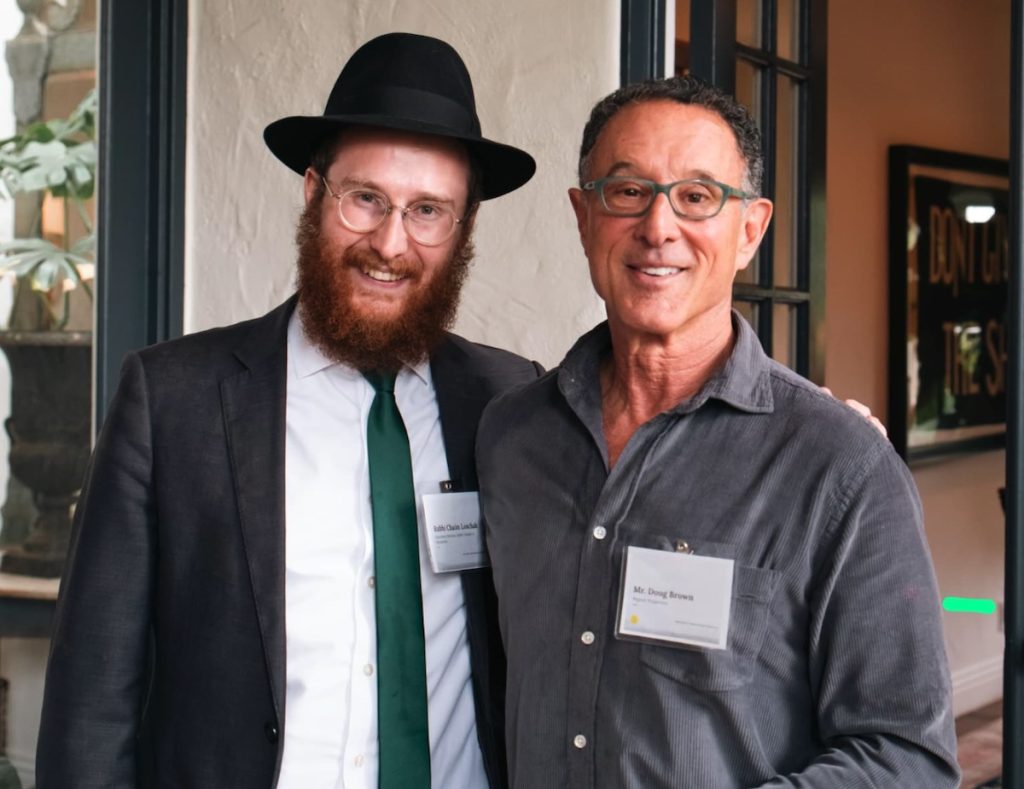
Rabbi Loschak is a guy with an amused, lopsided grin and an easy manner. He’s wearing the familiar yarmulke, white dress shirt, and wire frame glasses (I wear the same ones).
I mention this because in my possibly pitiable imagination a rabbi is approximately as decipherable as an Apollo-era astronaut – someone whose deep training, intellectual rigor, and journeys to places beyond my comprehension invite my polite staring.
In any case, I’ve never spoken to a rabbi before, and the idea intimidates me a little. The very word “Rabbi” suggests antediluvian wisdom, a walking, bearded repository of eternal laws and codes.
Within about 20 seconds Rabbi Loschak has put me at my ease. He could be a pal from down the block. At one point I comment on the densely packed, scholarly-looking volumes on the shelving behind him. He turns his head to briefly survey them and turns back to me with a mild grin.
“We’re called people of the book for a reason, right?”
He continues with the story of his visit to Montecito some four years ago, a visit whose findings would determine his and Mushkie’s next steps. He visited with many people on that visit.
“Some of them were older and it seemed they were mostly alone,” Rabbi Loschak says with feeling. “I remember I visited someone and the smile on his face seeing me! He was in his nineties. Now he’s 94. And this smile on his face of seeing someone who just cared for him as a person, it was incredible, it was incredible. That feeling of seeing that.” I see the Rabbi reliving the feeling before me and it’s terrific.
My personal intention in this piece is to write a broad profile of Rabbi Chaim Loschak, and out of my personal curiosity to learn what I can about Rabbinical training and life. There is nothing foreordained about becoming a rabbi. It is aspirational, deeply personal, and arduous. “Some of our greatest rabbis in our history were converts. My father became a rabbi. He wasn’t even born religious. He was Jewish, but he was not born religious at all and he became a rabbi.”
He explains the various “specializations” in the Rabbinical space, the places he’s studied (Los Angeles, France, Israel), the attraction of orthodox Jewry to the hub of Brooklyn, the NYC borough from which he and Mushkie returned to the central coast, to Montecito.
“I moved here for this specific purpose, to open this Chabad here to help Jews connect with each other,” he says. “To discover more about their heritage and celebrate Judaism in a positive way.”
Our conversation today is under an unacknowledged shadow, a cloud occluding the sun. A tragic attack in Australia has taken 15 lives, one of them, his friend named Eli.
“The response to that has to be to dig deeper,” Rabbi Loschak says. “If you’re familiar at all with the Old Testament, Aaron has two sons who died. They went into the holy of Holies with incense and they died by a fire. Aaron was the high priest. And the verse says Aaron was quiet. And so sometimes I don’t have the words to say, I’m just going to be quiet.
But if we don’t engage more in who we are, we’re basically fulfilling their wishes, the hater’s wishes. We have to honor the legacy of the people who were killed. That’s my immediate thoughts on the matter.”
You might also be interested in...




You must be logged in to post a comment.