
Greg’s Vocation Lets Us See the Poem Hiding in the Tree
“One of the first things I look at is what’s the essence of the tree that I’m working on? On a Japanese maple, for instance, in the wintertime it’s about the winter silhouette. In Japan they say when the tree goes dormant and loses its leaves, the tree is bearing its soul. Then when the Japanese Maple is in leaf, the essence changes…”
Okay. Greg Kitajima is an APA Certified Aesthetic Pruner® – a discipline most plainly (and inadequately) described as half horticultural care and half creative expression. That’s an oversimplification, of course. Michelangelo once famously said “I saw the angel in the marble and carved until I set it free.” Now imagine the block of marble as dynamic, alive, and growing as you meticulously work – through the passage of weeks, months, and years – to reveal its elegant hidden truth.
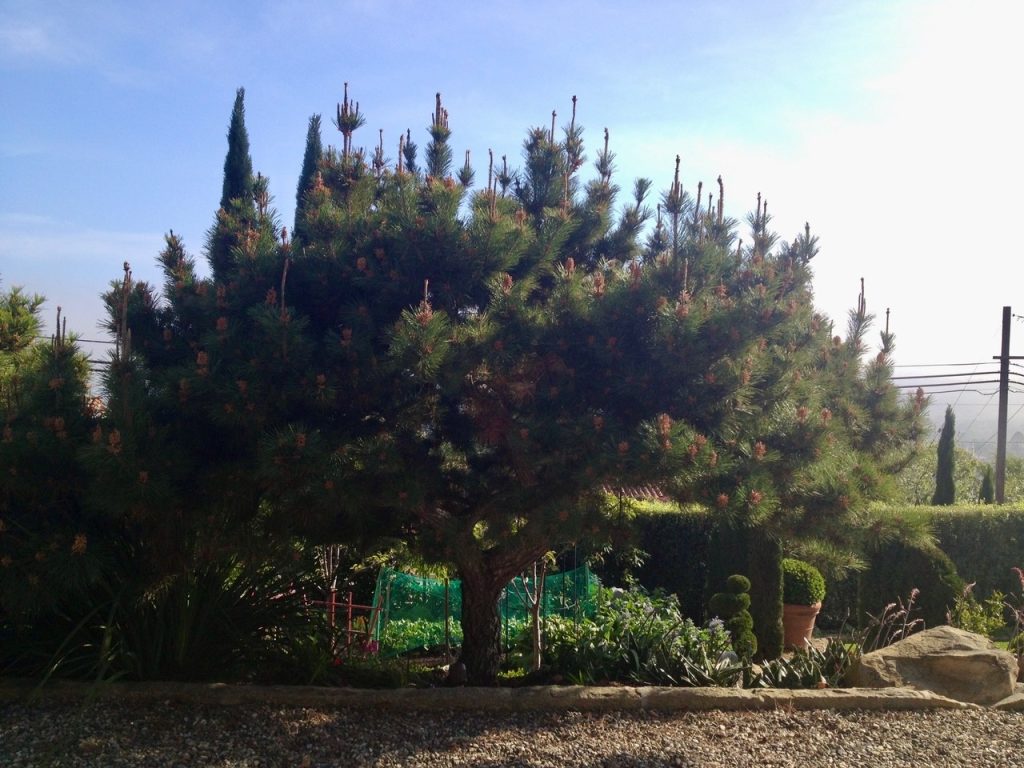
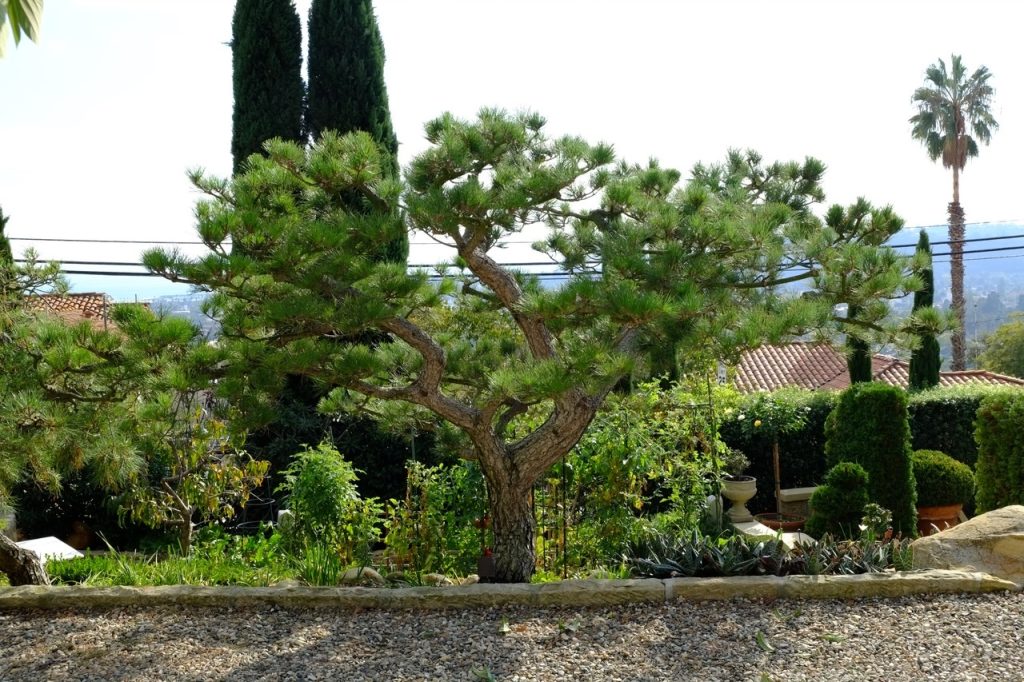
“Aesthetic pruning is really the science of arboriculture combined with an artistic vision of a tree or shrub,” Greg says. “We’re following the basic science, everything we’ve learned about trees through centuries of pruning and studying trees. But we’re asking ‘what’s the structure?’ With the Japanese maple, – considered the feminine form of the Japanese
garden – it’s about bringing out the delicate look of the tree. I want to create this effect of dappled light coming through the leaves.”
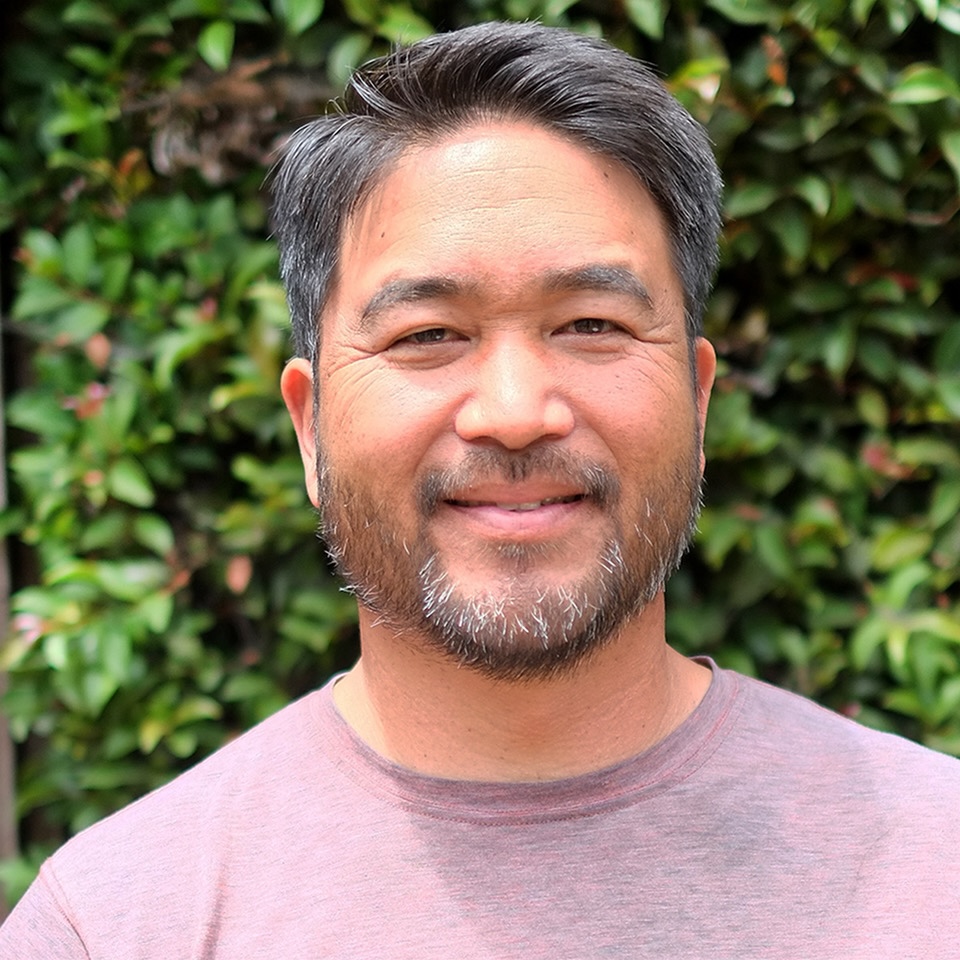
Greg Kitajima wandered almost accidentally into his artisanal mission. Signing up for a three-month day gig as a laborer to augment his evening work in mixology, Greg will ultimately spend some 14 years in the kaleidoscopic “garden” called Lotusland. There he’ll be drawn into the orbit of a certain Frank Fujii, founding botanical visionary and steward of both Lotusland’s Japanese Garden – and of Greg’s immersive (and philosophically colorized) expertise. It happened like this. More or less.
Arboriculture Shock
Having completed his UCSB undergrad in Philosophy, Greg Kitajima knew both the role of empiricism in Hume’s epistemology and the rye-to-vermouth ratio in a Manhattan.
“Yes, I graduated from UCSB with a philosophy degree. While still in school I got a job at the Brown Pelican” – today’s Boathouse atHendry’sBeach – “where I eventually became a bartender.” Just ahead lay Kitajima’s artisanal destiny, and the uncontainable geist of a previous esoteric philosopher, singer, and human firework named Ganna Walska. When fortune rang, Greg answered the door.
“I was just living in Santa Barbara,” he says. “I had no idea what my future or career was going to be. A guy that I shared a house with was working at Lotusland. They were doing a renovation project in the Cycad Garden there, and they needed a couple laborers. They couldn’t bring in heavy machinery so everything had to be dug up by hand. I was like, ‘I’ll go spend some days out there and I can still do my bartending at night and on the weekends.’”
What would follow from Greg’s three-month gig as a day laborer? Bromeliads, mentorship, a new personal epoch, and a belated deep-dive into his family’s – and our country’s – troubled mid-century history.
No big deal.
The Fruit of the Tree of Knowledge
“It was during the time I was working in the Cycad Garden that I met Frank Fujii,” Greg says with deceptive nonchalance.
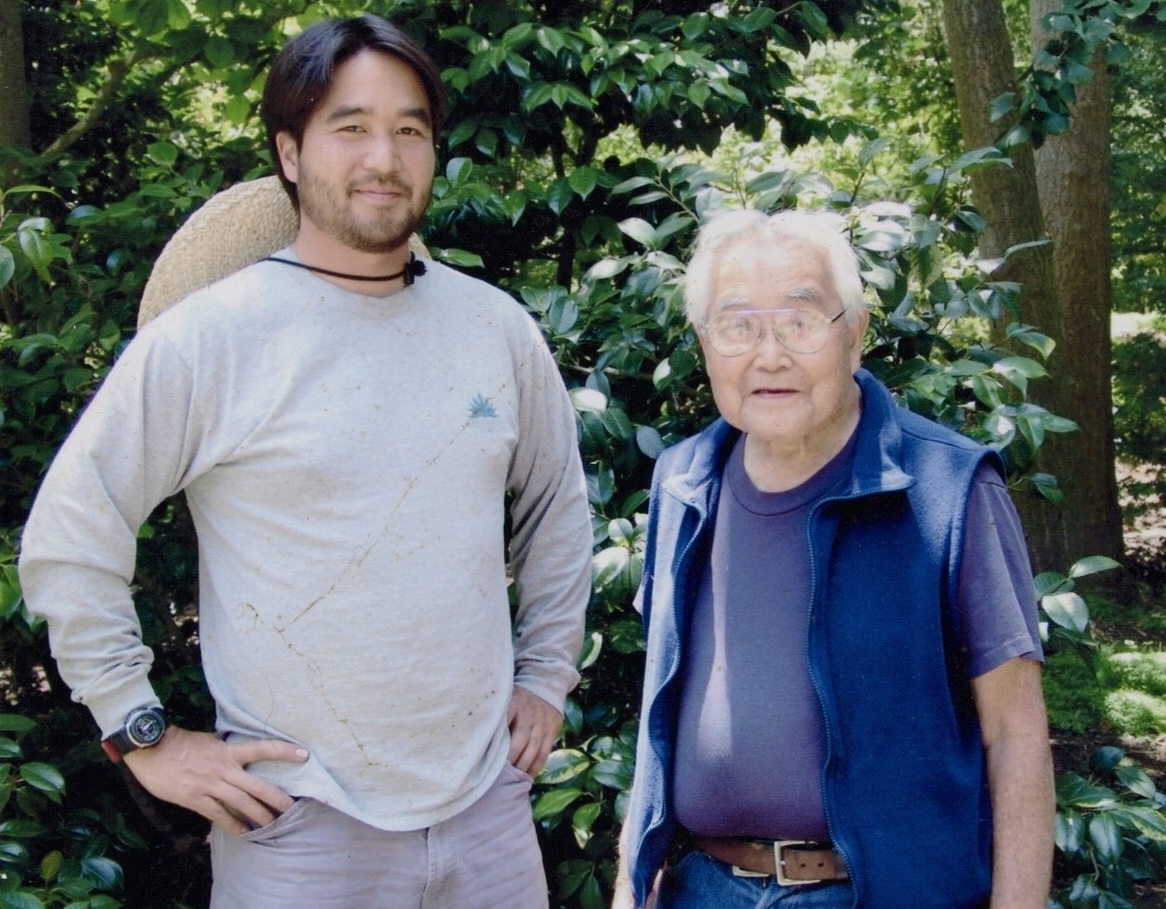
Storied Japanese gardener Frank Fujii came to Santa Barbara with his family when he was 10, in 1927. He later attended SB Junior High and SBHS, was a Gaucho at UCSB, and following the outbreak of WWII was imprisoned with his family on the Gila River War Relocation Center in Arizona. At war’s end four years later, the Fujiis, incarcerated Americans, were released. They returned to SB where young Frank Fujii found work at the Montecito estate of Louisiana cypress scion Kemper Williams.
Fujii would work at the Williams Estate for years, but when he met the meteoric Ganna Walska in 1967, the die was cast. Which die? You name it. That year, Fujii became a part-time gardener at Ganna’s horticultural fever dream, called Lotusland. Then in ‘72 Ganna would bring Fujii aboard full time. Alongside master stonemason Ozzie Da Ros, Frank Fujii would begin laying the groundwork for Lotusland’s globally renowned Japanese Garden and – some 28 years in the future – Greg Kitajima’s arboreal metamorphosis.
“I want to be able to work with Frank in the Japanese garden…”
Greg Kitajima is a soft-spoken guy with a wave-tossed inner emotional life one can sense from afar. One day at Lotusland he was invited to a pruning session. Greg’s account of the invite is as understated as everything he says, but the moment was as loaded as a steamer trunk. Fujii got wind of Greg’s pruning interest and the clouds began to part in earnest.
“Once Frank heard that I was interested in learning, I think my being of Japanese ancestry definitely created a connection between us.” An informal apprenticeship began to materialize. Here comes Greg 2.0. Cue the bugle-blowing cherubim. Kitajima’s Destiny shrugged into a dinner jacket, the Fates came gangling in with their “you rang?” grins, and helpful details fell curiously into place. It was something.
“At the end of my three-month contract with Lotusland,” Greg says, “one of the gardeners taking care of the Bromeliad Garden resigned his position, so there was a full-time opening.” The increasing allure of the Japanese Garden and Frank’s tutelage to that point had so captured Greg that when offered the Bromeliad position, the guy presented his conditions.
“Hey, look,” Greg said to his surprised interviewers. Picture them now, looking slowly up from their paperwork. “I’m interested in taking the job, but I want to be able to work with Frank in the Japanese Garden.” Taken slightly aback, the grounds superintendent was copacetic. “As long as you get your work done, we’ll allow you to spend one day a week working with Frank in the Japanese Garden.” Greg Kitajima took that ball and ran with it. After a year of Bromeliads, he moved to the Japanese Garden, and the apprenticeship of a new lifetime.
“I was at Lotusland for around 14 years,” Greg says, “from 1999 to 2013. I actually worked directly with Frank for eight years. People say to me all the time, ‘Oh, you must have learned so much from Frank Fujii!’ I tell them the biggest lesson that I learned from Frank Fujii was the value of humility; never thinking that you know everything there is to know. Even at 90 years old he would say to me, ‘I learn something new in this garden every day…’”
When Greg departed Lotusland to find his own path as a trained and certified Aesthetic Pruner and occasional Japanese Garden consultant, ahead lay a new perspective on the power a simple garden can wield.
Amache
Greg Kitajima is a third-gen Japanese American (Sansei in the Japanese terminology) and knew little of his family’s wartime experiences. In the wake of Imperial Japan’s Pearl Harbor attack and the panic that ensued in the U.S., President Roosevelt signed order 9066. Most of Greg’s extended family, all American citizens, were removed to a Colorado prison camp called the Granada War Relocation Center. “My parents were seven and three at the time,” Greg says. To internees the place was known as Camp Amache.
“This is a very Japanese thing,” he says. “My family never spoke about it. There’s a saying in Japanese, a phrase around the word Gaman, which means that you persevere.” He pauses. “And I think a lot of the Gaman is reflected in what they did at Amache, building all these gardens.”
In 2016 a chance meeting at a North American Japanese Gardening Association (NAJGA) conference in Florida changed Greg’s life. Again. As luck would have it, Dr. Clark – University of Denver Professor of Anthropology – was leading something called the Camp Amache Community Archaeology Project. These things happen; to Greg Kitajima, anyway. Naturally, the two got to talking.
“I told some of my family, ‘I met this professor and I’m going out to the site to volunteer with this archeology project.’ My dad’s older brother, my uncle Ken Kitajima, told me ‘Oh, you should come out to my house! I have boxes of information on the internment sites, especially Amache.” Ken Kitajima – 14 at the time of his family’s incarceration – would go on to serve with the U.S. Air Force in the Korean War. Mr. Kitajima passed in 2022, but not before spearheading preservation of Camp Amache as a Federal Historic Site – and infusing Greg with these missing pages of the Kitajima family’s legacy.
Greg would travel to Amache, working to disinter long buried ephemera and marinating in filial gravity.
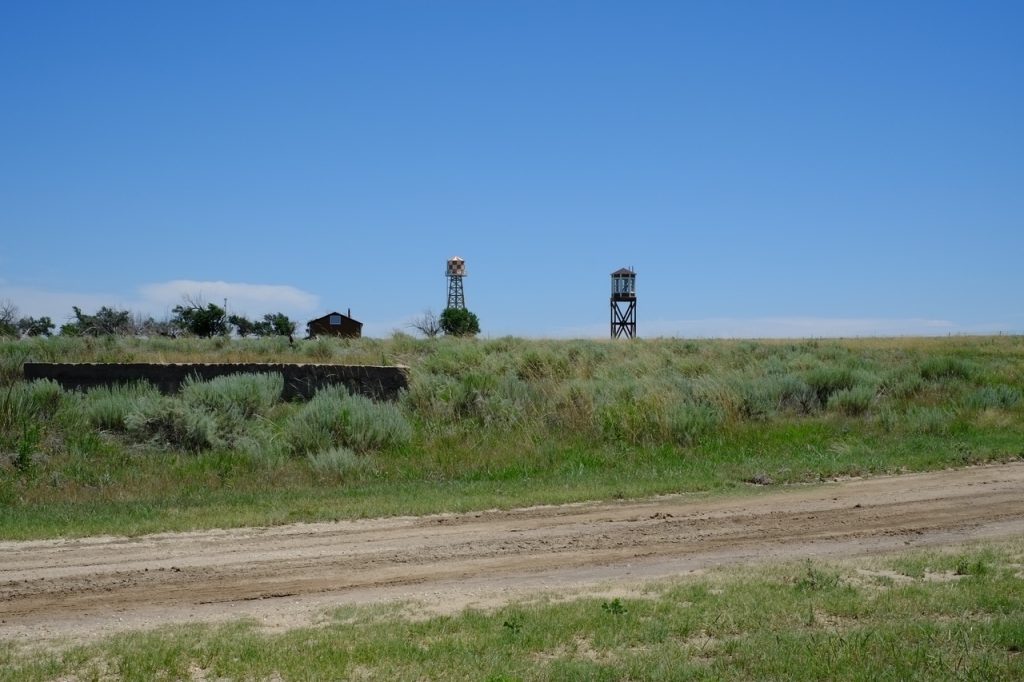
“The three main elements of a Japanese garden are water, plants, and stones.” Greg offers a mordant laugh. “Those were in short supply in that place.” It all comes back to gardens; not just decorative and orderly little plots, but community power stations. The incarcerated worked determinedly with what was at hand. Rarely has shattered concrete been given so exalted a second life.
“They broke off chunks of that concrete overpour from the barracks’ raised foundations,” Greg explains with some emotion. “They used those for garden stones. And the ‘soil’ there is literally just sand. It’s astonishing what they were able to grow there. We found eggshells in the sand that must have come from the mess hall, fish carcasses from the nearby river. They were tilling all this stuff into the sand, even nails for iron. They were creating soil structure…”
Huh. The Japanese Garden as spiritual battery charger. Or as overexcited Billy Shakespeare once wrote, “There are more things in heaven and earth, Horatio, than are dreamt of in your philosophy.” Oh.
To summarize – bartending philosophy major’s ditch digging side hustle takes him to previously unimagined inner and outer realms, a font of family, and a skill set ministering to Planet Earth. It comes down to flatware etiquette. You know, choosing the right fork. Greg?
“Frank’s apprentice said one day, ‘Hey, I’m going to be teaching an intern some pruning after work. You’re welcome to come and spend time with us’. I said ‘Sure, I’ll do that.’”
You might also be interested in...




You must be logged in to post a comment.