
La Arcada’s New Day
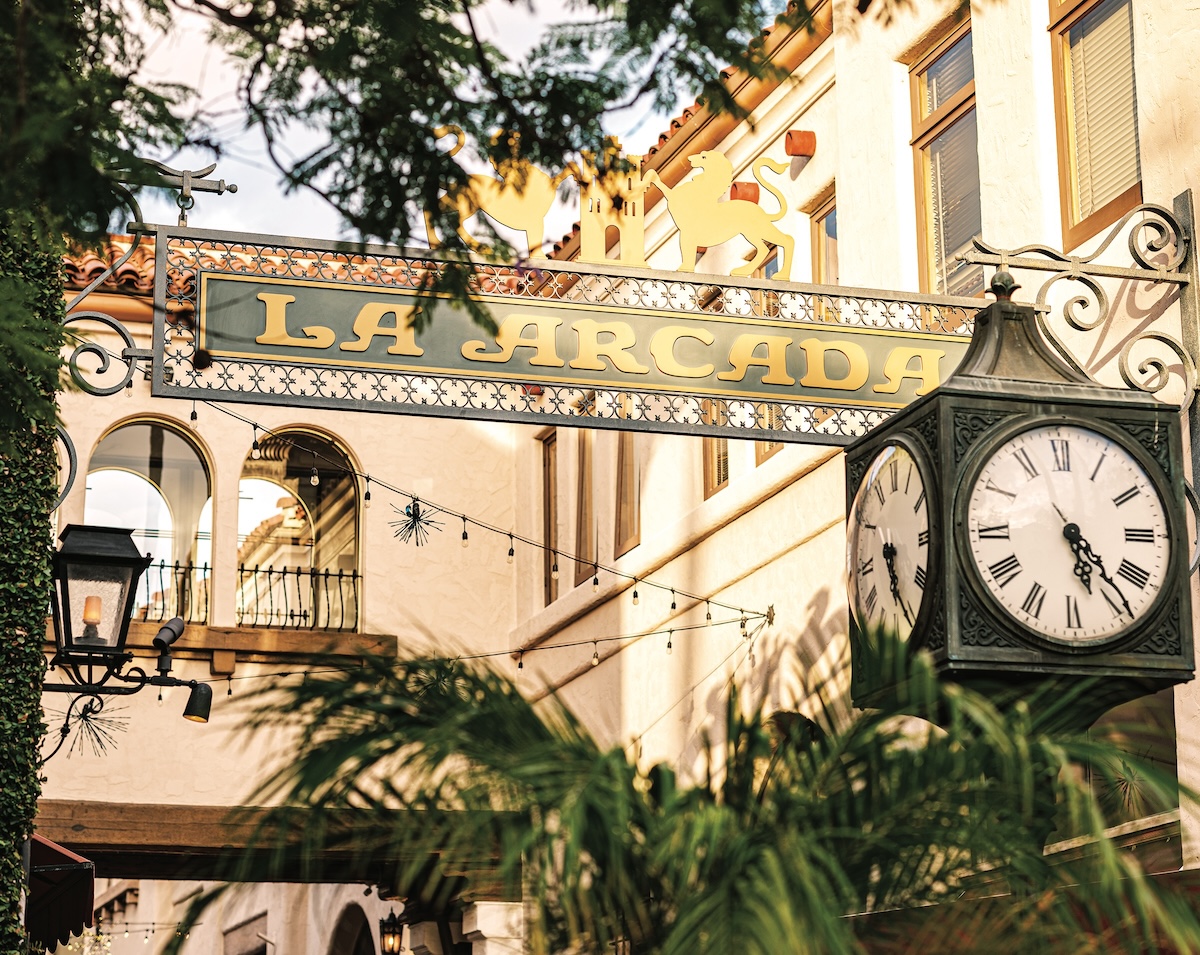
Santa Barbara’s State and Figueroa streets meet without a lot of outward fanfare; a relative judgement, of course. The whole of Santa Barbara’s main street, which actually begins 1/3 mile offshore in 25 feet of Pacific, could be described as one long instance of fanfare. For instance, not satisfied with elms and maples and other Father Knows Best arboreal boilerplate, State Street’s swaggering shade-throwers include Laurel Figs, Rainbow Eucalyptus, preening Jacarandas and the not-infrequent Syagrus romanzoffiana.
Santa Barbara’s main artery even shares a name with that storied Chicago thoroughfare Sinatra rhymingly rhapsodizes as “State Street, that great street” where “…they do things they don’t do on Broadway” (more on the Windy City in a minute). So I take it back. There is fanfare at the intersection of State and Figueroa; it’s just that much of its ballast is concealed in the hidden enclave of La Arcada.
“This place has been such a gift from Hugh to Santa Barbara,” says Lynne Tahmisian. “And he wanted it that way.”
Hugh?
“I had no idea Hugh would want me to come and do this,” Lynne continues. Hugh is Lynne’s uncle, and as of 1973 the father of La Arcada’s bespoke renaissance. “It was a surprise,” she says. “He’d asked me to come down and work with him for three years because, you know, he was getting a little older. I think maybe he knew.” She offers a rueful grin. “But I didn’t know.”
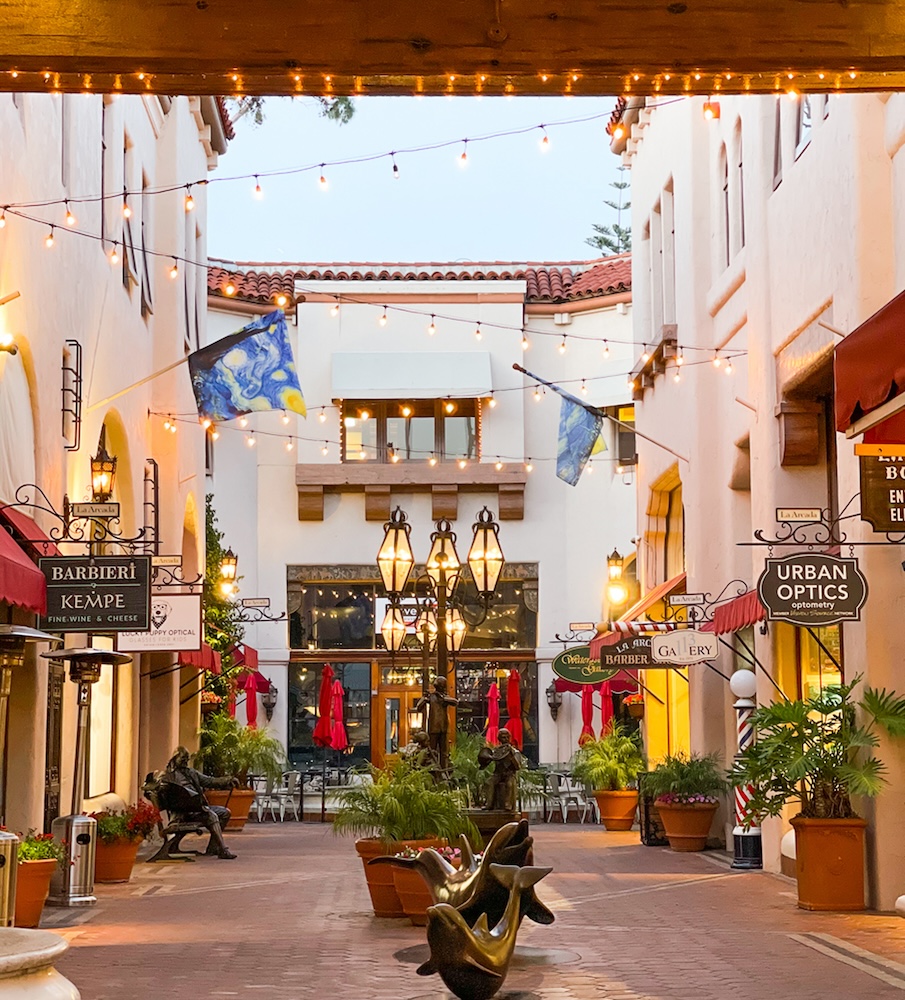
Hugh Petersen is the Chicago transplant who bought a neglected La Arcada in 1973 and turned it into the hidden happy hamlet the city has since grown to cherish. Alongside his wife, Marjorie, Hugh spent decades tuning up this 1.23-acre paseo with fountains, bronze turtles, smile inducing trompe-l’œil statuary, and a host of other utterly unique features he would collect in far-ranging travels or transplant from his beloved Chicago.
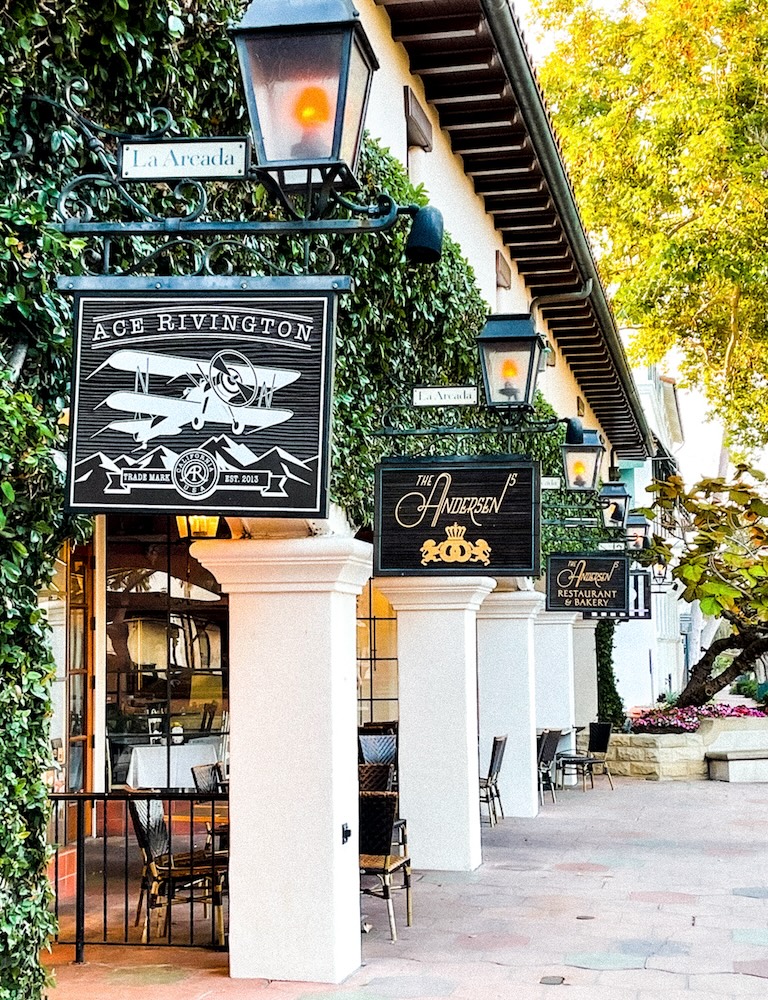
Behind and beyond the Ace Rivington flagship that anchors the northeast corner of State & Fig is a hidden realm. La Arcada’s cozy embrace and village within the village walkabout ambiance is the shade-dappled heart of Santa Barbara’s Arts District, and every December the miraculous nexus of local holiday snowfall. Since 2001 when her Uncle Hugh passed the torch, the unofficial mayor and official steward of La Arcada has been Lynne Tahmisian.
Now, as designer Myron Hunt’s Spanish Colonial Revival masterstroke celebrates its 100th birthday, the family is ready to turn a momentous page. This week, after 53 years of family stewardship and encyclopedic, anecdotal evidence of a town’s love for this charmed courtyard, La Arcada Plaza is to be officially listed for sale by Hayes Commercial Group. Partners Kristopher Roth, Francois DeJohn, and Caitlin Hensel are representing the sale. Lynne, who has spent much of her adult life administering, roaming, landlording, and adoring La Arcada, puts up a copacetic front.
“Most Santa Barbarans will say something like ‘I’ve been coming to the La Arcada Christmas Walk since I was a child,’” Lynne says, eyes moistening; windows in the storm’s preamble. “You know, I could write a whole movie about this place.”
Sentimental Centenary: The Village Hugh Built
Yes, La Arcada turned 100 this year, and was justly fêted back in August. The story of Santa Barbara’s explosive reboot – from well-off frontier cow town to Spanish Colonial Revival visitor magnet – is as familiar to most locals as nursing a bowl of clam chowder at the Brophy Brothers bar. But not everyone knows the related tectonic origin story of La Arcada. When on the morning of June 29, 1925, Santa Barbara was rocked by a 19-kiloton earthquake for a third of a minute, much of the frontier town’s central corridor collapsed like a non-union film set. Structural casualties included a large church at the corner of State and Figueroa streets, Our Lady of Sorrows. She’d already been knocked down once before by fire in 1865, and her keepers interpreted this second calamity as a declarative memo from the home office. When our Lady of Sorrows decamped to Sola and Anacapa (where their beautiful edifice stands today), a certain Hattie Stockton, respected possessor of a blue-chip commercial and residential real estate portfolio with holdings along State Street and in Montecito, seized the opportunity.
Enlisting the offices of architect John F. Cooper and supervising designer Myron Hunt – she commissioned La Arcada (The Archway) in 1926; a Spanish Colonial Revival warren of shopping experiences and offices whose entrances on both State Street and Figueroa would draw in the pedestrian curiosity seeker and energize the revived parcel. By the early 1970s, though, La Arcada had fallen into disuse.
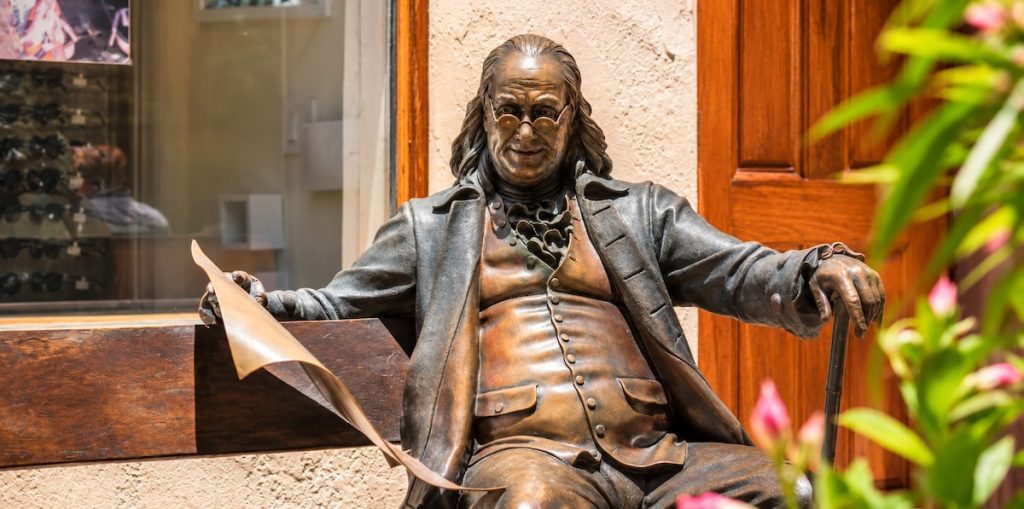
An imaginative, naturally caffeinated corporate retiree from Chicago named Hugh Petersen had settled delightedly in Bonnymede with his wife, Marjorie, and when the provably indefatigable Hugh discovered the ramshackle La Arcada, he excitedly purchased the exhausted property. Hugh Petersen spent the next 30 years recasting the neglected paseo as a leafy, sun-and-color-splashed reflection of his own restlessly curious, life-loving persona. Hugh curated sculpture, a Spanish galleon’s 18th century cannon, bronze dolphins, statuary produced by a right-brain scion of the Johnson & Johnson pharmaceutical dynasty, and a life-size Ben Franklin in an attitude of comfortable repose on a La Arcada bench. Ben is of course proofing the Declaration of Independence. This is a sampling of Hugh’s cornucopious vision. La Arcada isHugh Petersen writ large. When he bought the place, not everyone had faith.
“I was here in college in the mid-sixties and it was a very scary place,” Lynne says. “Hugh told the city council of his vision at that time and they told him he should really just demolish the whole thing.” Ignoring the sage advice of the short-sighted is its own reward.
A City’s Heart
The principals who will be overseeing La Arcada’s change of ownership see the property in all its colors.
“La Arcada is one of a handful of properties that truly define Santa Barbara,” says Kristopher Roth, partner at Hayes Commercial Group. “For two generations, this has been where locals and visitors alike gravitate. Why? To shop, dine, and simply linger. The Petersens’ care over the last 50 years shines from every fountain, sculpture and tile. It’s a rare privilege to help guide a property like this into its next chapter.” Hayes Commercial Group founding partner Francois DeJohn concurs.
“We expect strong interest from long-term investors, family offices, and local stewards who recognize what it means to own a true Santa Barbara landmark.”
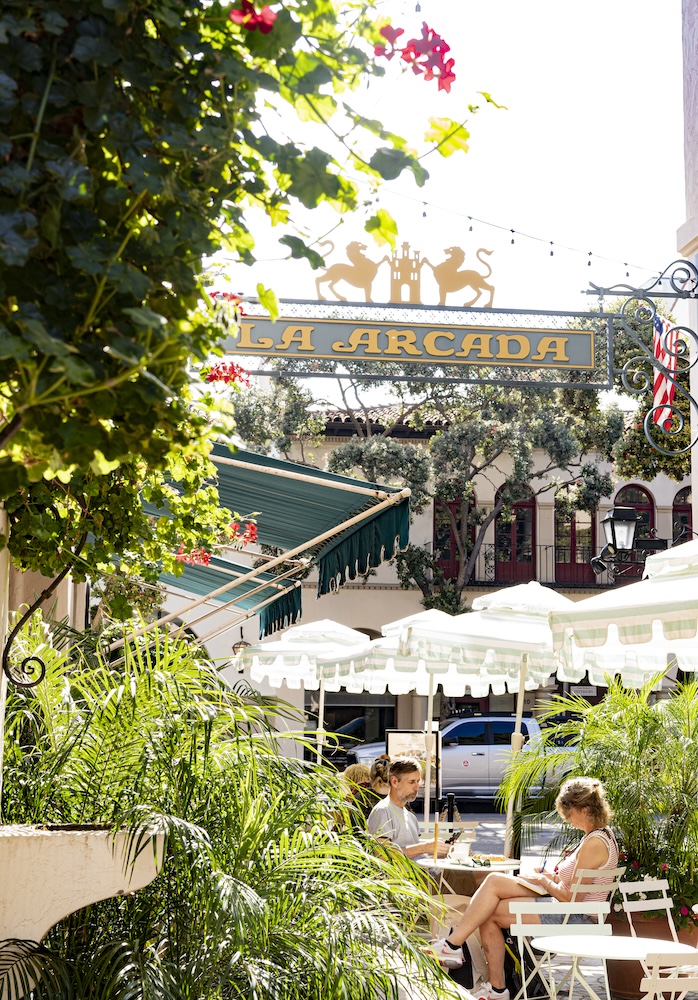
La Arcada is a force whose hometown energies emanate from the plaza’s heartfelt collective. Many of La Arcada’s 76 tenants are cherished Santa Barbara institutions in their own right. Andersen’s Danish Bakery, founded by Alfred and Birte Andersen in 1976, marks its 50th anniversary this year. Gallery 113, one of the SB’s longest-running artist-operated galleries dates to 1978. Lewis & Clark, beloved purveyor of antiques, decorative objects and curiosa (whose musical brickwork rings with every footfall) opened in 1981, and Waterhouse Gallery, known for its California landscape and pleinair painting, sidled in just a few doors down in 1984. Above the courtyard, upper-floor offices house an established community of professional tenants, striking connective bridges offering the environs a shire-like vibe – and an elevated vantage from which to distribute a gentle snowfall during the warmly spirited, locally adored La Arcada Plaza Christmas Walk.
“La Arcada’s tenants, its boutiques, galleries, restaurants and offices, are what give the courtyard life,” says Hayes Commercial Group partner Caitlin Hensel. “Our process will respect those relationships and the community’s connection to this place. Qualified buyers will have a full understanding of La Arcada’s place in Santa Barbara’s heart.”
And then there is Lynne. Gently coaxed into the gig by a warm, persuasive, and aging Hugh in ‘97, having assumed full stewardship in 2001, this moment is freighted with a poignant gravity, to say the very least. Hugh and Marjorie Petersen, a couple from Chicago, fell in love with Santa Barbara and wholly gave of themselves. The irrepressible Hugh, in particular, is everywhere you lay your eyes in La Arcada. His love for the place is its undimmed magic. Now the property offers itself up for the betterment and long-term health of the Hugh E. & Marjorie S. Petersen Foundation. Another long story. Lynne is turning her own page, and it’s all of a piece.
“I’ve spoken to people through the years, heard them tell of their memories,” Lynne says. We’re seated on a bench by the Turtle Fountain, its water music a balm. “Well, the memories are also here with my mom, with my dad, with my son, and now with my grandson. And so it’s a bittersweet thing in that this –” she gestures haltingly at the shady paseo she has overseen and nurtured and loved for much of her adult life – “…has been in my family for so long.” Behind her, old Ben Franklin grins at her through his spectacles. She folds her hands in her lap in a mild gesture of completion. “I mean, we love this place, we love La Arcada. You know, this has been home. We love this.”
You might also be interested in...


You must be logged in to post a comment.