
Veggie Rescue’s Playful Moniker Fronts a Merciful Juggernaut
“Last year we rescued 744,000 pounds of food, and we got that out to 73 nonprofits throughout Santa Barbara County.” As restaurant chit-chat goes, this is an apt opener. Eryn Shugart and I are sipping coffee (me) and tea (Eryn) at Merci; a lovely little place whose name is a French/English cognate meaning (respectively) “thank you” and “compassion.” Our conversational setting has thus teed up our discussion in more ways than one.
Eryn is executive director of Veggie Rescue. The nonprofit does one Herculean thing and does it well; “rescuing” surplus food from county growers, farmers markets, food distributors, and grocery stores and delivering this nourishing would-be landfill to people who need it. It is an uncomplicated mission of mercy. The logistics are not as uncomplicated as the mission, but that’s the nature of scaling benevolence.
“Our food donations help veterans, they help seniors, they help families with young children,” Eryn says. “We deliver to (YMCA’s) Noah’s Anchorage Youth Shelter, serving teens and people in the foster care system. We serve the whole gamut of people who are food insecure.” Yes, Eryn brings her work home – or more specifically to the grocery store. The food waste component that animates Veggie Rescue’s vision has a way of haunting the conscientious; which is anyone who glances even fleetingly at the numbers (see the first line of this story).
“Since I’ve been in this job, when I’m grocery shopping and there’s a chance I’m not going to use something before it goes bad, I don’t buy it. I’ve become a lot more mindful of that.” Understandably.
Okay, then. It’s time we answered the Dual Question implicit in all this earnest typing. Why do Veggies (of all things) need rescue, and from what fate are they being rescued?
Rescue
Veggie Rescue is a sort of double entendre. The nonprofit is indeed rescuing, or more accurately diverting, veggies and other nourishing foodstuffs from… oh, what’s the place called again? Oh yeah: the city dump. Veggie Rescue then sees to the disbursement of those fresh and merchant-quality foodstuffs to the Food Insecure citizens of SB County.
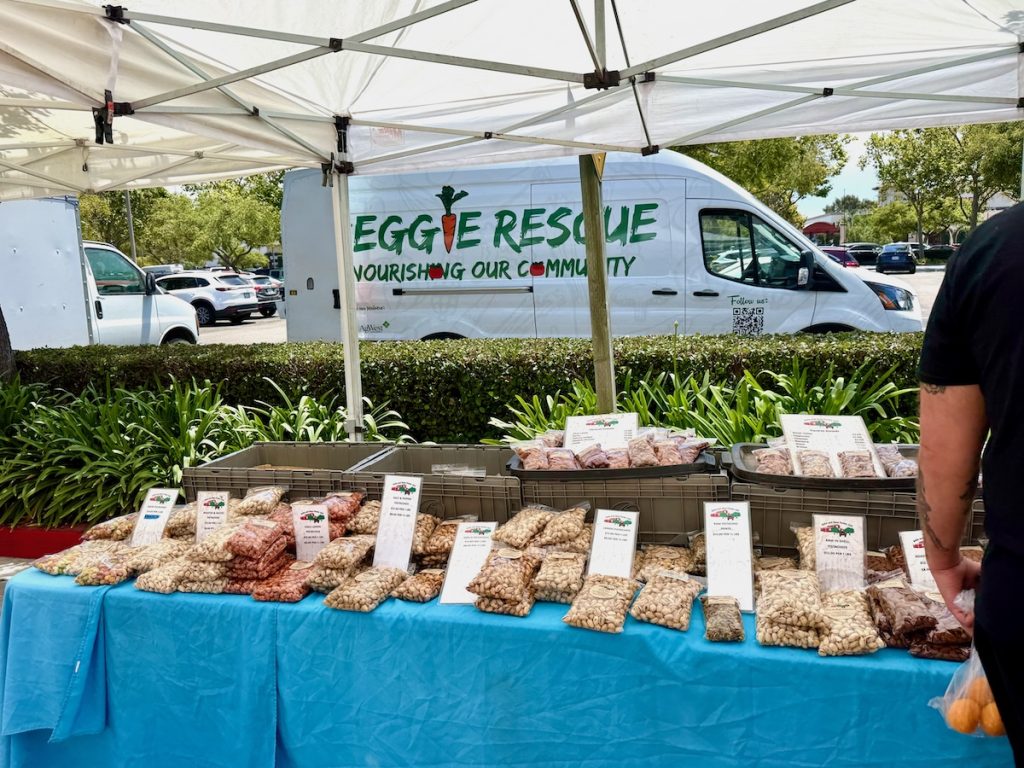
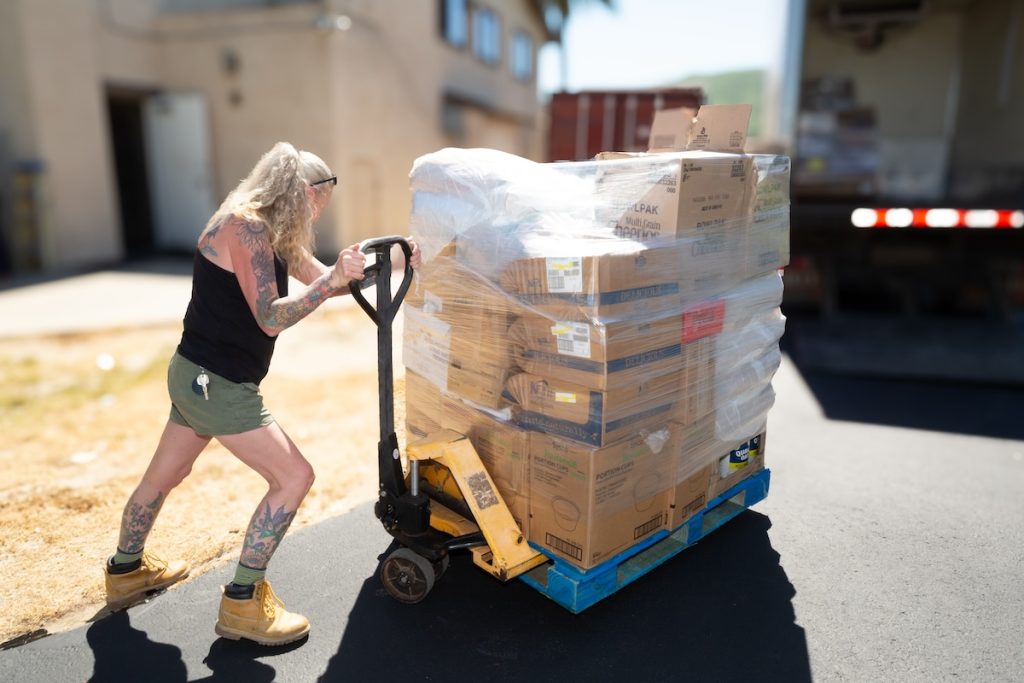
“Maybe two thirds to three quarters of what we rescue is veggies.” Eryn says. “We also go to Ralph’s market in downtown Santa Barbara and Trader Joe’s on De La Vina. We go to Bob’s Well Bread up in the valley and in Los Alamos. We go to Hollandia. We have many partners that give us things besides produce, which is great. Our biggest food donor is Cisco down in Oxford. We get thousands of pounds of food from them every week. We have an 18-foot truck.” (they have three trucks) “I mean, we really are a logistics organization. We don’t warehouse food.” No, they give it to the hungry. And last year’s 744,000 pounds didn’t quite cover the need.
In Santa Barbara County – Veggie Rescue’s service area – over 215,000 people experience food insecurity. To use bureaucrat-speak, these SB County residents lack “consistent access to adequate food.” FOOD.
Thank goodness for our area’s (almost weird) density of nonprofits, our unique species of gold lamé-averse, obsessively giving gazillionaires, and for the Veggie Rescuing missionary zeal of Eryn Shugarts and company.
“What I love about our organization,” Eryn says, “is we’re getting food out to nonprofits. We deliver to 73 nonprofits in total, and probably half to a third of those we’re doing every single week. We donate food all the way up to Santa Maria.” Veggie Rescue is not a monolith but a fleet-footed food magnet. The amiably-named outfit will clamorously swarm, collect, and push out nourishment whenever and wherever it comes available. Be careful what you murmur around Eryn Shugart.
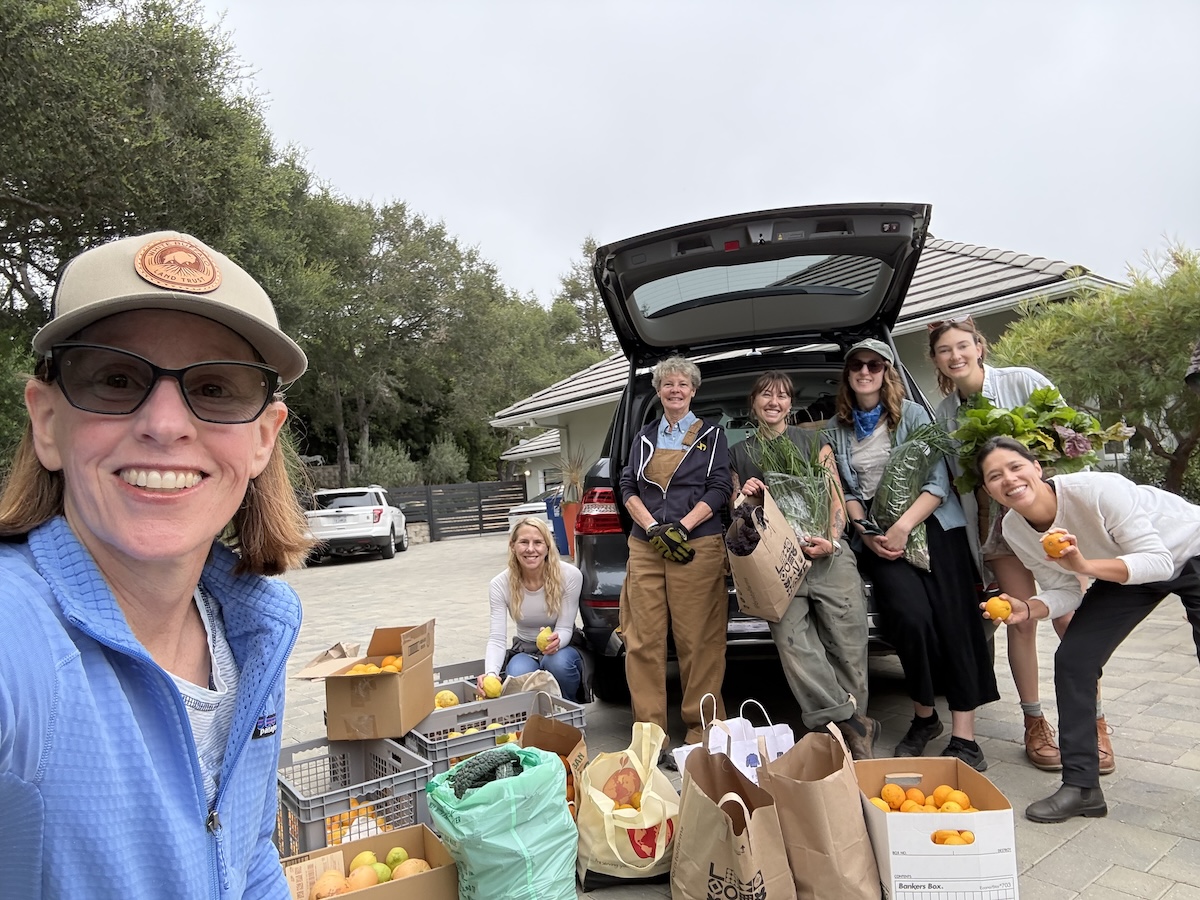
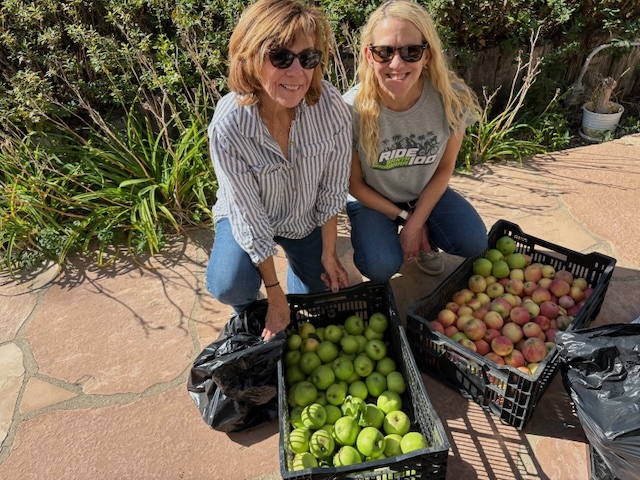
“Laura Wyatt had earlier in the week said ‘I’ve got a lot of fruit trees. Come and bring your group and volunteers and pick.’ And then one evening at a friend’s house, the hostess asked her friends too, and so we’re all going to go and do that, and then we’re going to get that food out to organizations that can take it.”
As you might expect, Veggie Rescue’s origin story has the simplicity of an Aesop’s Fable. It was in 2006 that longtime Santa Ynez Valley denizen Terry Delaney noticed that local farmers sometimes had a small quantity of surplus crop left in their fields after processing – and he wondered if some use could be made of it. Delaney got on the phone, wrangled a pickup truck, and started collecting and driving the surplus to Meals on Wheels. From such tiny, seedlike motivations are mountains moved (as Someone once remarked).
Word spread and farmers jumped aboard – among them early adopters Shu and Debbie Takikawa.Local orgsLos Olivos Rotary and the Orfalea Foundationchipped in to fund a refrigerated truck. By 2010 Veggie Rescue was formally christened.
Mitigating food waste is a gold-plated side effect of Veggie Rescue’s prime directive; getting food to people who need it. Metric tons of edible chow don’t get hauled to the city dump at the producer’s expense, mountains of food aren’t left to disintegrate into milieu-fouling methane, and hungry people get nourishment. This symbiotic trifecta is almost too good to be true, a frictionless flywheel of beneficence. Of course, a speed bump in the “good deed” business is as inevitable as a natural law.
“We’re always looking for more food to get out to people,” Eryn says. “At this point in time, we have more demand than we have supply.”
Waste Not, Etc.
Food waste figures in the U.S. have a certain character of geometric horror-accrual. Few would likely guess that FOOD is calculated to be the number one categorical input to U.S. landfills, comprising an estimated 24% of the slop being churned by bulldozers (and rhapsodized by gangs of yelling seagulls in these parts – your peaceable contemplation of Jonathan Livingston notwithstanding).
All those decomposing club sandwiches produce methane, a greenhouse gas 80 times more potent than carbon dioxide on a 20-year time frame. Methane’s comparatively short residence time in the atmosphere – about 12 years on average versus CO2’s generational loitering up there – makes methane the bogeyperson we can actually address. Veggie Rescue is doing their part.
“A secondary goal of ours is to reduce food waste,” Eryn says. “The amount of food we rescued last year helped conserve 300,000 gallons of water.” How’s that?

About 70% of the world’s fresh (non-saline) water is used to grow, transport, and process the food we eat, and in counterintuitively striking quantities. Producing a kilogram of rice (2.2 lbs) takes about 660 gallons of water. Believe it. (Proteins are another story and one you’ll be glad we skipped.)
When food is trashed rather than eaten, the amount of de facto water waste can, ironically, make you weep. 2023/2024 data show that about 74 million tons of food went unsold or uneaten and trashed. That waste was about 30-40% of the total U.S. food supply.
In the VR model, water, fuel, and fertilizer used to produce food are not wasted, optimizing the food production system. To get all this done means a minimum of dallying.
“We’re on the road 363 days a year,” Eryn assures. “On a Thursday like today our driver goes to Rincon Hill Farm, Hollandia in Carp, which produces hydroponic lettuce. From there, they usually go to the Rescue Mission, they go to the Organic Soup Kitchen…”
For Whom the Belle Tolls
On May 21, Veggie Rescue is throwing itself a well-earned Sweet 16 Party at the Bernat Vineyard and Café Farm. “Live Music, Local Bites, Exquisite Wines, Live & Dessert Auctions” are promised. At this writing, the event is sold out but does have a waitlist. This is a nonprofit with teeth, and allies in the wings.
“I was at an Open House by a nonprofit called Apples to Zucchini Cooking School,” Eryn says. “They help teach kids how to cook healthy food. Belle Hahn was in this same class and asked me ‘what do you do?’” Eryn explained and Belle almost literally jumped with enthusiasm. They met under more intentional circumstances sometime later.
“I gave a proposal for her to make a donation, and we’re going to get food every single week to La Casa de La Raza,” Eryn says. “And Belle just … warmed my heart so much. Then she made another donation in January. We’re going to do this for the rest of the year for this entire year through the end of 2026. She is just such a kind soul.”
And then there’s the unlikely Shepherd Farm. “A farmer named Tom Shepherd knew about Veggie Rescue – he’s at the farmers market Tuesdays and Saturdays – and said, ‘..we’re interested in funding a farm such that everything grown on that farm would go to hungry people.” Eryn now looks at me with wide can you believe this?! eyes.
“Tom Shepherd found a location between Buellton and Lompoc that’s 20 acres, and he’s already beginning to farm on it. We are going to be providing some volunteers. I’m a member of Rotary and there are four rotary clubs in SYV, one in Lompoc. I mean, it’s so exciting that we have this in the works!”
The world may occasionally slip off the rails, but nonprofits like Veggie Rescue – and the human empaths who throw their lot in with these orgs – they are our common backstop.
“A man who lives up in Toro Canyon called us a couple of weeks ago,” Eryn exults. Yes, it’s about fruit. “He’s like, ‘I just bought this property, and I have about 3,000 oranges on trees. Can you guys come and take them?’
And I said, ‘Yes!’”
You might also be interested in...




You must be logged in to post a comment.