
Little Mountain: Plating the Village

When local investment empath (and healthy hair exemplar) Graham Duncan bought Pierre Lafond’s beloved and fallow Wine Bistro space in the Upper Village, local eyebrows arched as one. There were whisperings in the woods. A jewel in the Upper Village crown, the cozy retail oasis perched above the miraculous Corner Green has long been a cherished Montecito hangout. What would become of the vibe now that the dear Bistro had taken its leave? Not to worry.
Little Mountain – the much-anticipated new epicurean living room in the Upper Village – opens its doors this evening (November 6, 2025), and promises a relaxed, convivially local, gastronomically immersive experience. Yes – the new culinary rendezvous is named after our town. Montecito, you see, is a Spanish word (he lectured without embarrassment), and owners Graham Duncan and Eva and Bryan Schreier have chosen to fête the village in their naming of the new digs, as well they should. As more gustatory establishments plant flags and turn our woodland hamlet into a collective culinary nirvana, Montecito is becoming increasingly synonymous with approachable fine dining. “Where you wanna eat tonight?” “Montecito. Duh.” Little Mountain is acknowledging the fact. It must be said: this restaurant naming convention wouldn’t work as well in Lickskillet (KY) or Chug Water (WY).
Little Mountain, though, speaks to the majesty of a demure, delicately cloud-flocked peak – and to the summits attained by culinary eloquence. Home is where the art is. Meet Chef Diego Moya.
“Yes, Chef” – Diego Moya’s Sources-First Magic

Today, Chef Diego Moya’s stated approach to menu-building makes artisanal use of palate-seducing local color. His sources-first model builds dishes around optimally available local ingredients, with an emphasis on seasonality and sourcing.
“I think food is so ephemeral and local,” he says. “Every amazing food experience I have had has been because it was so singular to the place. The first thing I think about when opening a restaurant is to understand what the region has to offer. Then come the stories of the producers and trying to figure out the best possible way to honor what they do.”
His reputation is built in part on the vegetable-forward masterfare he has perfected over time and made his own. At Little Mountain, Moya’s plant mastery is brought to the fore both as botanic delicacy – eggplant with black garlic and hazelnut, for instance – and as delectable augment to dishes like ribeye with hearth sofrito. He has spent some time in the global cocina deeply optimizing local treasures, localizing his creations, and ever pursuing sustainability.
Born in Chile, little Diego would busy himself helping to cook and preserve the family’s backyard fruit yield. He was 6 when the Moya family moved to Long Island, and he would grow up an NYC boy, prep-cooking in the family pizzeria, drinking in the details of kitchen and hospitality – rehearsing for an aproned, globe-hopping career he likely didn’t foresee as a kid. Though there were inklings. These revelatory moments are not always written in the constellations or announced by a flock of trumpet-blowing cherubim.
“It was something I realized very young,” says Chef Moya of his early epiphany. “In elementary school our class had an occasional lesson plan on home economics. The lessons I recall are planting little shelling peas that we later got to trellis and harvest – which really sparked my interest in growing food. Later, we learned how to make a very basic no-bake peanut butter truffle – that I was so excited about I made them for my parents as soon as I got the chance. Between these classes and after school PBS replays of Great Chefs of the World, I realized that I was completely hooked.”
In Peru he doubled down on seasonality at Astrid y Gastón, cooked in Paris at Le Comptoir, and (significantly) spent time at the City of Lights’ cornucopious L’Arpège. It was there he met a mentor in Chef Alain Passard, L’Arpège’s owner. Passard’s manner of slow-cooking meat had earned him honors as one of the leading rôtisseries in Paris, in 1996 earning Passard’s L’Arpège three Michelin stars. Notably, Moya’s mentor stopped cooking meat altogether in the early 2000s in pursuit of a veggie-ennobling haute cuisine.
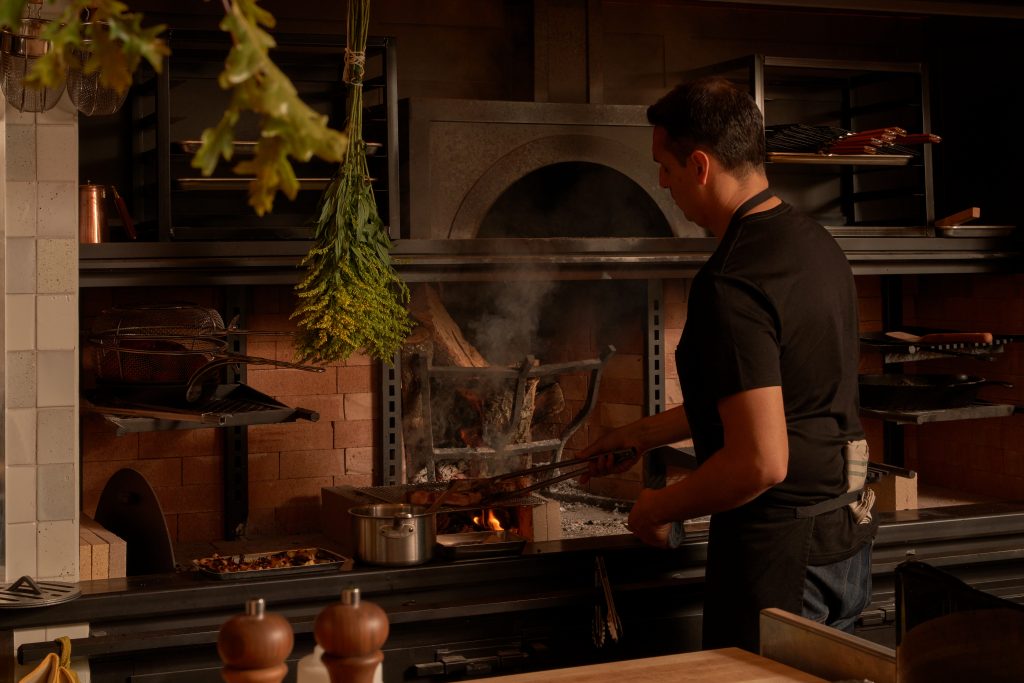
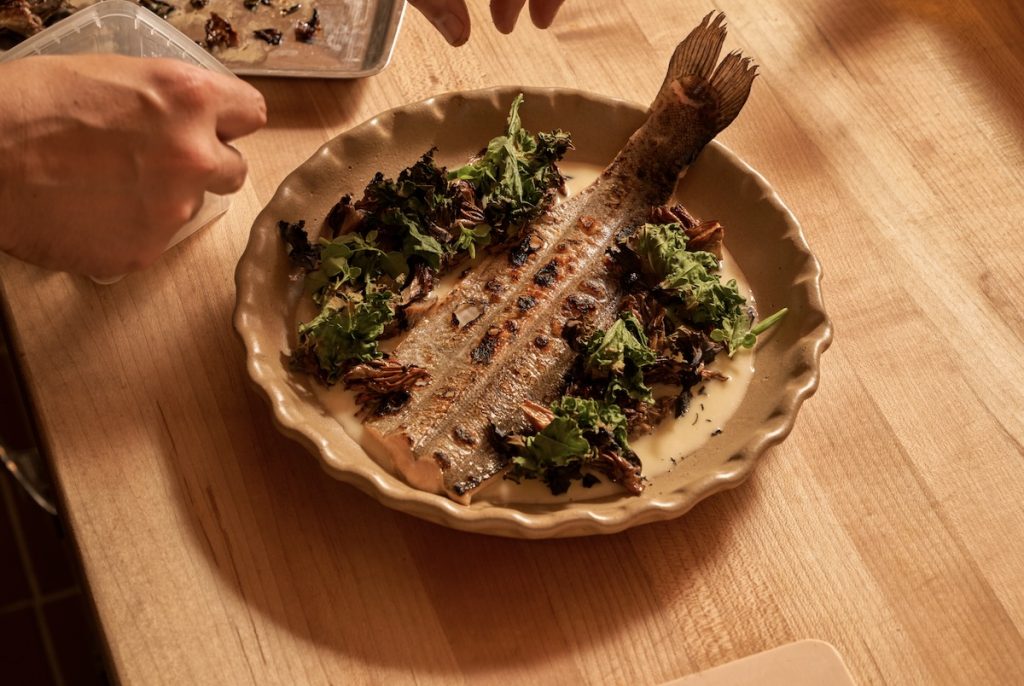
This approach fired Chef Moya’s own evolving artistry, his newfound passion compelling him to explore and work on various farms, immerse himself in biodynamics and permaculture, and commit to a sustainable ingredient model that will not strip edible resources today at the expense of tomorrow’s diner – and world. Produce became Moya’s focus, and imbuing seasonal flora with subtly penetrating flavors and textures his mission.
When he did return to NYC, he worked in a number of establishments – Dovetail, Kin Shop, the Michelin-starred Casa Mono among them. He founded The Cure SupperClub out of his own Williamsburg apartment at one point (alongside wine director Zach Ligas), an arguable staging ground for the ideas that would energize his own Lower East Side restaurant, Hemlock. He later enjoyed an executive chef stint at celebrated Tribeca wine bar Racines and acted as culinary advisor to Brooklyn-based hospitality collective The Oberon Group. Moya even began his own community garden in Manhattan’s Battery Park at the isle’s southern tip. This is an abbreviated list of the artist’s restless CV.
Moya is one of those chefs. Known to the cognoscenti who follow his every move and transition, breathlessly written about in endless foodie publications (and The New York Times), Moya has now landed in leafy Montecito as Little Mountain’s Kitchen Magus. This should quicken the epicurean heart.
Style is Substance (Mapping Palate to Palette)
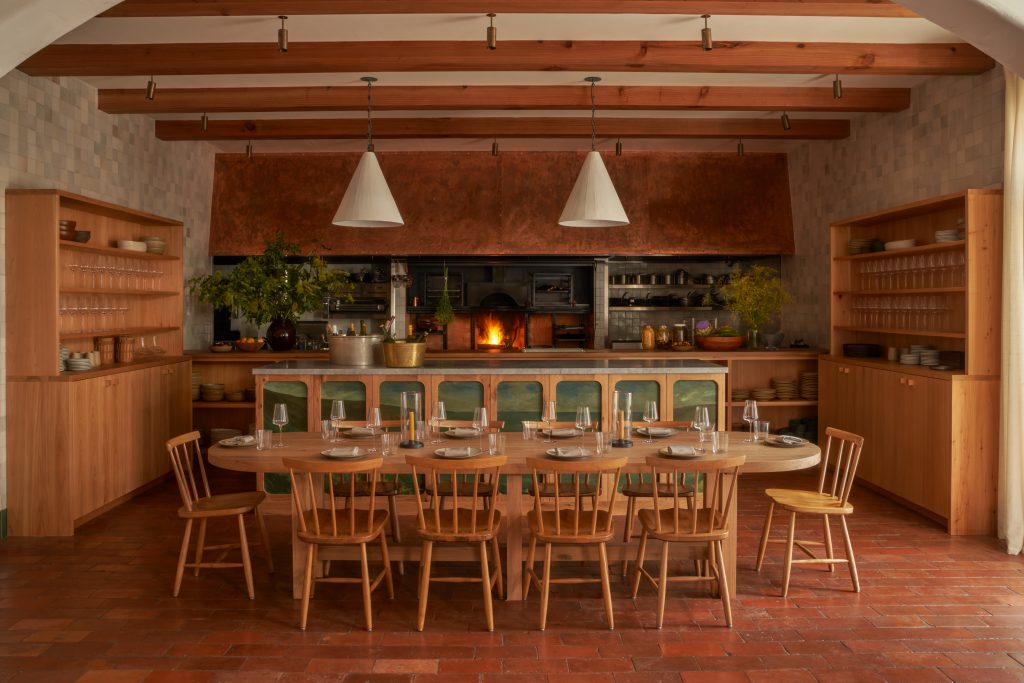
Dinner of an otherworldly quality is best enjoyed in an intentionally designed space whose mien adds to the palatable experience. (Yes, there is a simpler way to say that.) Eva and the ownership team tasked ID Andrew Cosbie with a tallish order: infuse Little Mountain’s space with cozy Montecito home mojo – an embraceable dwelling with a menu. In Cosbie’s description of the design brushstrokes we hear an assuring grasp of the village soul.
“I wanted Little Mountain to reflect the grandeur of Montecito’s landscape, the elegance of its architecture,” Cosbie says. “But I wanted to capture the ease of Montecito’s understated charm. People should walk in the door and be delighted, but not entirely surprised by what they see.”
Little Mountain’s warmth is non-ostentatious, and as indefinably appealing as your favorite room. Salvaged redwood beams, a dry-laid brick floor, burnished metals, textured plaster, and lamplit dark woods enfold like a favorite well-worn shawl, each distinct nook a cozy contributor to the whole. Fellow diners become convivial pals in a space like this. The artwork, curated by Allison Harding, is a warming array of still life and coastal plein air portraiture, the space’s color palette an inward extension of the forested environs that surround the place. Yeah – it’s Montecito with seating and table service.
In naming their baby after the cozy borough that surrounds it, owners Graham Duncan & Eva and Bryan Schreier have arguably put their thumb on the scale, ingratiating the new noshery to locals by adopting the village name. On that front, the wine list leans into the exceptional and regionally diverse, and Little Mountain seems otherwise determined to offer itself to the local vibe, hand in glove. The intentionality of the project speaks volumes. Chef Moya makes no bones.
“Santa Barbara has some of the most incredible produce I’ve ever had the pleasure to cook with. I’ve had the luck to work in some incredible places with localized diversity, but the vibrancy of the materia prima here is second to none. I don’t say that lightly.”
You might also be interested in...




You must be logged in to post a comment.