
Ballet Cherishes Charlie Chaplin from all Angles
Charlie Chaplin has been inextricably linked to Montecito ever since he founded and developed the Montecito Inn almost a century ago to serve as a more accessible yet upscale getaway for Hollywood stars, of which he was one of the biggest. Considered perhaps the greatest comic artist of the silver screen and one of the most important figures in motion-picture history, his recurring Little Tramp character merged physical comedy and slapstick with themes of emotional poignancy and outright social commentary, an astounding achievement in the silent film era. The quintessential misfit who was both daringly cheeky and charmingly gallant, and also embodied the economic disparity of the era, the Tramp was his alter ego for decades, right up to and beyond the advent of “the talkies,” when he released City Lights and Modern Times, both of which featured a soundtrack he composed and conducted, but little or no dialogue.
Later features like The Great Dictator and Limelight, in which Chaplin also starred and directed, are also considered classics. Meanwhile, Chaplin’s nexus to the Santa Barbara area was strengthened when he married his last wife, Oona O’Neill, daughter of playwright Eugene O’Neill, in Carpinteria in 1943 (they got their license at the Santa Barbara County Courthouse but wanted to avoid attention for the actual ceremony). By then, though, his troubles had started and in 1952 he was refused reentry to the United States during the McCarthy era, and the family settled in Switzerland for the last 25 years of his life.
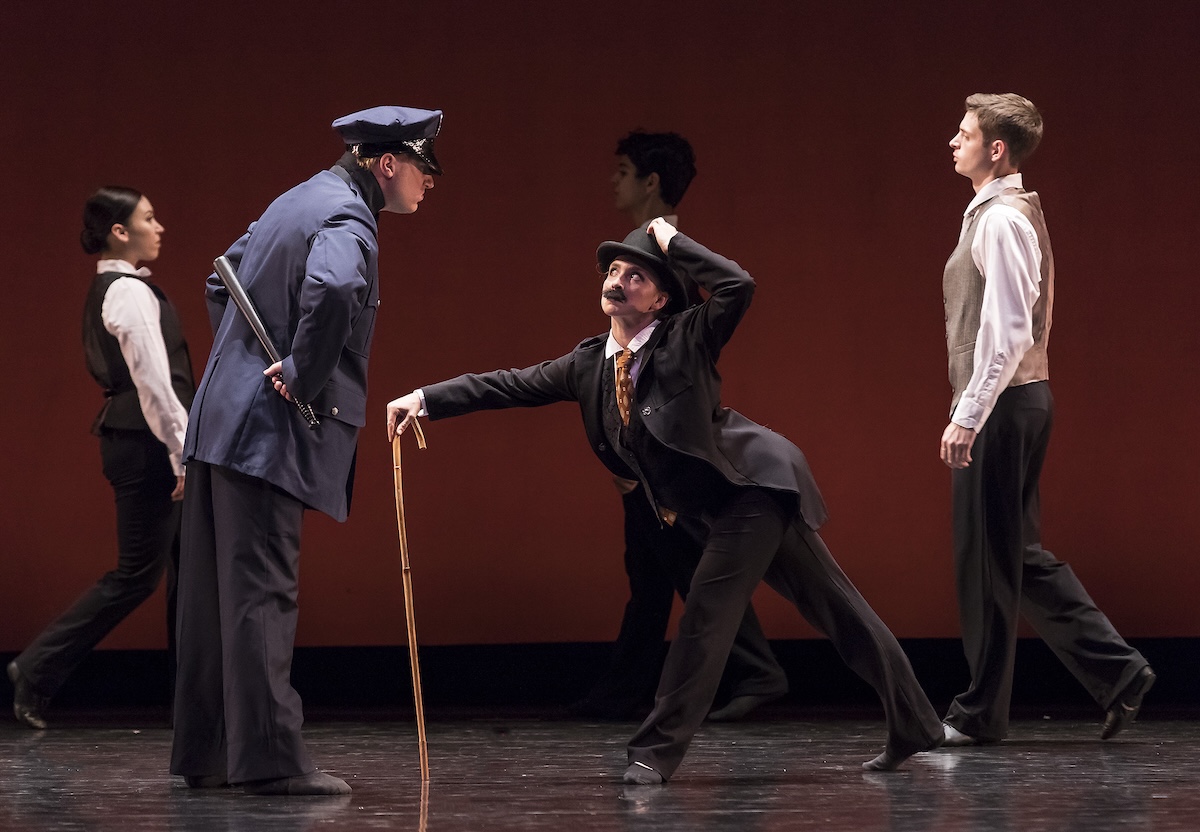
This weekend, Chaplin’s connection to Santa Barbara continues when the homegrown State Street Ballet remounts its uniquely choreographed and conceived evening-length ballet Chaplin for the first time since its debut almost eight years ago. The work’s unique angle is to access the career and world of Charlie Chaplin through the eyes of a young girl, who encounters his films in a retrospective in New York, and becomes so obsessed with the icon that she eventually morphs into the role of the Little Tramp herself. What makes the work even more exciting is that all the aspects of Chaplin’s career and life are examined in the ballet, which was created by three choreographers working in concert.
Chaplin had its genesis in San Diego, where Choreographer Kevin Jenkins had created short pieces with dancer Ahna Lipchik fashioning a movement vocabulary to embody the Little Tramp. When he approached State Street to potentially show some of the work, then Artistic Director Bill Soleau suggested turning it into a full-length piece.
“Kevin was fascinated by Chaplin’s movement and the Tramp character, while I was interested in the man who was on the other side of the camera – the director, the political activist, that artist who was the richest man in the world at one point, then got expelled from the U.S.,” Soleau explained earlier this week. “We came up with the idea of having two Chaplins to portray both sides, the girl who gets mesmerized by the images that she sees on the screen and gets drawn into his world like Alice in Wonderland, and the actual human being who was Charlie Chaplin. That’s the part I wanted people to see.”
That led to the chance to have both on the stage at the same time, including a scene where the director teaches the Little Tramp how to use his famed bowler hat, which follows a fascinating sequence where the hat lands on Chaplin’s head in the first place; a choreographic depiction of how the comic first put on the Tramp’s famed costume.
“Chaplin always, always, said that the clothes found him,” Soleau said. “So there’s an early sequence choreographed by Edgar Zendejas [the third creator of Chaplin, who current Artistic Director Megan Philipp said brought the ‘magical Cirque du Soleil aspect’]. The bowler hat is actually bouncing from dancer to dancer, looking for Chaplin, which is an incredible section.”
Multimedia is used to convey headlines and set scenes for the passage of time, including for a pas de deux signifying Charlie and Oona’s departure for Europe. Original music and themes from songs of the era also provide context and emotional latency.
In order to have the work of three distinct choreographers coalesce as a whole, Soleau had a couple of techniques to avoid it coming off as a “hodgepodge that we just threw together.” One involved having each choreographer take a share of the 24 different sections, but divide them among the era so that it moves smoothly.
“Chaplin was such an incredibly complex character and man that having these different voices express that through dance was quite beneficial,” Soleau said.
More important was attention paid to ensuring movement continuity, he said.
“Because we knew the styles would be very different, we made a pact to utilize one or two movements from each of the other choreographers when creating our segments,” Soleau said. “It worked out really well.”
Local audiences loved Chaplin when it premiered in 2018, but nobody else ever got to see it; the tour planned for 2020 was scotched by the pandemic. Bringing it back was a priority for Philipp and the new SSB leadership, especially having both Soleau and Jenkins return to work with the current dancers, Lipchik also reprising her guest role as the girl who becomes Chaplin’s iconic Tramp.
“It’s a very unusual piece, not a typical repertory program,” Philipp said. “This ballet is meant to make you think and leave with questions, rather than spoon feeding you the story of Chaplin’s life. You have to work to follow along, but the choreography weaves together in a really beautiful way. It’s so exciting to be bringing it back.”
State Street Ballet performs Chaplin at the Lobero Theatre at 7:30 pm Friday, May 8, and 2:30 pm on Saturday, May 9. Visit www.lobero.org
You might also be interested in...



