
‘Animal Farm’: Still, Sadly, an Allegory for Our Times.
George Orwell’s 1945 novella “Animal Farm” was written as a satirical political allegory in response to the rise of Stalin’s totalitarian regime in the Soviet Union. The plot concerns mistreated farm animals who rebel against their owner to instead build a free and equal society, only for a group of power-hungry pigs to turn the farm into a ruthless dictatorship. The book became a classic piece of literature that has been taught in public schools for decades. Eighty years later and on a continent a world away, the fable still resonates as an indictment and cautionary tale about concentrating power in those who would rule with an iron fist and without compassion.
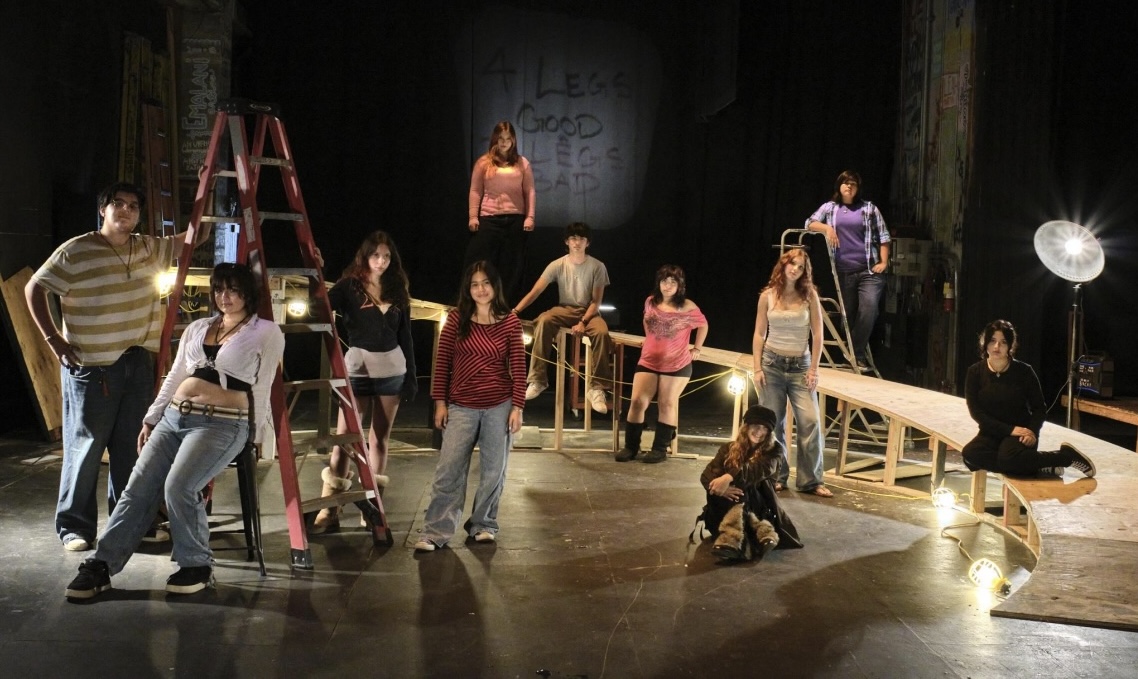
Which is why UCSB theater department’s production of Tatty Hennessy’s recent adaptation evoked deep emotions among the student cast that performed Animal Farm just last February and also resonated with the audiences that saw the inventive show. The same thing seems to be happening with students who are about four years younger and 10 miles east as they prepare to put on a much older adaptation of Orwell’s book by Ian Wooldridge that opens this weekend at Santa Barbara High School Theatre.
“I love escapism theater. But there’s also a time to talk about things that are going on right now, experiences that we’re feeling currently,” said Robert Rodarte, who is director and production designer for SBHS’ Animal Farm. “I have the philosophy that characters, when you boil it down, want either love or power. That’s represented strongly in Animal Farm, and it’s such a timely question when we see the choices people are making in our world.”
Rodarte brought that up early in the rehearsal process with the student actors to spark their ability to relate to the characters.
“Teenagers can be overlooked in our tumultuous times,” he said. “This is an opportunity for them to be a part of the conversation. I’ve encouraged them to approach their characters with their beliefs and feelings, their ideas and their truths.”
The students have clearly responded, if quotes from the actors in a press release are any indication.
“Animal Farm is a piece that can be felt past our theater’s walls,” said Maria Butler, who plays Squealer. “… Working with such heavy material as teenagers has been a fruitful experience, highlighting real events taking place in the world … which means digesting the raw reality that is a part of us right now.”
Esther Hernandez (Clover) has a similar take: “With everything happening in the world today, including what we are witnessing here in our own city, these are no longer topics we can afford to ignore.”
“Experiencing this show makes you question how you think of leadership, brutality, and what is actually important in both your personal life and in the greater world,” said Dragon Aditya, who plays Napoleon. “Animal Farm asks you: Are you willing to feel the suffering of corruption or is ignorance really bliss?”
One of the twists of the production is that the animals are portrayed as human characters while the humans are turned into animals, with the use of 12-foot puppets created by students at SBHS’s sculpture class, said Rodarte, the co-founder of the fledgeling Happy/Sad Theater company in town that he runs with his wife and co-founder, Riley; the play’s producer, and mentor for the marketing and producing students. It’s part of a new approach at SBHS Theatre that features partnering with local companies in a one-year training program that gives students professional level theater training and performance experience with professional theater teachers, directors, actors, and technical theater mentors.
Check out the results when Animal Farm performs October 23-November 1. Visit www.sbhstheater.com
You might also be interested in...



