
A Symphonic Parade Through the States
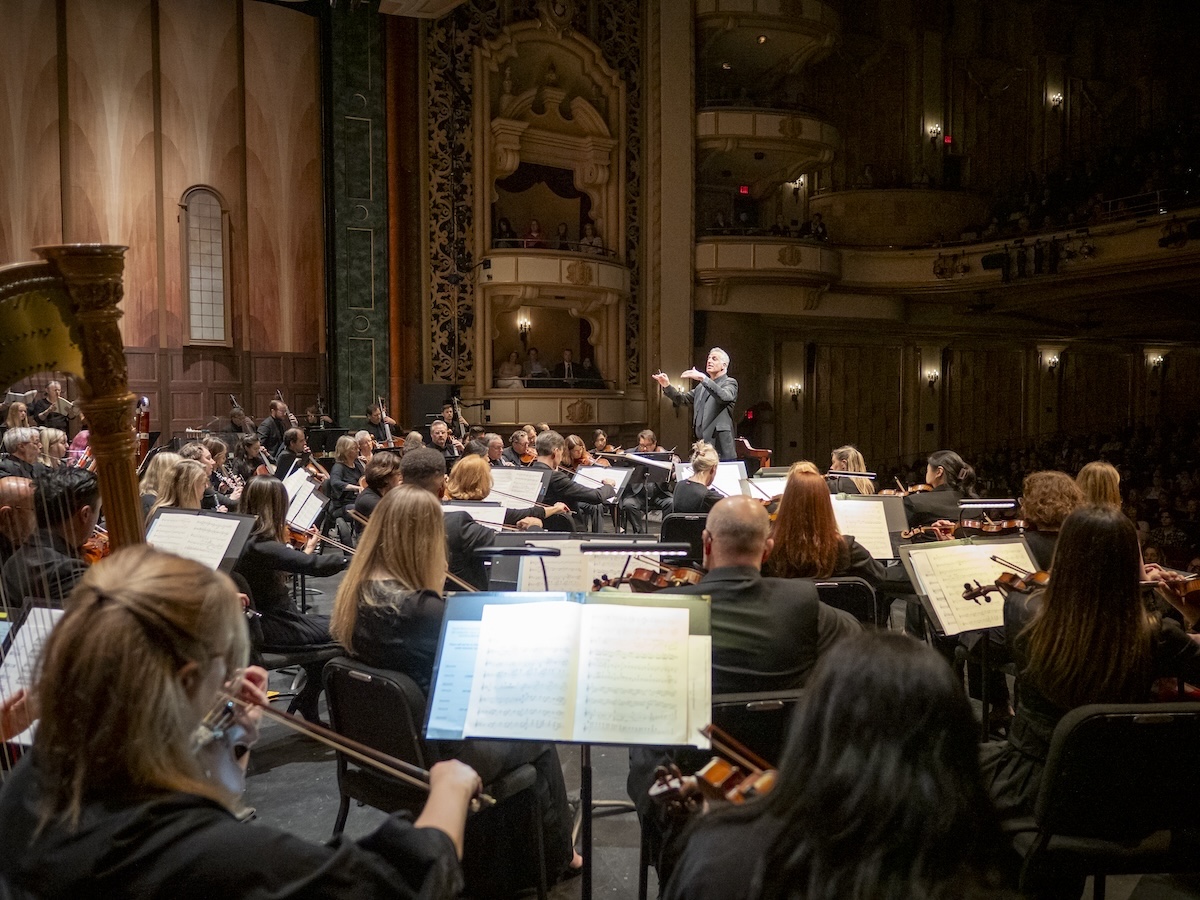
The Santa Barbara Symphony took a deep dive across the pond to immerse in Italian classical music for last month’s pair of concerts at the Granada. Music from the continental country was also the focus of three concerts spearheading the indoor part of the La Piazza festival around the corner at the Library Plaza last weekend, with works that included vastly different settings for Respighi’s “The Pines of Rome”(with festival founder Jacopo Giacopuzzi and Alvise Pascucci‘s four hands on piano ) and Vivaldi’s The Four Seasons (with the symphony’s concertmaster Jessica Guideri in a violin-piano duo rather than the accordion soloist with the orchestra).
This weekend, April 18-19 at the Granada Theatre, Music and Artistic Director Nir Kabaretti steers the orchestra back to the USA with an all-American program encompassing four distinctly American composers across more than a century in celebration of America’s 250th birthday this summer. Our country is a lot younger than Italy, hence the more compressed time frame, but the program is designed to alight on touchstones that have served to shape and define America’s musical heritage.
“We’re an American orchestra so it’s always nice to go to our own roots,” said the Israeli-born Kabaretti who spent many years conducting in Italy. “It’s not only part of our DNA, but it’s important that we play this music. There were lots of directions to go in, but I wanted to mix the familiar with pieces that might be new to our audience, match very well-known works with pieces that are very important, but maybe less known.”
The “portrait of America in sound” Kabaretti came up with opens with Charles Ives’ “Three Places in New England,” an experimental New England work of nostalgia blending Civil War-era melodies, marching bands, hymns, competing rhythms, and a measure of the mild dissonance which Ives pioneered. The SB Symphony will be playing Ives’ piece for the first time since Kabaretti assumed leadership in 2007.
“Ives was an important figure in the development of American music, the father in some ways, someone who inspired a lot of composers,” he said. “He was maybe the very first one to move away from the European tradition, a pioneer, a revolutionary in a way. The piece has parts that are very dark, but also includes patriotic songs of the time that are largely hidden. And it’s specifically about a place, similar to Respighi’s ‘The Pines of Rome’that we played last month.”
The orchestra then ambles forward a decade to Samuel Barber’s “Violin Concerto,” a staple of the repertoire that has achieved international acclaim and is a perennial competition piece primarily due to the extreme technical demands of the finale, a movement full of relentless, fast-paced triplets that contrast with the largely lyrical and romantic first two movements. Kabaretti enticed violinist Alexi Kenney, who has been praised for both his lyrical sensitivity and virtuosity.
“He’s a beautiful player, an amazing musician who has everything,” he said. “He came very highly recommended by musicians that I know and trust. I am sure our listeners will enjoy seeing him take on this popular piece.”
After intermission, the symphony leaps forward to modern composer Jennifer Higdon’s “Blue Cathedral,” the modern composer’s deeply personal piece written in memory of her brother that evokes a spiritual atmosphere. The emotional journey through personal grieving comes via an accessible, atmospheric and richly orchestrated soundscape. There are actual glass instruments, several tuned crystal wine glasses to add to the effect of the “glass cathedral” vibe.
“It’s exciting to create more sonorities beyond the traditional ones,” Kabaretti said. “Everything is clearly written in the score, the exact dynamic where it goes from a forte to piano, where it has to move on and when it has to be mysterious and where it has to be very dramatic. Higdon has a different type of 21st century approach, a very beautiful voice… But we have to work on how we achieve those sonorities and balance the sound.”
In a rapid change of pace from the serene ending of “Blue Cathedral” that creates a moment of collective stillness in the Granada, the concert closes with the most popular piece on the program in George Gershwin’s “An American in Paris.” The very vibrant and equally jazz-tinged opus premiered just shy of a century ago and followed the composer’s success with “Rhapsody in Blue,” bursting with swaggering rhythms, bluesy harmonies, bright orchestral colors, and horns-a-plenty.
“Gershwin was the first one to bring popular music into a classical concert hall, and also maybe the very first American composer to achieve huge fame out of the country,” Kabaretti said. “‘Paris’is great music, people are very proud of it, and love to hear it.”
Taken together, the concert follows a strong narrative arc, the conductor said, although there’s no theme tying them together other than their country of origin.
“Each piece is remarkably well written, well-orchestrated, and sits beautifully on the instruments – and they’re all unmistakably American. It’s usually pretty clear from the opening bars that they could not have been written by a non-American. They’re very different, and the audience will walk away with a deeper understanding of the American sense of music.”
You might also be interested in...



