
Baik Is Back at MAW
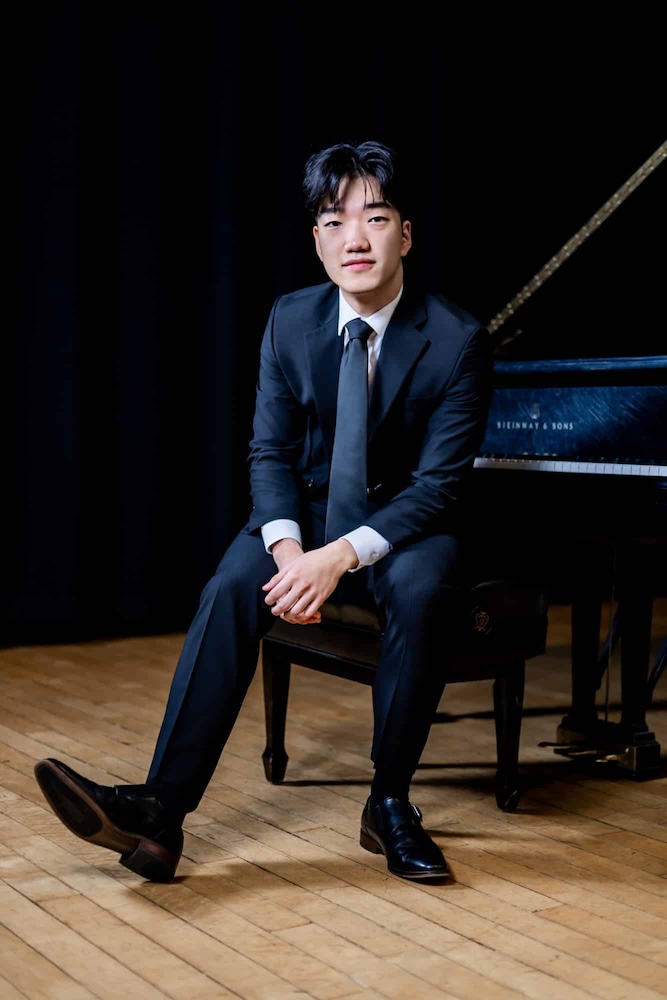
Music Academy of the West fellows don’t normally return to the Miraflores campus as professionals just 14 months after finishing their residency at the summer festival. But that’s exactly what will happen when young pianist-composer August Baik, a 2025 MAW fellow who just turned 21, performs with violist Richard O’Neill, who was a fellow back in 1998-99 before returning as a faculty member more than a decade ago and joining Takács Quartet in 2020, in the initial concert of this year’s Mariposa Series at Hahn Hall on October 8. The program, which includes the world premiere of a composition for the two of them by Baik, is one that’s investigative as well as deeply personal for the two musicians. This examination of music that lives beneath the surface bears the intriguing title “Tradition Transformed.”
Speaking from his family home in Seattle, Baik talked about his time here, working with O’Neill, and the upcoming program.
Q. Anytime I talk to an alum, I always start out by asking about their time here. Given that you were here just 14 months ago, let’s just talk about the highlights of your summer last year.
A. It was a huge opportunity for me. I was really grateful to work with the astounding piano faculty of Conor Hanick and Jeremy Denk, mentors who just in that summer pushed me to grow a lot and change my perspective as a pianist and as a musician. The people that I met there, the piano cohort, are all my friends still, and we’re all still supporting each other. It was a really special time.
Can you say a little more about how your perspective changed?
[Conor Hanick and Jeremy Denk]are both such amazing artists with their own unique perspectives. Playing the same piece for both of them and hearing their feedback let me find a balance between their ideas and harmonize them, no pun intended, with my own playing.
Nowadays, few composers work as professional pianists, and vice versa. How did that happen for you, and how is it working?
I think both of them inform each other quite a bit. Being able to create music as a response to what you’re doing is very important to me in my process of performing. I got into composing basically when I started playing piano, because I realized that it would sound like I was practicing if I was just sort of improvising things, which was more fun. Then I got into the Seattle Symphony Young Composers’ program in my last two years of high school, which was huge. What MAW did for my piano playing, that program did for my composing in terms of finding my voice. But I keep them separate. Composing needs to happen in its own sphere.
Turning to the Mariposa concert, I understand it was Denk who put you together with Richard. You’ve worked together since the festival in Washington. How has that gone so far?
I had no clue what to expect in that first rehearsal with him. But he’s incredibly kind, always creating a dialogue with you about the music, and he’s very open to new ideas and new ways of playing things. He has no ego at all when it comes to taking in suggestions.
How did the two of you create the Mariposa program?
The first piece we thought of was Britten’s “Lachrymae” [Op. 48. subtitled “Reflections on a Song by John Dowland”] which has this feeling that you are searching for the theme, but it only happens at the end when you hear John Dowland’s song. Then we worked with Indigo [Fischer] at MAW to build a program around the idea of the hidden melodies. That’s why I’m also playing Rzewski’s “Winnsboro Cotton Mill Blues” (which transforms a folk song made famous by Pete Seeger), because that worker song melody comes out right at the end, with a feeling of catharsis. One of my earlier pieces is also like that, but I wrote a new one for this concert.
Yes, the world premiere is at this concert. What can you tell me about the piece? I understand it’s based on Korean folk songs, reflecting on your shared heritage with Richard.
Without using Korean characters, it’s called “Square Cycle.” It grew out of the Seattle composer program where we had a guest who draws on Hindustani classical music and incorporates it in her own work, which breathes a different sort of life into it. That was new for me, and I was intrigued because I want to play music that is more representative of me as a Korean American. It’s a way to reconcile my own heritage and find ways to make sense of it because what I do is very Western in playing classical piano music. The only way for me to do that would be to write it myself.
For this piece, I took a transcription of a recording I found of Pansori, which is Korean folk opera with just a vocalist and a drummer. The music is only passed down orally, and the singers who can do it are considered national treasures. It’s very different from classical music, where we’re trying to harmonize with each other. There’s nothing that you can really latch onto in Pansori. My understanding is that you’re harmonizing with nature. I based the theme on that transcription I did, and the variations sort of converge at a certain point and then move away. There’s also a surprise at the end as with the other pieces, a very recognizable Korean theme.
The goal in my compositions is trying to recontextualize something unfamiliar, like Korean folk music, and turn it into something recognizable to create conversations about it. I think as long as people are talking about, “What did I just listen to?” Even if they don’t like it, that’s what I’m after. My main goal in any concert is for people to learn something new or be inspired to listen more or create their own art.
The program winds up with Sergei Rachmaninoff’s “Sonata in G Minor,” which I’m told has special meaning for both of you. I know that Richard first played it when he was a fellow at MAW studying with Donald McGinnis. I guess he started creating the arrangement for viola back then. But what’s your relationship with it?
Actually, I think he was just playing the transcription then, but I know he’s been working on it ever since. For me, I think it’s one of the greatest instrumental sonatas ever written. It was the first one that I learned because one of my best friends is a cellist. It’s an amazing piece and I’m very excited to play it with viola because I’ve never heard some of the registers that this music could be played in with only the cello. It’s really exciting to be coming back to Santa Barbara, bring back all those memories of my summer there, and to play with Richard at Hahn Hall.
OK, this is tongue in cheek: Seattle is the grunge capitol of the world. How did you end up in classical music?
Well, actually, I think much of music is connected. I bet if you give me a day to sit down, re-listen to some Nirvana and Pearl Jam and really think about it, I’m sure I’d find a lot. Those Romantic composers, they loved all that dark and moody stuff.
You might also be interested in...




You must be logged in to post a comment.