
Cut From History: The Couture Pattern Museum Preserves Fashion’s Blueprints
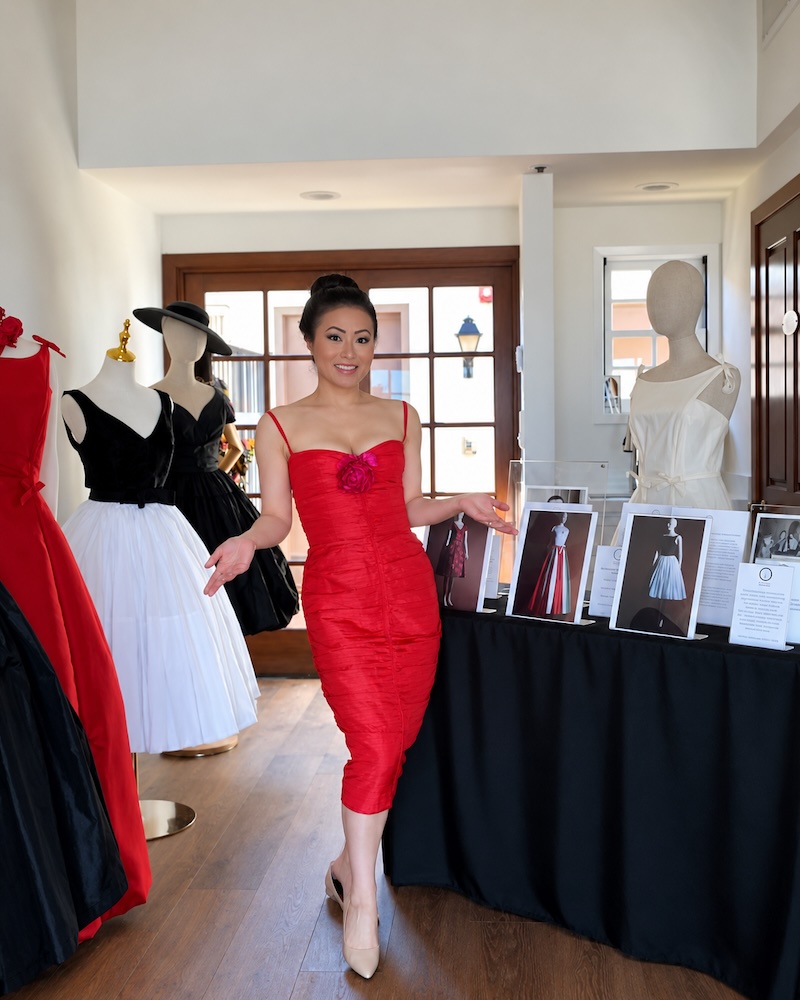
Cara Austine-Rademaker (courtesy photo)
There are worse fates for a Chanel than being wrapped around a teacup.
Still, it is probably not the preferred one.
Years ago, while hunting through vintage and antique shops for old sewing patterns, Cara Austine-Rademaker asked one shopkeeper whether she had any tucked away. She did. They were in the basement, where she had been using the tissue-thin paper to wrap china.
Austine-Rademaker asked her to send everything.
Among those rescued sheets was a Chanel pattern that Austine-Rademaker says she has never encountered anywhere else. What another person saw as packing material, she recognized as something closer to an architectural drawing, a surviving record of how one of fashion’s great houses actually built a garment.
Soon, that rescued Chanel will find itself in rather different company.
On October 24, Austine-Rademaker’s Couture Pattern Museum will host the exclusive West Coast premiere of Chanel in Vogue, bringing the authors of the new two-volume work to Santa Barbara for an afternoon of fashion history, archival photography, French pastries and a rare look inside the technical craft of Chanel. The museum’s own Chanel patterns and archival materials will be part of the occasion.
It is a fitting moment for a museum built around the idea that the most revealing parts of fashion are sometimes the ones never meant to be seen.
Founded by Austine-Rademaker in 2022, the museum preserves one of the world’s largest comprehensive collections of licensed couture patterns and related archival materials. There are names one would expect to see strutting a European catwalk: Chanel, Dior, Balenciaga, Schiaparelli, Lanvin, and scores of other designers.
Yet the names are only part of the story.
A finished couture dress tells you what someone made. A pattern tells you how they made it.
“It’s the information behind the dress, the architecture, the intelligence behind the dress,” Austine-Rademaker says.
That hidden knowledge only becomes more valuable with time. Historic garments are inherently fragile. Fabric deteriorates, light damages fibers, and museums understandably discourage visitors from dismantling priceless dresses to see what is happening inside.
Patterns offer another way in.
Many in the museum’s collection reproduce couture designs line by line and at full scale, preserving not merely a silhouette, but the technical information needed to reconstruct it. Austine-Rademaker compares them to sheet music. Where a score records a composition note by note, a couture pattern can preserve a garment stitch by stitch.
The analogy is particularly useful because, like music, couture depends upon something being passed from one set of hands to another.
Lose the instructions and you can admire what remains. Preserve them and, potentially, you can teach someone how to make it sing again.
Haute History
RJ Rademaker, the museum’s creative operations director and key advisor, points out that these were not simply watered-down interpretations of Paris fashion for the home sewing market. They preserved the construction of the original designs, allowing women thousands of miles from Paris to encounter something remarkably close to the real thing.
The path that brought those Paris designs into American homes is also, in many ways, the path that eventually brought Austine-Rademaker to the museum.
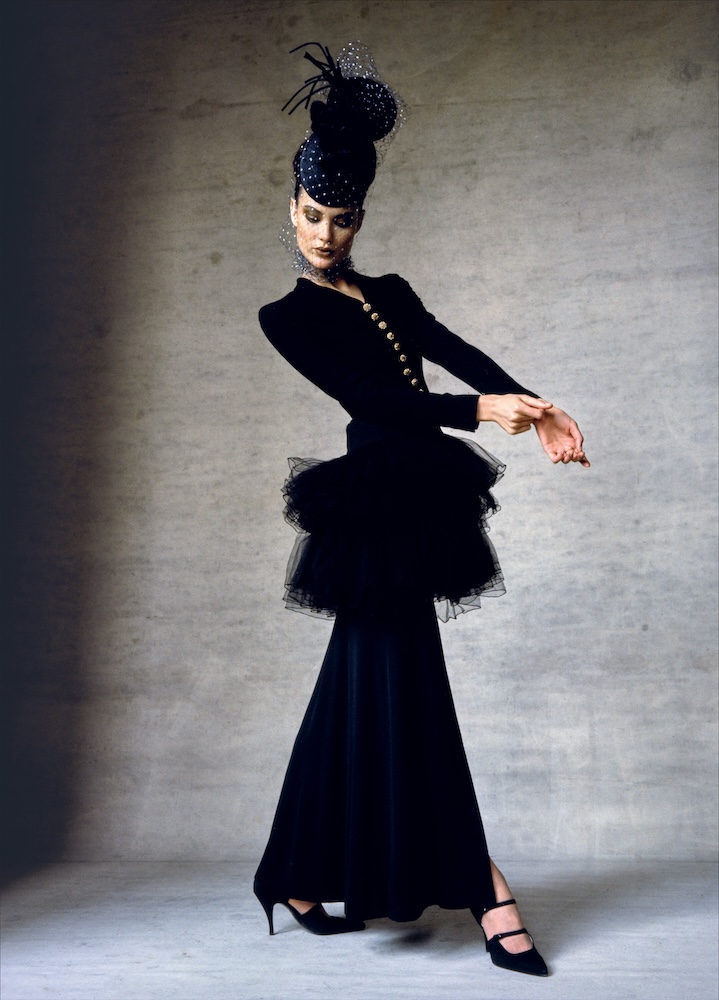
photographed by Irving Penn, Vogue, April 1996. (photo by Irving Penn, Vogue © Condé Nast)
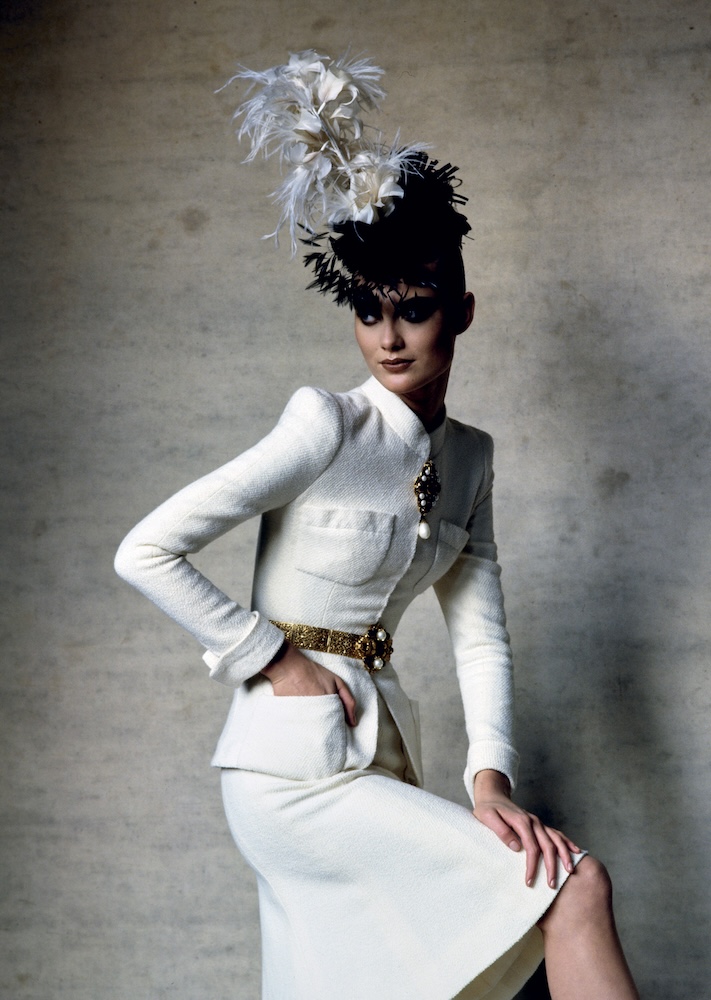
photographed by Irving Penn, Vogue, April 1996. (photo by Irving Penn, Vogue © Condé Nast)
Her own began about as far from a Paris salon as one might imagine.
She was born in South Korea during its military dictatorship and came to the United States through international adoption at four years old. She found herself growing up among the cornfields of Iowa, in a place where high fashion was largely something to be imagined rather than encountered.
Sewing provided an entrance.
“I went really deep into my imagination and found beauty through patterns,” she says.
There were no Chanel or Saint Laurent boutiques nearby. There was, however, access to a sewing machine and the distinctly Midwestern conviction that if something did not exist, one could probably figure out how to make it.
Patterns offered the instructions.
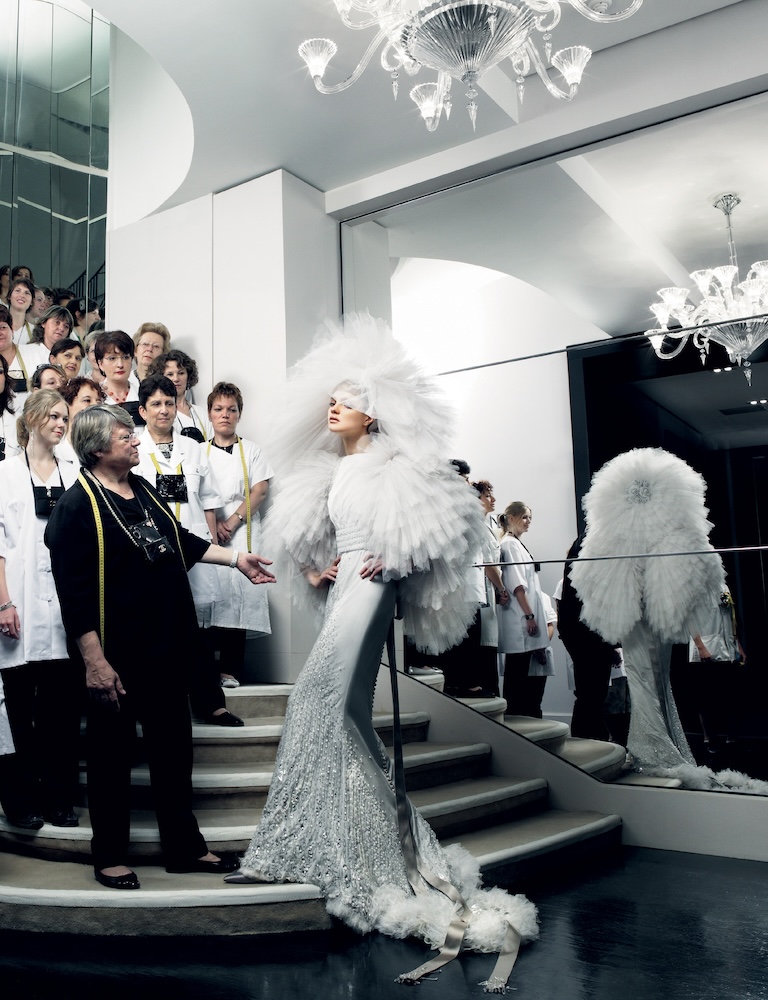
photographed by Irving Penn, Vogue, April 1996. (photo by Irving Penn, Vogue © Condé Nast)
“I could, in my own Cinderella way, imagine dressing myself in the Paris couture and feeling beautiful in my own way,” Austine-Rademaker says.
She began collecting and researching patterns, a fascination that continued through college and eventually drew her toward what is often called the golden age of couture.
Hidden within those envelopes was also a larger economic and cultural story.
Following World War II, many Paris couture houses were struggling. The number of women who could afford genuine couture was exceedingly small, and fashion houses needed other sources of revenue. One was licensing designs to pattern companies, opening a pathway from Paris couture to an increasingly prosperous American middle class.
Suddenly, the home seamstress could participate.
That history affected millions of women in the United States, United Kingdom, Australia and elsewhere. Yet because sewing patterns were often treated as domestic ephemera, relatively few institutions thought to preserve them systematically.
They stayed in sewing rooms, attics, and basements. When their owners died or downsized, many simply disappeared.
Some, apparently, protected the good china.
Austine-Rademaker kept collecting.
Eventually, thousands of patterns presented her with a question. What happens to all of this when she is gone?
“I just said, ‘Oh my gosh, you know, when you hit your midlife, you’re like, what am I gonna do with this? Are they just gonna go into the dumpster?’”
The answer became the Couture Pattern Museum.
Rather than treating the collection as vintage merchandise, Austine-Rademaker wanted the patterns protected as historical records and educational materials. Today they are kept with archival backing and sleeves in controlled conditions, while the museum undertakes the considerably larger task of digitizing them.
That does not mean snapping a photograph and calling it a day.
The museum is creating full-size digital copies, preserving the patterns at their original scale. More than 100 designers have already been digitized, with the archive continuing to grow.
The goal is not simply to save old paper. It is to preserve old knowledge.
Couture techniques have changed over generations. Even skilled contemporary dressmakers may approach a garment differently than their predecessors did decades ago. Austine-Rademaker recalls discussing a historical dress with someone from the Paris couture world and asking how she would recreate a particular detail. The modern solution made sense.
The pattern revealed that the original dressmaker had done something entirely different.
Those little technical surprises are precisely what can disappear when the pattern disappears.
That is why Austine-Rademaker increasingly sees education as the museum’s future. She wants the digitized collection to become a teaching resource, bringing contemporary students together with people who actually work in Paris couture and allowing them to study historic methods without repeatedly handling delicate originals.
The Couture Pattern Museum may have started small, but its reach is becoming decidedly international.
‘Chanel in Vogue’

(courtesy of Thames & Hudson)
Which brings us back to Chanel.
On October 24, the museum will host the exclusive West Coast premiere of Chanel in Vogue, a two-volume work by fashion and photography historians Rebecca C. Tuite and Susanna Brown tracing the House of Chanel through more than a century of Vogue’s international editions.
The event came to Santa Barbara following the museum’s previous Balenciaga programming, which drew international attention. This time, publisher Thames & Hudson approached the museum.
Austine-Rademaker decided that simply hosting a book talk would not do.
Instead, Chanel in Vogue will become a full cultural salon.
Guests will begin with French-inspired afternoon tea and champagne, accompanied by pastries from Yannick Dumonceau, Rosewood’s pâtissier who previously worked at a three-Michelin-star restaurant in Paris. Among the offerings will be Gabrielle Chanel’s favorite dessert, Mont Blanc.
Then comes the intellectual dessert.
The program includes remarks of friendship from Adrien Frier, Consul General of France in Los Angeles, followed by a recorded teaching presentation from a former Chanel technical fashion designer and draper in Paris. She will discuss what happens after a Chanel runway show, including the technical process through which garments are prepared and patterns completed.
Tuite and Brown will then present a lecture and Q&A similar to their recent sold-out appearance at London’s Victoria and Albert Museum. Brown is traveling from London for the event.
Around them will be another layer of the Chanel story. A photography exhibition previously shown in New York will feature images connected to Chanel in Vogue, displayed alongside Chanel archival materials dating from the 1930s through the 1960s from the museum’s own collection.
Guests also receive the rather substantial two-volume book, weighing in at roughly 10 pounds.
Fashion, apparently, remains heavy work.
For all the Chanel glamour, though, Austine-Rademaker is remarkably straightforward about how she sees herself within this world.
Founder, curator and managing director are accurate titles.
She prefers another.
“I’m a seamstress,” she says. “That’s ultimately what I am and do.”
She believes the museum could only have emerged through the eyes and hands of someone who works close enough to clothing to care about what happens before the finished dress appears. Not simply the designer name or the person who wore it, but the cutting, draping, stretching, gathering, stitching, and accumulated knowledge required to transform flat fabric into form.
The Couture Pattern Museum is preserving that knowledge one fragile sheet at a time.
Which makes that Chanel pattern rescued from an antique shop basement seem rather fortunate.
Instead of protecting a teacup, it is helping preserve a piece of fashion history.
Visit www.couturepatternmuseum.com for more information and tickets
You might also be interested in...




You must be logged in to post a comment.