
Montecito Union School’s Two New Music Teachers
“There’s something refreshingly human about making music together.” – Liz Caruso MUS Music
Montecito Union School has a long history of a strong music department headed by top tier music faculty. When I started covering local news in 2002 for the Montecito Journal, I met the multitalented Pamela McClendon (MUS, 1971-2012). Under her expertise and enthusiasm, she started the MUS music education program, chorus, and artist-in-residency programs. Her initiatives, most of which carry on today, included African Drumming with renowned enthomusicologist, composer, and master drummer Sowah Mensah. She also taught UCSB Extension classes in music education, as well as Music for Children at Westmont College. Pam is married to Phillip McClendon, former choral conductor of the SB Master Chorale and former choral director of the SBHS Madrigal Singers and A Cappella choir.
MUS’s orchestra leader and string instrument faculty was Ron Zecher (MUS, 1995-2025). Under his wing MUS launched the first of its kind violin studies as an academic requirement in the second and third grades. I was informed back when it was started that McClendon and Zecher supported the theory that music and math are cognitively complementary and mutually supporting, improving test scores and academic performance. Zecher expanded stringed instrument offerings to create an orchestra that performed at school concerts, events, and every graduation.
McClendon was followed in the role by Pam Herzog (MUS, 2012-2026), who as a MUS elementary school student had been a student of McLendon’s. Herzog was music teacher at Cold Spring School (1990-2012) and came to MUS on McClendon’s retirement. Herzog brought MUS music programs to the community via holiday concerts and inter-school performances at both the Music Academy of the West, the Lobero Theatre, and outdoors on Coast Village Road for the holidays.
Zecher retired the summer of 2025, and Herzog retired summer 2026, leaving two large roles at MUS open — no pressure for an elementary school whose school song “All Standing Together” was composed by Grammy Award winning singer-songwriter Kenny Loggins in the 1980s when two of his children attended MUS.
To their credit, the shared due diligence of MUS Superintendent Anthony Ranii, MUS Principal Nick Bruski and their search teams, have seen to the successful placement of two new music teachers as follows:
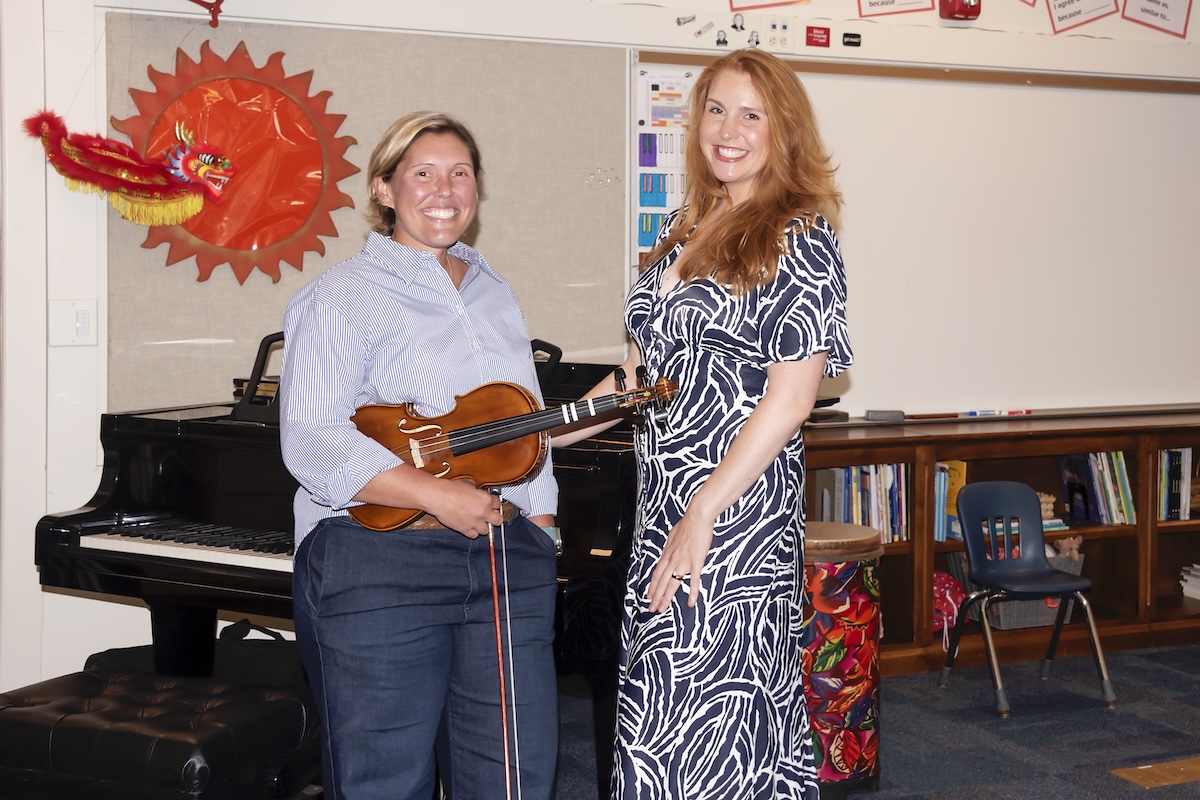
Inheriting Pam Herzog’s role is Sarah Gatehouse, and Ron Zecher’s successor is Elizabeth [Liz] Caruso.
I asked MUS Superintendent Anthony Ranii for his comments on the occasion of these two new music teachers joining the MUS family. “We’re thrilled with our new music teachers, who continue the long tradition of truly exceptional music teaching at MUS. Liz Caruso is terrifically skilled in both strings and general music. Her skill is only surpassed by her heart; she is so committed to each student’s musical journey that she makes time for one-on-one work with some of our neurodiverse learners who need additional support. Sarah Gatehouse lights up any room she walks into. Her love of music is infectious, and her joyful way with students helps all students strive to meet her high expectations.”
A proper meeting of the new teachers for this report was scheduled after Labor Day. We met in the MUS music room for introductions and a photo op. They assured me that we can look forward both to their upholding MUS music programming traditions, and beginning rich new ones. Let’s get to know them through our interview:
Joanne A Calitri [JAC]. How did you discover the position opening at MUS?
Liz Caruso [LC]. I knew Ron Zecher from his years teaching in Santa Barbara Unified and heard that he was retiring from MUS in 2025. Around that same time, a colleague encouraged me to apply, and thankfully, I listened.
Sarah Gatehouse [SG]. Liz and I previously worked together in Santa Barbara Unified. When Pam announced she was retiring, Liz reached out to me and encouraged me to apply. While we taught at different sites in SBUSD, we co-taught our Bravo after school band programs and always thoroughly enjoyed working together. Now we get to live the dream of working together every day!
JAC. Tell us about your music background.
LC. I don’t remember a time in my life when I didn’t know how to read or play music. I was drawn to it from a very young age and, fortunately, had parents who encouraged that fascination rather than questioning it. I earned my Bachelor of Music Education and later my Master of Education from Pepperdine University, and I’ve spent my career doing work that feels joyful – sharing my passion for music with young people.
SG. Growing up, I participated in every musical activity I possibly could and was constantly learning to play new instruments. My parents were incredibly supportive of my passion for music and encouraged me every step of the way. I earned my Bachelor of Music Education from the University of the Pacific and later completed my master’s in education administration.
JAC. And teaching music?
LC. Before coming to MUS, I taught music at Monroe Elementary School on the Mesa, where I had the opportunity to build a comprehensive music program from the ground up. It was an exciting challenge that stretched me as an educator and ultimately led to being named Santa Barbara County Performing Arts Teacher of the Year.
Over my 14 years there, the program expanded to include guitar and ukulele instruction, jazz band, an adaptive music class for students with special needs, and a digital recording studio and program. My goal was never simply to add more classes – it was to create as many entry points into music as possible, so that every student could find a place where they felt inspired and excited to participate.
SG. I have been teaching for 14 years and have had the opportunity to direct ensembles ranging from band and orchestra to general music and choir.
JAC. What inspired you to teach music?
LC. As a child, I was incredibly shy, so the thought of becoming a teacher would have seemed completely implausible to anyone who knew me – including me. I loved music, but I was much more comfortable playing an instrument than standing in front of a group. That all changed during my junior year of high school when my director asked me to become the drum major for the marching band. That experience drew me out of my shell and completely changed the trajectory of my life. More importantly, it taught me that one thoughtful teacher can fundamentally impact a child forever.
SG. My music teachers played an integral role in my life growing up. Music ensembles have a unique ability to become deep, family-like communities for students, and my music teachers often felt like second parents to me. In high school, the opportunities I experienced through music opened my world and shaped the person I was becoming. Attending college would not have been possible for me without the music scholarships that my high school band directors encouraged me to pursue and helped me apply for. When it came time to choose my path of study, I knew I wanted to enter the same profession that had made such a profound impact on my own life.
JAC. Do you perform, either solo or in a group?
LC. I do! I perform throughout the Santa Barbara area as a singer-songwriter and with a cover band called Paper Moon.Continuing to write and perform music reminds me what it feels like to be a student – to take risks, hit walls, and stay curious.
SG. Yes! I think it is so important to keep up my love of playing music in addition to teaching it. I currently play in the band Paper Moon with Liz. Throughout the years I’ve played and sung in a variety of professional choirs, jazz bands, and orchestras in Santa Barbara and the Bay Area.
JAC. What disciplines[s] are you teaching in MUS’s music program? Is that defined for you, or do you shape it?
LC. During the school day, I teach lower elementary general music as well as the second and third grade strings program. Outside the school day, I direct the fourth-grade Chorus and conduct the MUS Orchestra, which includes instrumentalists in fourth through sixth grade.
SG. I am teaching grades 1st, 4th, 5th, and 6th in general music, in addition to our school chorus. I will also be directing our 6th grade musical in the spring.
JAC. Did you interface/transition into the position with the guidance of Pam Herzog and Ron Zecher?
LC. Absolutely. I met with Ron several times before the school year began, and he generously shared not only the nuts and bolts of the program but also its history and traditions. He gave me both the practical knowledge and the broader perspective that helped me appreciate the program I was inheriting. I also had the extraordinary privilege of working alongside Pam during her final year before retirement. Watching an experienced educator teach is a bit like watching an accomplished conductor – you notice that so much of what makes them exceptional is almost invisible. She understood children so deeply, and it was invaluable to experience the thoughtful progression of the program as she routed student learning from August to June. Pam and Ron continue to be wonderful mentors, friends, and the kind of people who are always willing to brainstorm, answer questions, or simply provide encouragement.
SG. Most definitely! Pam took the time to meet with me multiple times in the spring to walk me through the program, its history, the classroom and curriculum, and the school logistics. Not only is she an immensely talented musician and educator, but she is also incredibly organized. I had the good fortune of inheriting a beautiful space, along with carefully curated documentation of the repertoire the students have performed over the years. Pam has become an invaluable resource for both Liz and me, and we are incredibly grateful that she and Ron are always there to support us and answer any questions we may have.
JAC. What are your top priorities for the music program at MUS?
LC. MUS has a remarkable legacy of artistic excellence, and I feel both honored and excited to be part of carrying that tradition forward. At the same time, we know that children change, communities change, and good teaching, therefore, has to change with them. I hope the heart of the program always remains the same, while the ways we engage students continue to evolve. One of the luxuries of music education is that there are so many meaningful ways for children to experience success. Some students find their voice through singing, others through an instrument, movement, or composition. My priority is creating those opportunities and paying close attention to the students in front of me, because they have a remarkable way of telling us what they need if we’re listening.
SG. Liz and I are very aligned in our vision for this program. We strive to uphold the legacy of artistic excellence that this school has cultivated over the past century while keeping our students at the heart of everything we do. Our top priority is to provide them with a music education that nurtures their artistic interests, encourages their creativity, and supports their individual goals. One of the most rewarding aspects of being an educator is that you are also a lifelong learner. My music programs are constantly evolving in response to the needs, interests, and growth of my students. I am excited to see how we can continue to learn, grow, and build together in the years to come.
JAC.Where does music fit into a student’s academic life, e.g., benefits, time spent learning/performing…
LC. To me, music is an essential part of educating the whole child. Certainly, the academic benefits are well documented, and anyone who has learned an instrument understands the focus, discipline, and persistence that music demands. Those are wonderful outcomes, but they’re not what keeps me passionate about teaching.
What has always resonated most with me is the way music shapes children as people. It asks them to listen carefully, collaborate generously, persevere through frustration, and contribute something meaningful to a group. In a world that often celebrates individual achievement, there’s something refreshingly human about making music together. If my students leave my classroom with stronger musicianship, that’s wonderful. If they also leave with more empathy, curiosity, and joy, then I think we’ve done something
truly worthwhile.
SG. There is no shortage of research demonstrating music’s positive impact on learning and academic achievement. But what I love most about teaching music is witnessing the joy it brings to students every day. There is something incredibly special about watching a group of students come together to create something that none of them could create alone. They learn to listen to one another, support one another, celebrate each other’s successes, and work through challenges together. Over time, an ensemble becomes more than just a class – it becomes a community. Students find their people, develop a sense of belonging, and build friendships and memories that can stay with them long after they leave the classroom.
JAC. Your favorite teaching motto or quote about music?
LC. One quote has stayed with me throughout my career:
“In years to come, a child may forget what you taught them, but they will always remember how you made them feel.” It serves as a wonderful reminder that relationships supersede repertoire. And then there’s my favorite quote about music itself: “Writing about music is like dancing about
architecture.”
It’s a humorous reminder that music can only be truly experienced in process.”
SG. “Music is enough for a lifetime, but a lifetime is not enough for music.” – Sergei Rachmaninoff. Just a reminder that the joy and purpose music can give you will never run out.
JAC.Any other statements you wish to provide about your new career at MUS?
LC. MUS is a remarkable school community, and it genuinely feels like an ecosystem in the best sense of the word. From my first days here, it was obvious that teachers, administrators, staff, and parents all share a common purpose: helping children grow into thoughtful, kind, capable people who will contribute positively to the world. Schools often talk about educating the whole child. At MUS, that philosophy isn’t simply spoken – it is lived every day. I’m incredibly grateful to be part of a community that values both excellence and humanity so deeply, and I can’t imagine more meaningful work than contributing to the musical slice of this educational community.
SG. I want to share my immense gratitude for the opportunity to teach at MUS. From the moment I stepped into my interview, I could tell that this was a school community that truly values and supports its students, families, faculty, and staff. It is such a blessing to work in an environment where I have both a teammate and the resources needed to provide my students with the best music education possible.
I feel incredibly fortunate to be part of this community, and I am so excited to see where the future takes us!
You might also be interested in...



