
Nathaniel Silberschlag’s ‘Times’at MAW & Beyond

When you Google Nathaniel Silberschlag, one of the early listings is a feature that ran in the New York Times back in 2022, when the horn player was all of 23, but already tenured as the principal horn with the Cleveland Orchestra, one of the country’s most storied. He’d landed the prestigious position at 21 years old, securing a job he’d dreamed about since he was barely past toddler years.
That’s because Silberschlag’s parents come from a long line of musicians, including a grandfather who held the principal viola seat at the New York Philharmonic, and parents who were both members of the Jerusalem Symphony Orchestra. The records he heard as a kid were often the ones recorded by the Cleveland.
But his appointment was no fluke. Musicians and critics have raved about the horn player for years, noting his ability to achieve a sound that has a clarity and color most never achieve. The Times piece closes with the orchestra’s Music Director Franz Welser-Möst suggesting that Silberschlag has what it takes to be a role model, not just a great artist. “The potential with him is to become a real legend.”
Silberschlag started playing horn at age 4, but he gives a lot of credit for his success to his two years as a fellow at Music Academy in 2017-18 – less than a year before he won the Cleveland audition – when he studied under longtime faculty member Julie Landsman, the former principal horn with the Metropolitan Opera Orchestra and his mentor (and fan) for more than a decade at Julliard starting in his pre-teen years. (She was also quoted extensively in the 2022 NYT story, including calling the then-12-year-old horn player “brilliant, motivated, personable and talented beyond belief” and lauding Silberschlag as “the biggest talent I’ve ever seen” to Welser-Möst.
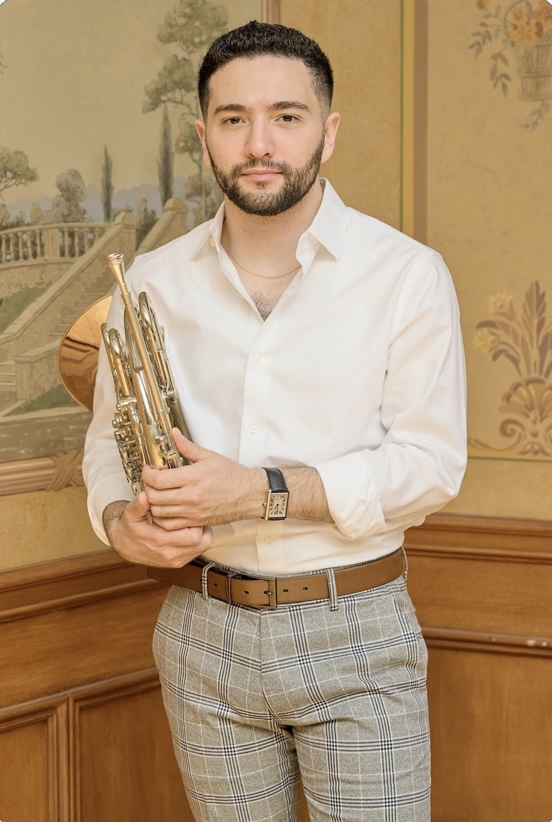
“Those summers really helped me prepare for moments like that article,” he said. “You’re not only trained here as an artist and a musician, but you’re trained to be a total person. It’s such a supportive environment which is crucial to learning how you are going to become your best self. And the masterclasses were huge growing moments for me as a person, having to not only connect to my audience through music, but having to talk, creating a connection in that way which was super new for me.”
There were other ways that being a fellow at MAW was much more than developing his skills and technique, Silberschlag said.
“The faculty really teach you how to believe in yourself and how to trust your abilities. The mental work with Julie, meditation, visualization, really helped me with imposter syndrome, having started the job at Cleveland so young. That story was a mind-boggling moment, but at the same time, I felt well equipped to handle it.”
Also mind-boggling was actually landing the Cleveland job, not just to join a world class ensemble, but because they are a perfect fit for Silberschlag.
“I’d have been happy in any of the top American symphony orchestras,” he said. “But I definitely have an affinity for Cleveland because they play on a very specific type of French horn that I also used growing up. They play in a way that felt most relatable to the way I wanted to. When I auditioned, I didn’t have to think about changing how I play to fit them.”
His latest pure pleasure in this still-early phase of his career? Taking over the horn studio at MAW from Landman for the last two weeks of the summer festival as a teaching artist peer. In the final Teaching Artist Showcase on August 6 at the Lobero, he will play Bramwell Tovey’s “Santa Barbara Sonata,” a fun, style-hopping piece for brass quintet commissioned by MAW for Canadian Brass in 2004. He’ll also perform as one of the four “soloists” in Mozart’s “Sinfonia Concertante in E-flat Major, K. 297b,” in the closing Academy Festival Orchestra concert at the Granada two days later.
Silberschlag is hoping to impart to the current horn fellows some of the magic he absorbed during the 2017-18 summer festival.
“They were two of the most formative summers of my life, and the second one was when I knew what I wanted to learn, how I wanted to progress,” he said. “So I also feel like I have a unique knowledge of how to maximize fellows’ experiences, almost like a secret weapon.”
Unlike most other MAW faculty, who leave town when their residency is over, Landsman now lives in Santa Barbara, and Silberschlag was still buzzing about spending the previous day with his mentor and friend in town.
“I’m thrilled that we had a whole great day together, just kind of chilling and me playing horns,” he said. “It was funny, but I had to tell her, ‘I’m really nervous playing for you again’ after something like seven years. It was almost like I was back being a fellow, or in her studio at Juilliard.”
Silberschlag shared that he will be buying two of Landsman’s rare horns as she continues to slow down her playing. Following in her footsteps as a longtime faculty member at Music Academy is potentially on the horizon, arguably delaying Landsman’s retirement indefinitely, her ethos embodied within, and borne forward by, her grateful former student.
“That is exactly the goal and hope,” Silberschlag said. “I want to do justice to everything that she’s given me, to spread her legacy to others in the hope that it can be as big a part of them as it has been for me.”
Upcoming@MAW
The end is here. Just three more days remain in the truncated six-week fellows-powered summer festival; eight if you include the inaugural High School Intensive. But there are still almost a dozen events to choose from, spanning everything from master classes to a symphony concert.
Thursday, August 6: It’s master class mayhem with fully four public coaching sessions slated for this afternoon. It’s your choice between the newish faculty member Judith LeClair leading the bassoon session (1:15 pm; Weinman Hall) and new teaching artist Stefani Matsuo working with the violin fellows (1:15 pm; Lehmann Hall). Two hours later, the final Lehrer Vocal Institute piano master class features longtime Music Academy faculty Martin Katz, a 1964 Academy alumnus (yes that’s 62 years ago; he was just 18 that year), who received the 1999 Distinguished Alumni Award Winner. Considered the dean of collaborative pianists – Musical America magazine created the award Accompanist of the Year expressly for him. Katz has been in constant demand by the world’s most celebrated vocal soloists for more than five decades, including serving as accompanist to our very own Marilyn Horne for almost all of that time, and also working with Frederica von Stade, José Carreras, Kiri Te Kanawa, Kathleen Battle and many others. He’s also the author of a comprehensive guide for accompanists, The Complete Collaborator, published by Oxford Press, which is widely seen as the seminal work on this subject (3:30 pm; Hahn Hall)… Or you could check out the Trombone & Tuba session with Weston Sprott, who just curated and conducted the Brass at the Band Shell concert last Sunday. (3:30 pm; Weinman Hall). Admission to each master class is just $10.
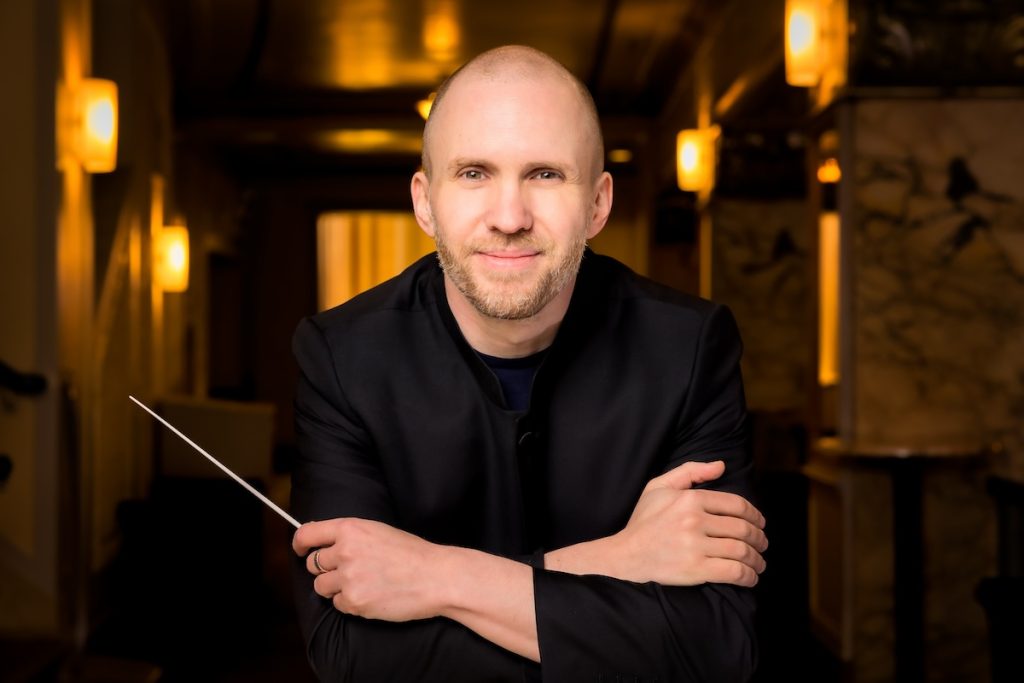
The end is near and renowned Conductor David Danzmayr is here to lead the fellows in one final, ravishing performance (courtesy photo)
Tonight’s concluding Teaching Artist Showcase boasts a bevy of instrumental faculty members – 15 in all – split between Tovey’s “Santa Barbara Sonata” for brass quintet (see interview with horn player Nathaniel Silberschlag), Reynaldo Hahn’s “Piano Quintet in F-sharp Minor” (which reunites current and former Camerata Pacifica members in cellist Ani Aznavoorian and violist Richard O’Neill), and Shostakovich’s “Piano Quintet in G Minor, Op. 57,” the latter two pieces boasting the MacArthur Genius Grant awardee Jeremy Denk on piano. (7:30 pm; Lobero Theatre; $10-$125)
Friday, August 7: The Marilyn Horne Song Competition is, at least for this year, the only one of three such contests between fellows to still be part of the season, with the winners claiming high honors, cash, and a chance to perform back at Hahn Hall within the following 10 months. The song sing-off is the grand lady of them all, one in which there are no preliminaries, so every vocalist and every vocal pianist get the chance to perform three selections in front of the impressive panel of judges, competing for the coveted title and a cash prize. (11 am-5 pm, with 90-minute break at 1 pm; Hahn Hall; $60)… Tonight, it’s put up or shut up time, with a fair number of fellows going the former route as the finale in the newly-revived Picnic Concert series features 22 different instrumentalists, with works by Dvořák, Schumann, Tchaikovsky, Saint-Saëns and Marcel Bitsch on the program. (7:30 pm; Hahn Hall; $10-$65)
Saturday, August 9: With six-weeks of connection and rehearsals behind them, the fellows-fueled Academy Festival Orchestra is clicking on all cylinders, perfect for closing the American Mosaic season with a program that actually doesn’t actually have any American music. But it’s a powerful pair that begins with Mozart’s charming and virtuosic “Sinfonia,” featuring as “soloists” a quartet of MAW’s estimable teaching artists including Silberschlag, LeClair, oboist Eugene Izotov, and Montecito’s own prestigious purveyor of the clarinet Richie Hawley. That’s followed by Rachmaninoff’s romantic and sweeping “Second Symphony.” Renowned Conductor David Danzmayr, widely traveled and highly praised, wields the baton. (7:30 pm; Granada Theatre; $10-$125)
You might also be interested in...




You must be logged in to post a comment.