
Drum Roll, Please… PercussionFest!

Michael Werner’s 2026 Music Academy of the West experience began well before the majority of his percussion fellows even arrived on the Miraflores campus. That’s because Werner, a 1990 MAW alum and longtime faculty percussionist who is principal at the Seattle Symphony during the rest of the year, was a faculty member for MAW’s inaugural High School Intensive. He appeared in the first public concert in the Teaching Artist Showcase, performing sections of Jeff Scott’s chamber piece “Silenced Angels Speak” with Kenneth Thompkins on the slide brass.
“It started with a bongo solo, which, I mean, sign me up anytime I can do that,” said Werner, who also played marimba and tubular chimes at the Hahn Hall concert with the trombonist.
Those instruments will be among the more staid that Werner, fellow faculty percussionist Joseph Pereira, and the five percussion fellows will employ at the annual PercussionFest, which this year comprises two almost identical concerts at Hahn, including a pointedly more accessible performance for families in the afternoon. But with both programs, the concept is a multi-pronged approach.
“I try to pick things that will challenge the students, but also be rewarding for both them and the audience,” Werner said. “We want it to be accessible but also highlight the creativity of our instrument which can show up in almost infinite forms.”
A perfect example is “Click,” by Mary Ellen Childs, which has three percussionists each playing claves, a pair of solid wooden sticks that are better known as rhythmic backbones of salsa, son and rumba. The Village Voice called the piece “a fiendishly complex game of pattycake”.
Werner wouldn’t object to that description.
“It really focuses on the relationship between physical gestures and music,” he said. “That’s how the different events are described and how you study the piece. One part is about how you’re hitting the sticks together with windshield wiper motions and circles. So there’s a lot that happens beyond the sound that’s being produced, and a lot of choreography which makes it a very visual piece.”
Seeing as well as hearing is a big part of the pieces exclusive to the afternoon show, including Mark Ford’s “Head Talk,” which finds the five musicians seated in a semi-circle with drumheads – detached from the drum – and sticks.
“It’s very theatrical because they’re not just hitting the heads – they’re rolling them back and forth and throwing them in the air,” Werner said. “It’s a lot of fun for the audience.”
Youngsters will also appreciate “Clapping Music,” by early minimalist composer Steve Reich, which simply features two percussionists clapping, in sync or in syncopation. The evening show will feature Reich’s “Mallet Quartet,” a much more complex three-movement piece that challenges neighboring musicians by displacing the melody on vibe or marimba by an eighth note.
Aliayta Foon-Dancoes’ “LIGHTEN UP”is one of the more, well, enlightening pieces on the evening program, as it calls for the percussionists to play desk lamps from IKEA (it’s specified) along with vibes – a work that requires an explanation sheet for the symbols on the score.
“They use a musical staff but, say, an F natural means turn the lamp on for the duration of the value of the note,” Werner said. “You have all of these keys that you have to go through and learn a new language.”
Gene Koshinski’s “Ingrained” is scored for txalaparta, a Basque folk instrument made up of a set of large wooden boards – the title references both the materials used and the art form rooted in Basque culture.
“That piece is difficult but is going to be a lot of fun,” said Werner, who is performing “Ingrained”with fellow Isabella Butler.
The work is immediately followed by Mansoor Hosseini’s “Confrontation,” which Werner said turns on its head the idea that percussionists in a recital may often play across to the other person’s instrument, and switch instruments for a passage; meaning there a lot of cooperation and coordination that has to happen.
“You have to work well with each other, especially on something like ‘Ingrained.’ ‘Confrontation’ basically says, ‘Hey, what if we didn’t work well together?’ It’s a really fun piece for snare drum and a floor tom that looks at what might happen if you didn’t get along.”
Which of course won’t be the actual case with the musicians on the July 8 concerts or anytime else during the summer. Indeed, having the PercussionFest early in the summer brings benefits to the studio beyond the fun of the concerts.
“We’re all immediately forced to quickly understand the way we play music and experience rhythm because we will be rehearsing all day long for 10 days to put that program together,” Werner said. “It really sets us up for the rest of the festival to just know each other really well less than two weeks in.”
Upcoming @ MAW
This first week of the Music Academy summer festival proper – meaning with the fellows, who largely arrived after the two-week High School Intensive – is a bit truncated in event offerings. But buckle up: Lots more is coming before the season closes on August 8.
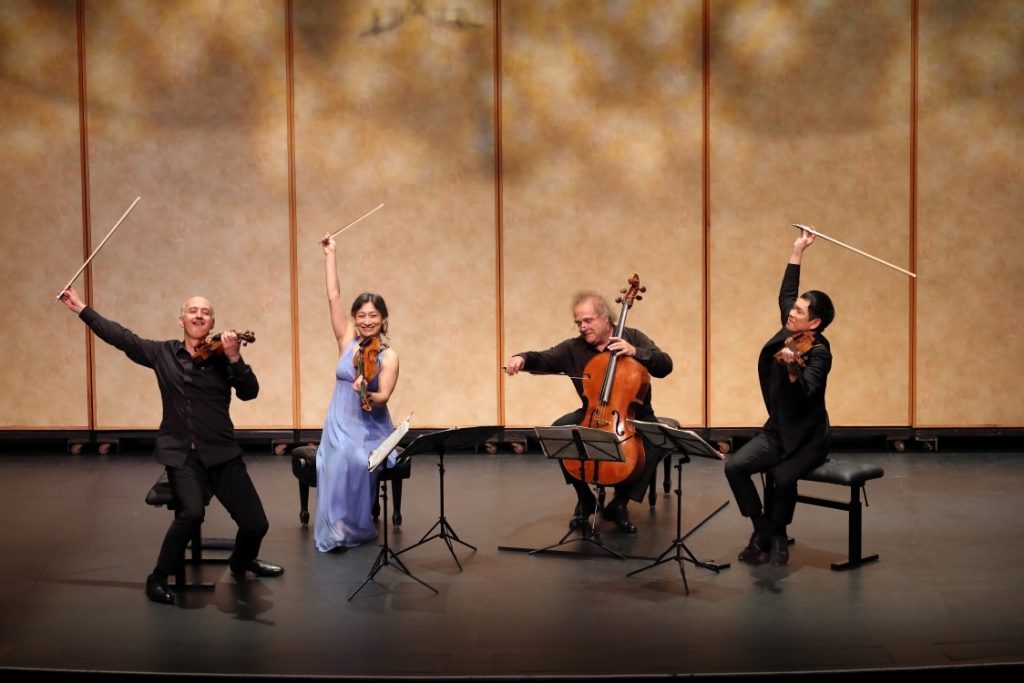
Thursday, July 2: Tonight’s second Teaching Artist Showcase of the summer closes with Mendelssohn’s “Octet in E-flat Major, Op. 20,” which will be played by the combined Takács and Maple Quartets, with the 20-year MAW mentors and this year’s Emerging Artists String Quartet mentees share the stage. What makes it even more memorable; it’s the last time cellist András Fejér will grace our local stages as a member of the Takács, the vaunted string ensemble whose all-Beethoven recital at the same venue last weekend induced whoops and hollers. (7:30 pm; Lobero Theatre; $10-125)
Friday, July 3: The 100-strong fellows-powered Academy Festival Orchestra makes its 2026 debut under the baton of Miguel Harth-Bedoya, the maestro who also conducted last year’s season-closing Mahler concert at the Granada. The fare this time around? Gershwin’s beloved jazz-tinged classic “An American in Paris”paired with Brahms’ “Symphony No. 2 in D Major, Op. 73, ‘Pastoral,’” another staple of the repertoire. (7:30 pm; Granada Theatre; $10-125) MAW has added a new twist to the event with the option to expand your evening downtown at Bistro Amasa inside the historic Upham Hotel (1404 De La Vina St.), where your concert tickets are the gateway to an exclusive three-course prix fixe menu ($50) before the performance.
Saturday, July 4: Time was at the Music Academy that the fourth of July was just another day at Miraflores, with master classes and even performances in the evening pushing patriotic celebrations aside. Then in more recent years the place shut down in full for the 4th, like many an institution around the country. That’s still largely the case, but this year the brass and percussion fellows are slated to kick off the compact Village Fourth parade down San Ysidro Road. It’s not The Music Man’s 76 trombones leading the big parade – there’s only four of those fellows in total – but it’s still pretty cool. (11:30 am; Upper Village)
Monday, July 6: Mosher Guest Artist Missy Mazzoli, one of a number of living American composers making their local debuts at MAW this summer, also inaugurates a new series of talks with the guest artists with today’s Composer Chat. The Grammy-nominated Mazzoli has had her music performed worldwide by leading orchestras, ensembles and soloists, including the New York Philharmonic, Los Angeles Philharmonic, Philadelphia Orchestra, BBC Symphony Orchestra, Kronos Quartet and many more. Her operas, which include Breaking the Waves, Proving Up,and The Listeners, have received international acclaim for emotional intensity and contemporary relevance. No doubt today’s talk with Conor Hanick will cover the upcoming debut of the revived Picnic Concert Series that features the world premiere of her “Piano Études” performed by the Music Academy’s six solo piano fellows in a concert Mazzoli is curating on July 10, and her piece “Lies You Can Believe In,” which will be played by Mosher Guest Artist Jennifer Koh and several fellows on July 23. (1:30 pm; Weinman Hall; $10)
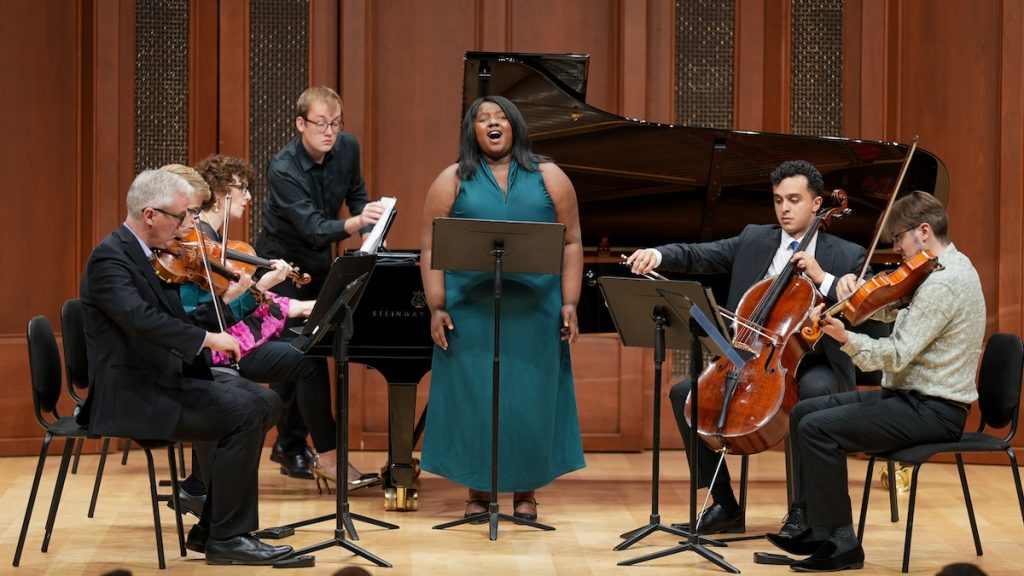
Tuesday, July 7: Think of it as the return of Tuesday@8. Only instead of the typical varied chamber music programs performed at the Lobero by the MAW Teaching Artists (aka faculty & guests) beginning at, yes, 8 pm – the new Sonata Nights features the faculty collaborative pianists pairing with other instrumental teaching artists back on the Miraflores campus and a half hour earlier. Tonight’s fare includes sonatas by Charles-Marie Widor with Margaret McDonald and flutist Marianne Gedigian, Prokofiev with Natasha Kislenko and violinist Sibbi Bernhardsson, and Mendelssohn, with longtime department chair Jonathan Feldman and veteran MAW cellist Alan Stepansky. Future series shows are slated for July 7 & 28, and August 4. (7:30 pm; Hahn Hall; $10-50)
Wednesday, July 8: The percussion fellows and faculty do double duty in two separate concerts for this year’s PercussionFest at Hahn Hall. The 4 pm family friendly performance is followed by an Instrument Exploration Station outside on the plaza. See interview with Michael Werner above. (4 pm & 7:30 pm; $10-$65)
Thursday, July 9: MAW’s x2 Series – which partners teaching artists with fellows side-by-side in chamber music recitals – debuts for the season with a doozy, as more than a dozen instrumentalists in total play three works that span centuries, instruments, and approaches. Bach’s “Concerto for Violin and Oboe in C Minor, BWV 1060R,” sets the stage, followed by “Portraits of Langston,” by another important contemporary American composer in Valerie Coleman. Baritone Byron J. Mayes – who was a fellow in 2020-21, a former Chrisman Studio Artist with Opera Santa Barbara, and a doctoral candidate at UCSB – narrates two of the suites that serve as Coleman’s take on Hughes’ poetic memories of Harlem and Europe. Dvořák’s “Piano Quartet No. 2 in E-flat Major, Op. 87,” closes the evening. Future x2s follow on the next three Thursdays, July 16, 23 & 30. (7:30 pm; Hahn Hall; $10-65)
You might also be interested in...




You must be logged in to post a comment.