
Conducting and Quartets

By the time Peruvian-born Conductor Miguel Harth-Bedoya finishes his residency at the Music Academy of the West early next month, he will have conducted the last three concerts in a row as part of the Academy’s summer season. Harth-Bedoya closed out the 2025 festival last August leading the by then well-seasoned Academy Festival Orchestra in Mahler’s epic “Symphony No. 3.” This year, he’s conducting the 14- to 18-year-old instrumentalists in an orchestral concert at 2 pm on June 25 to wind up the inaugural High School Intensive. He then turns his attention to the just-arrived MAW fellows making up this year’s AFO to launch the orchestral season at the Granada on July 3.
The engagements make up for a 20-plus-year gap since the last time Harth-Bedoya wielded the baton at a MAW event when he conducted the AFO in the early 2000s, back when the orchestra still performed at the Lobero Theatre. Of course, he has been busy in the interim, serving as music director of the Fort Worth Symphony from 2000-2020, chief conductor of the Norwegian Radio Orchestra from 2013-2020, and engaging in scores of guest-conducting roles all around the world.
Harth-Bedoya has semi-retired from the road to take up teaching positions, first at Baylor for the 2023-24 academic year, and now permanently as resident director of orchestras and professor of conducting at the Rice University Shepherd School of Music.
“I’ve definitely cut down on traveling because I like to spend time with my students,” Harth-Bedoya said. “I’m not of the idea that you say you are teaching, but you are gone half the time performing elsewhere. I want to be available to my conducting and orchestra students.”
Which of course makes him ideal for the two roles at MAW this summer in what may turn into a permanent spot on his early summer calendar. You might say teaching young musicians is a passion, but Harth-Bedoya sees it through a different lens.
“It’s a very selfish thing because I learn more that way. When you train others, you actually learn because you have to prepare differently, which is very exciting and a never-ending process.”
Harth-Bedoya had less than two weeks with the high schoolers interested in conducting, but he said such early exposure is integral.
“We’ve really been missing programs in this country for more than a generation. We haven’t really had early training in conducting. It’s the equivalent of pre-med for medical school, but we just dropped it. So I am happy to be part of resurfacing it.”
Harth-Bedoya said the inaugural program was simply an overview but very valuable that included the opportunity to actually wield the baton for sections toward the end of this week.
“We exposed them to a lot of elements, but letting them actually practice with real people is important,” he said. “It’s like a class on how to plant flowers and vegetables. If you just talk about the soil that feeds the water but don’t get your hands dirty – that’s when you realize how it feels. It takes patience and time
and steadiness.”
Moving on to work with the vastly more experienced fellows in the regular summer festival might seem an easier task, but once again Harth-Bedoya had his own point of view.
“I approach every orchestra the same way – the San Francisco Symphony two weeks ago, the high school orchestra now, and the college or beyond musicians next week. What never changes is the why we do this, which is the music. We are human tools to get to the music. It’s not about us. With an orchestra that has never played together before, you have to help them build, but the goal is the same. I never deviate from that – it’s the music.”
The music on July 3rd is, somewhat surprisingly, not only by American composers.
Gershwin’s “An American in Paris” is a well-known piece that never gets tiresome, says Harth-Bedoya.
“It’s a gem, a jewel of American orchestration,” he said. “Gershwin added flavors that are jazzy or bluesy to what had been rather square Central European music to depict an ‘American in Paris.’ What he did was beautiful and brilliant and it should never be taken for granted, even if it’s easy to listen to.”
The Gershwin is paired with Brahms’ “Symphony No. 2 in D Major, Op. 73 ‘Pastoral,’” which the conductor called almost a polar opposite.
“There’s no storyline, nothing external,” he said. “It’s just the music for the music and about the music. That’s it. The music does the magic. I’ve said this many times, but I still believe it: You cannot touch the music but music can touch you. It’s pretty incredible but that’s what happens over the course of the 40 minutes.”
Upcoming@MAW
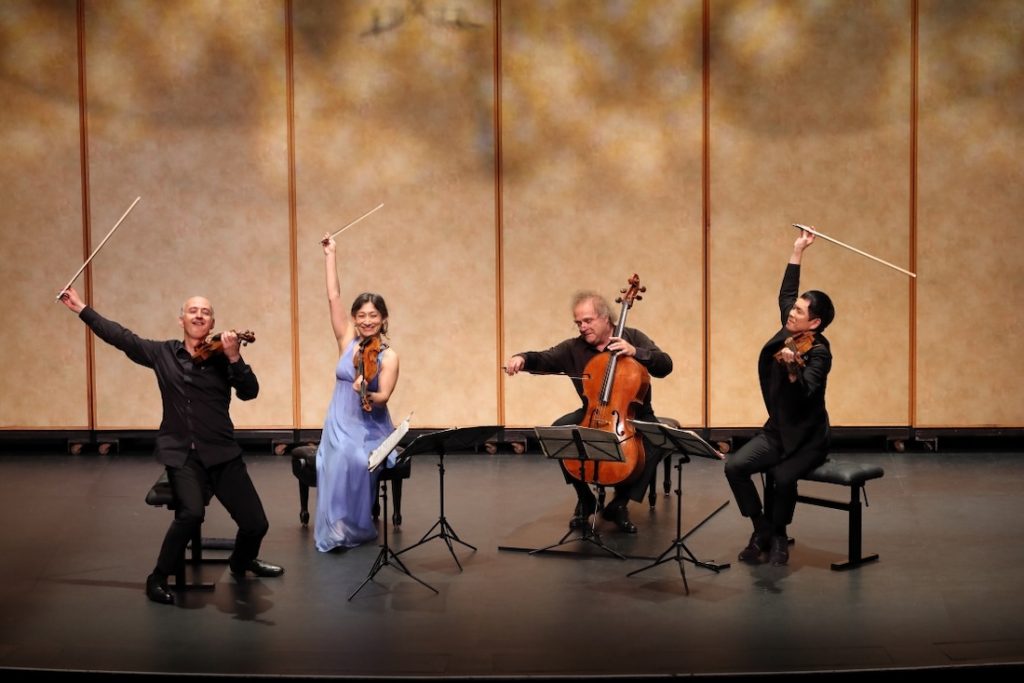
Takács founding cellist and last remaining original member, András Fejér is playing one more round before retiring after more than half a century (photo by Phil Channing)
We don’t mean to string you along, but the Music Academy is giving no quarter in its next three marquee events, focusing fully on the fearsome foursomes known as the string quartet. You’ll have to wait until Wednesday for a wider scope. But no need to vociferously vocalize about it, as mid-week brings a surfeit of singers.
Friday, June 26: The two fellows quartets that were hand-selected for the Takács Quartet’s coveted String Quartet Seminar Program perform for the first time together in recital following coaching and rehearsals in the season’s first two weeks. Among the works being played at the summer’s first event featuring the fellows: Smetana’s “Quartet No. 1 in E Minor, ‘From My Life’”; movements from Gabriela Lena Frank’s “Leyendas: An Andean Walkabout”; sections of Schubert’s “No. 15 in G Major, D. 887”; and parts of Bartók’s “String Quartet No. 4, Sz. 91, BB 95.” (7:30 pm; Hahn Hall; $10-$50)
Saturday, June 27: In what is surely an honor for the Music Academy, the Takács Quartet, who have been the resident string quartet at Miraflores for many years, perform their final string quartet concert before founding cellist András Fejér retires after more than half a century. The big bonus: It’s an all-Beethoven program, with the quartet – whose violist, former Camerata Pacifica and MAW faculty Richard O’Neill, who following tonight will no longer be the newbie after six seasons – playing the “G Major, Op. 18, No. 2”; “No. 10 in E-flat Major, Op. 74, ‘Harp’”; and “No. 14 in C-sharp Minor, Op. 131.” (7:30 pm; Lobero Theatre; $10-125)
Tuesday, June 30: Founded in 2022 at the Eastman School of Music, The Maple Quartet bested the competition to be named this year’s MAW Emerging Artist String Quartet, the second in the new program. Violinists Isabel Chen and Magali Pelletey, violist John Crowley and cellist Gabriel Hennebury were two-time recipients of the Eastman’s Celentano String Quartet Award, and have gone on to place highly at national chamber music competitions. The foursome believe the string quartet medium is an essential tool for bringing people together, leading them to share music in unconventional spaces including museums, hospitals, classrooms, libraries, detention facilities and schools and community spaces for people with disabilities. Amidst their coaching by the Takács, Maple makes its MAW debut with a recital that sandwiches Haydn’s String Quartet in D Major, Op. 20 No. 4, Hob. III:34, and Dvořák’s No. 10 in E-Flat Major, Op. 51, around the prolific modern composer Caroline Shaw’s Valencia. (7:30 pm; Hahn Hall; $10-$50).
Wednesday, July 1: Let’s hear it for Lehrer! The 20 singers who comprise this year’s cohort in the Lehrer Vocal Institute make their debut with the intro event that has quickly turned into a smart and charming annual affair. The vocalists will be starring all summer long in various projects, including master classes, opera scenes, chamber music concerts and, of course, the full-scale production of Kevin Puts’ “Gothic thriller” opera Elizabeth Cree. But first we get to know them as people as well as singers, as each will individually perform a song that has special meaning for them as a reminder of home in its many guises. “Oh Beautiful: Songs from Home” will feature such wide-ranging selections Víctor Carbajo’s “La Niña de Guatemala”from soprano Mariana Iguavita; Lu Zaiyi’s “The Bridge in my Homeland,” sung by tenor Zhongjiancheng Deng; Harold Meltzer’s “Autumn Begins in Martins Ferry, Ohio” from Beautiful Ohio, from tenor Christopher Leimgruber; the Korean folksong “Byul Hana (A Star),” with baritone Daniel Byun; and Charles Samuel Brown’s “A Song Without Words” from mezzo-soprano Maiya Williams. It’s also the first chance to hear the 2026 vocal piano fellows Pei-Wen Liao, Youngsu Cho, Yuhan Wang, Jay Patrick Forsythe, and Xi Huang perform four times each in supporting and partnering the singers. Come prepared to have your eyes opened and your heart moved. (7:30 pm; Hahn Hall; $10-$65)
Thursday, July 2: Tonight’s second Teaching Artist Showcase features five faculty members playing Arthur Foote’s “A Night Piece for Flute and String Quartet,” and three more taking on Bruch’s “Eight Pieces for Clarinet, Viola and Piano, Op. 83,” before the evening closes with Mendelssohn’s “Octet in E-flat Major, Op. 20,” which will be played by the combined Takács and Maple Quartets as the mentors and mentees share the stage. (7:30 pm; Lobero Theatre; $10-125)
You might also be interested in...




You must be logged in to post a comment.