
Charles Wood III: Mentorship and Swing in the Age of Surrender
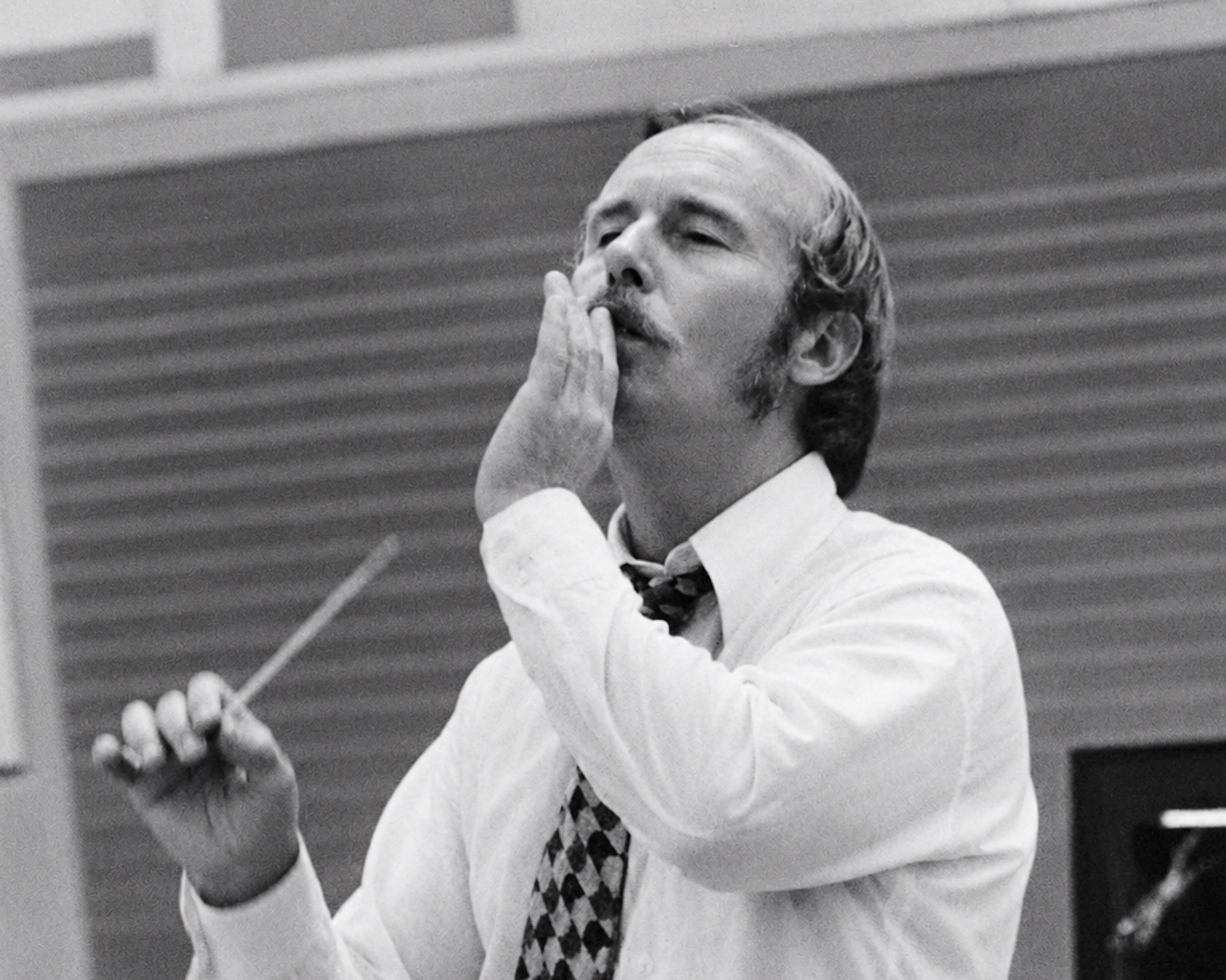
“At Bakersfield College in the ‘70s, Charles put together and choreographed a whole program of those songs that had made Sinatra famous. The marching band played it at the football game on Friday nights. Everybody went to those football games.”
Charles Wood III – jazz fiend, music educator, instrumental proselytizer, and a catalyzing match tossed into the creative tinderbox of youth for some 60 years – passed away in March of this year. Joanne Wood is his widow.
“I’d always known he was doing a great job,” she says. Throughout our conversation she is glassy-eyed, but animated and given to teary bursts of light laughter. She chants the serial kudos that attend a successful career. “‘Yes, congratulations. Good job, good job, good job.’ And then when he died,” she says with a mildly stunned expression, “…all these accolades started coming in. ‘He did this and he did that and he was such a mentor…’”
A treasured and beloved ambassador from The Time Before Art-Destroying Algorithmic Appliances Began Attacking Humankind’s Expressionist Wellspring (not to mince words), Wood’s life – a many-splendored jazz symphony spun out over some 90 years – was largely spent gifting the incandescent joy of music to young people.
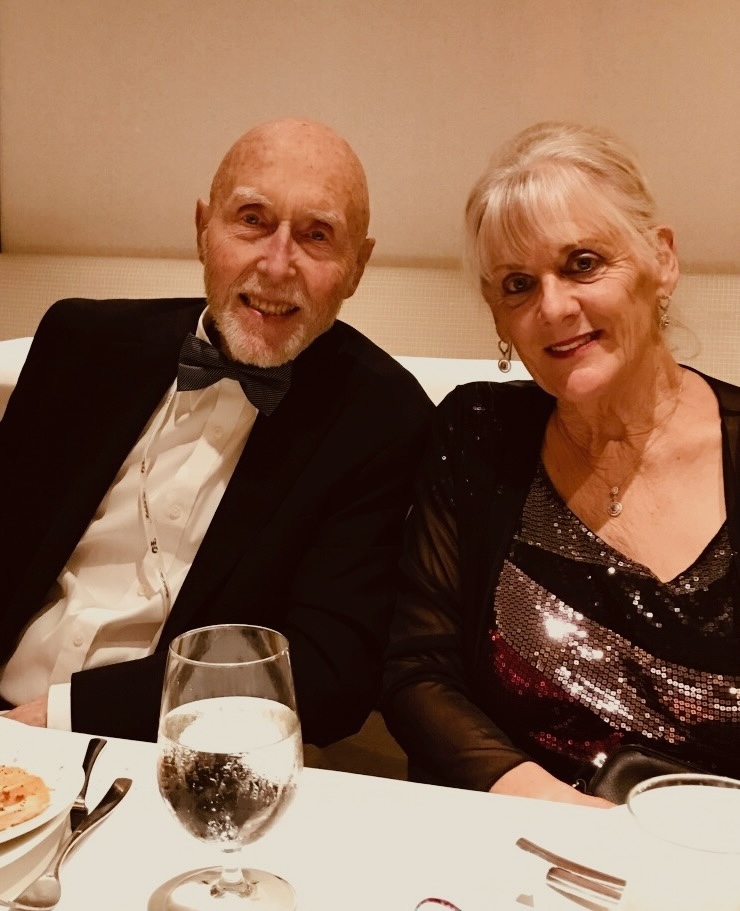
Educator, composer, trumpeter – at Wood’s formal retirement in 2010 he was Director of Bands and Jazz Studies at Santa Barbara City College, and taught a popular jazz appreciation class – Wood’s conducting chops would find him energetically waving his arms at jazz combos, chamber wind bands, concert bands, tuba-hoisting marching bands; the gentleman liked bands. In the ‘70s he would find himself conducting backup combos for Dizzy Gillespie, Ella Fitzgerald, and a fellow trumpeter named Miles.
“We would have been married 38 years on July 1st,” Joanne says wistfully, and goes on to explain her Charles, whose nickname in the space became Dr. Jazz.
Dr. Charles Wood – Dr. Jazz – was a force in the music community, a tireless jazz missionary, educator, and exemplar. In the days, weeks, and months since his departure, the composed and improvised notes of Wood’s lifelong service to art have cohered into a retrospective melody whose peaks more than occasionally hit Double High C. The murmured stories keep coming. This Sinatra thing, for instance. Wood’s having put together this Sinatra set for Bakersfield College’s Friday Night halftime show?
“There happened to be an employee or assistant to Frank Sinatra in the stands one Friday night, someone whose kid was in the college concert band,” Joanne says. “This man went back to Sinatra and said, ‘Boy, you should have heard this wonderful program with your music at the football game the other night!’” Joanne pauses to arch her eyebrows and shake her head in wonder, as if to say “You know, Jeff?” “No, I don’t,” my eyebrows answer.
“My husband was meeting with the band the Monday morning after the game, doing the usual post-performance analysis of how things went.” The band room phone rang and Wood excused himself and picked up. One can imagine both the Chairman’s booming voice on the line and the color leaving Wood’s stunned expression.
“Charles, I heard about your wonderful Sinatra halftime program. Thanks for putting it together!”
There he is… Mr. America
The Charles and Joanne Wood story, like all such unions, is unlikely. A lady from Casper, Wyoming, and a gentleman from Athens, Ohio, cross paths in a distant California desert, join hands, and are led by the fates to a swinging grotto called Santa Barbara. Whose gonna believe that treatment?
“We met in Bakersfield through mutual friends,” Joanne says. “I was living in Riverside at the time and newly divorced, and Charles was in Bakersfield, also recently divorced. A friend of mine in Riverside moved to Bakersfield and Charles actually became her music teacher at Bakersfield College.” Her friend spoke well of her instructor.
By the time Charles and Joanne met, he had long since been tempted by and happily succumbed to the sirens of Jazz, having completed his BA of Education at Ohio University (where augmenting ROTC coursework would later find Captain Wood nervously awaiting resolution of the Cuban Missile Crisis while conducting a soldier’s chorus at Ft. Dix in NJ), his MA in Performance and Conducting at Columbia, and his PhD in Music Education at UCLA. He would spend some time at Juilliard just to sprinkle some grace notes into his score. But back to Joanne’s matchmaking friend.
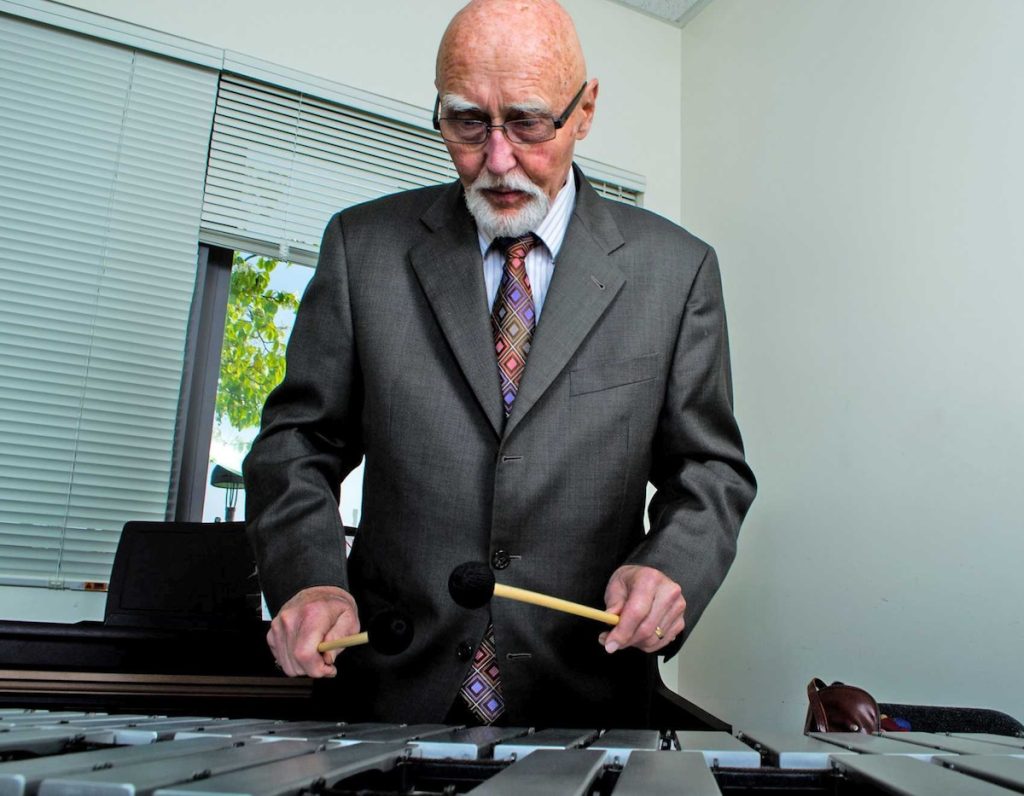
“She says, ‘I think you should meet.’ And so I drove to Bakersfield with my kids and we had a blind date. He’s 15 years older than I am, and I thought, I don’t know…my mom would say ‘no, no no.’ But there was a band and we danced after we had dinner. And he was just cutting the rug!”
Over the course of that evening, she would fall into Charles’ orbit, certain personal deets emerging like odd but compelling chromatic stops between more familiar notes. “I thought, ‘this guy’s pretty cool.’ And he was very athletic and in very good shape,” she notes appraisingly. “He was a bodybuilder too, you know. He was a Mr. America contestant once.” The guy had even gone to Ohio U. on a track scholarship – a pole vaulter, of course.
Finding his footing in Bakersfield, Charles would be Bakersfield Symphony’s principal trumpet for 14 years and ultimately Director of Bands at Bakersfield College for 24 years, swinging by Santa Barbara and UCSB as a Visiting Associate Professor in the early ‘70s and getting a taste of Shangri-La. Then came Joanne.
MUS means Music
Joanne’s feelings for Charles were complicated. On the other hand, everyone has an Achilles heel. “I fell in love with him when I saw him conduct the Bakersfield symphony in his tuxedo for the first time. I thought, ‘Oh my gosh, I have to have that guy!’”
The two dated long distance for a year. All the while, Charles wanted Joanne to leave Riverside and join him in Bakersfield, where they would marry. “And I said, ‘I need to think about that.’ And then he got that SBCC gig. And I said, ‘Well, I can do Santa Barbara!’”
They moved to Santa Barbara in 1988, marrying on the way (their legal witness, her five-year old daughter if she could but sign her name…) and Charles began making waves at SBCC, in time founding and directing the celebrated Monday Madness and Lunch Break Big Bands there. Before long another school in the area started hankering for an opportunity to enlighten the student body.
“I was the school secretary at Montecito Union School in 1990,” Joanne says, “and Bronte Reynolds was superintendent and principal. At that time they had a choral program, but they didn’t have a band program.” One day Principal Reynolds was musing aloud about the possibility of starting a band at Montecito Union. “My husband could do that!” Joanne offered reflexively. Wood and Reynolds would meet to hammer out the details, with everlasting effect.
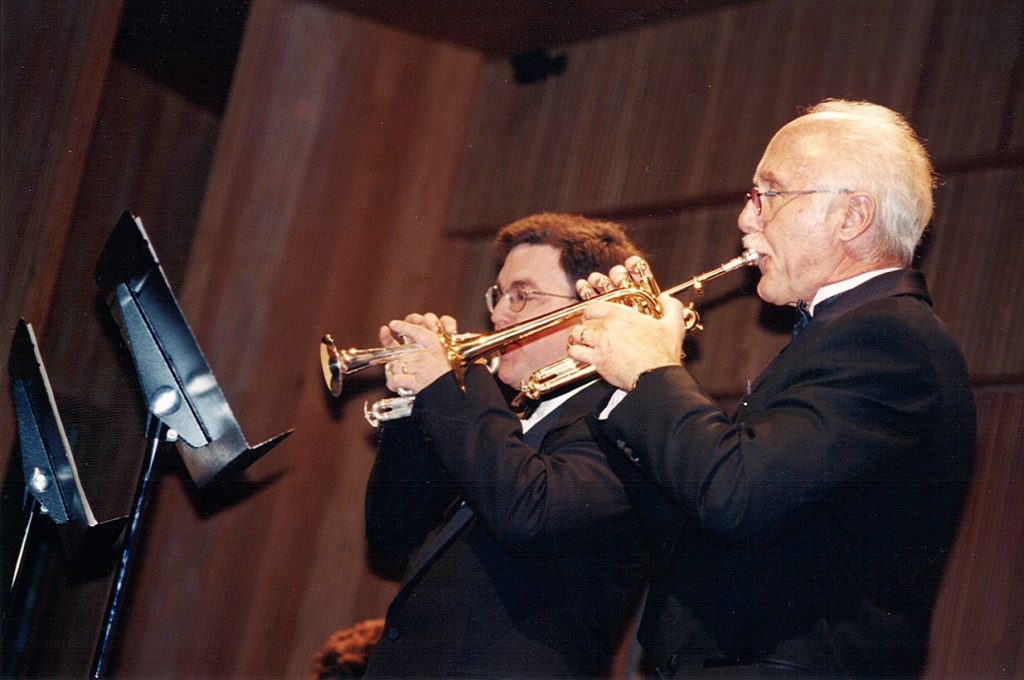
James Mooy, himself a legendary fixture in town, is conductor of the SBCC Symphony Orchestra and the Lunch Break Jazz Ensemble. He is a Music Academy alum, and longtime pal of Dr. Jazz.
“Chuck Wood left his mark on music education,” he says, “and the music scene in general. He not only brought legendary musicians to work with his students, he trained the very musicians who would go on to become professional musicians and educators themselves. His passion and enthusiasm for the music and those who made it was infectious.”
The intrinsic value of Wood’s mentorship of literally thousands of young people over the course of his life – it can’t be overstated. The energy of that mission seemed to permeate Dr. Jazz’ final laying to rest.
“Trumpet was his primary instrument. He had to have trumpeters at his funeral.” Joanne laughs lightly, eyes clouding. “So I reached out and I said, ‘I need a trumpeter.’ And I ended up having four trumpets and two trombones. It was a sextet of brass. It just… blew everybody away. They’re like, ‘What? You have a band?!’”
Did they ever.
“We had a 30-voice choir, and a seven-piece brass ensemble, and we had the two vocal soloists. I mean, it was fit for a king.” Because Charles had served in the military, he was due a degree of formal military sendoff, and that martial tradition sounded its own sweet note at Charles Wood III’s final leave-taking.
“At the funeral,” Joanne says, “a Montecito Union band parent stood and talked about Chuck, how wonderful he was at teaching kids at the elementary level. I thought others would also get up and talk, but later on they told me that they were too torn up.
“But this MUS band parent, Lizzie, got up and talked about education, young minds and music. She talked about how instrumental my husband was making musicians out of the kids at Montecito Union.
“Because Charles had been in the military, they had a military service at the grave site, too, where they played taps and they presented me with a flag. Well, Jim Mooy had learned that the “Taps” that they were going to play was to be a recording. ‘Absolutely not,’ Jim said. ‘We’re not playing a recording for Chuck. I’ll play my trumpet.” Joanne tears up in the telling.
“And so Jim went and stood under a tree a short distance away from the grave site and played ‘Taps,’ all by himself out there.” Following a literal lifetime of gifting priceless jazz to anyone and everyone, Charles Wood exited the stage to the strains of a trumpet, “Taps” wafting across the sun-drenched lawns. Joanne gathers herself and smiles with sudden brilliance. “There was not a dry eye in the place.”
You might also be interested in...




You must be logged in to post a comment.