
Thermal Quest

It felt like lying on gritty sandpaper. A broad, wide-open, sandstone plateau surrounded in a deep gorge choked in dense chaparral, was a hot spot for spotting endangered California condors in the mid-1990s.
Lion Canyon is an impressive, stratified canyon deep in the Sierra Madre Mountains, a “condorminium” in the middle of the Los Padres National Forest. I’d been looking all day in those honeycombed cliffs for North America’s largest flying landbird. Scanning with my binoculars, searching as many ledges, grottos, and treetops for these prehistoric raptors had become intoxicating, but I hadn’t seen a single condor.
I took a break on that massive mesa. I laid down, eyes closed, with my hands behind my head. I started to doze off when puffy clouds drifted overhead… or so I thought. A shadow flashed across my face. I ignored the first one thinking it was a cloud, but after the next one, I opened my eyes and sat up. It was a curious California condor soaring about 200 feet above me.
Condors have incredible eyesight, soaring for hours in thermal updrafts scouring the rugged backcountry for their next meal. I’m not saying that lone condor was sizing me up as a potential carcass to be scavenged, but I was lying still for 20 minutes or so. Only that solitary condor knew for sure.
Release Me

Since the early 1990s captive-bred condors have been released back into the wild to reestablish populations throughout their historic range. In the mid-1990s the Sierra Madre Mountains were the launching pad for these 20-pound birds with nine-foot-wide wingspans. During that time, I watched groups of condors socializing on big slabs of sandstone, and soaring swiftly in swirling afternoon thermal updrafts. It was a desperate yet exciting time for these Old World, Pleistocene relics.
As the years have mounted, more release sites have been established. Populations of captive-bred birds have continued to grow. There are now release sites in Baja California, Grand Canyon, Big Sur, Hopper Mountain (Ventura County), and Bitter Creek National Wildlife Refuges, and sites in Oregon, Utah, and Idaho have also been established. Today, there are close to 370 California condors in the wild, and another 210 condors are in captive breeding sites.
“Condors bring people together,” said Mike Clark, a biologist who captive-bred California condors for 35 years for the Los Angeles Zoo. “We were a condor factory. We wanted these birds to be successful.”
Still, threats persist, mainly poisoning from lead bullets. Besides habitat loss and micro trash, lead has been prevalent before and after captive breeding. As condors continue to reestablish their old haunts, they soar and scour the land for carcasses. When they come in contact with a gut pile, condors are susceptible to lead poisoning. Fifty percent of all condor mortalities are still due to lead bullets.
Lead bullets were banned in California in 2008, but they are still readily available. About half of the Golden State’s land is privately owned, roughly 50 million acres, so landowners can do as they please. Fortunately, there’s lots of lead outreach, hunters delivering and demonstrating alternatives for lead ammunition. Although it costs a little more, copper is a better alternative to lead. It delivers a cleaner kill, whereas lead breaks apart, with more fragments dispersing in a carcass.
“Hunters will be the reason why condors will survive,” continued Clark. “There’s lots of outreach there for them. Ultimately, that’s what will save the condor.”
In the meantime, Clark has been busy. He recently retired from the Los Angeles Zoo, but that doesn’t mean he’s walking away from these high-soaring raptors. In 2024 Clark formed his own nonprofit, California Condor Alliance. He purchased a 158-acre parcel at the base of the Eastern Sierra and its stunning granite peaks. Located near the Owens Valley, Clark is intent on getting more condors into the wild.
“Condors live to have babies,” said Clark. “That is when they are the most happy.”
He’ll have his own condor captive breeding and release sites, encouraging these large scavengers to fan out across the alpine zones of the Eastern Sierra. At this point, Clark is in it for the long haul.
“Now that we have it (captive breeding site) we can move forward,” said Clark. “Captive breeding is the lifeblood of the recovery. More breeding space is needed, and we need to release more birds.”
Lofty Sandstone Cathedral
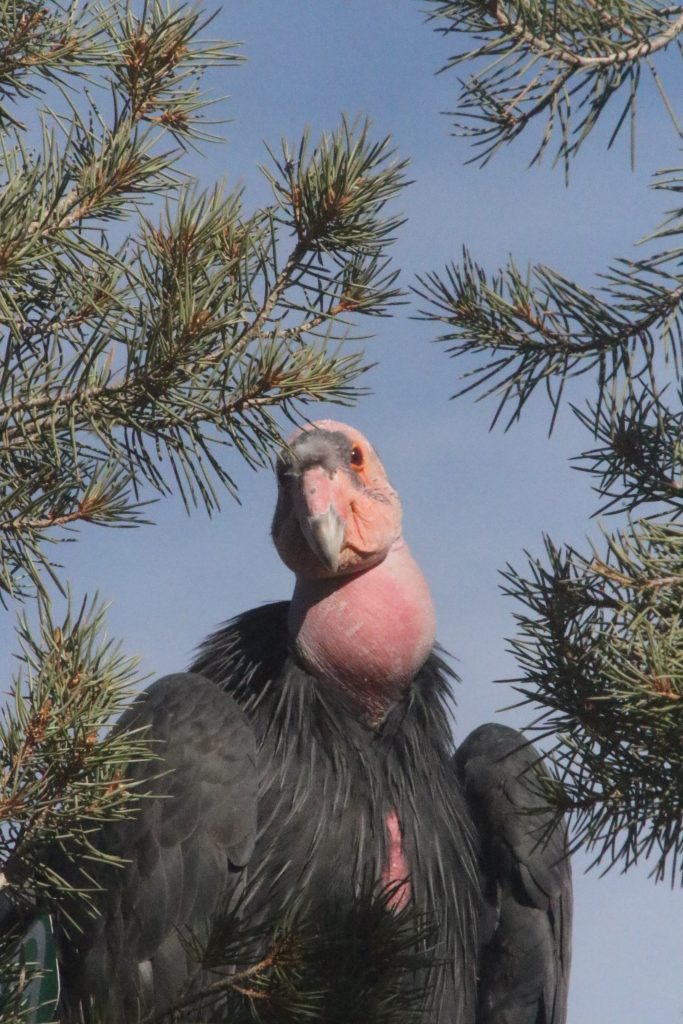
Late afternoon in Lion Canyon was magical, a backcountry cathedral that looks across the Cuyama Valley and beyond to the arid Caliente Mountains to the northeast. A warm breeze swirled up the lofty gorge to its apex where a small, gnarled pine tree grew out of a crack in the sandstone. Suddenly, a subadult condor landed on an exposed branch, steadying itself with its impressive velvety black wingspan.
I bushwhacked through the dense chaparral and oak woodlands, circling the fringe of Lion Canyon to see if I could get a better look at this iconic scavenger. Moving quickly as I could, I was hoping the lone condor was still clinging to its lofty perch. I got more than I bargained for with two condors being better than one.
After clearing thick brush, I ran around the backside of Lion Canyon. I was actually above it to the west. After traversing a path leading out to the pine tree, I had a great vantage point where now two condors shared the same branch. Typically, sandstone provides great handholds, and I used those to inch out toward the massive condors.
They were playful with each other, two young condors balancing on a narrow limb, a fine line for the two birds. Teetering on the brink is something this next wave of condors will continue to grapple with while reestablishing their historic habitats in far flung wild places.
You might also be interested in...




You must be logged in to post a comment.