
Camerata Pacifica
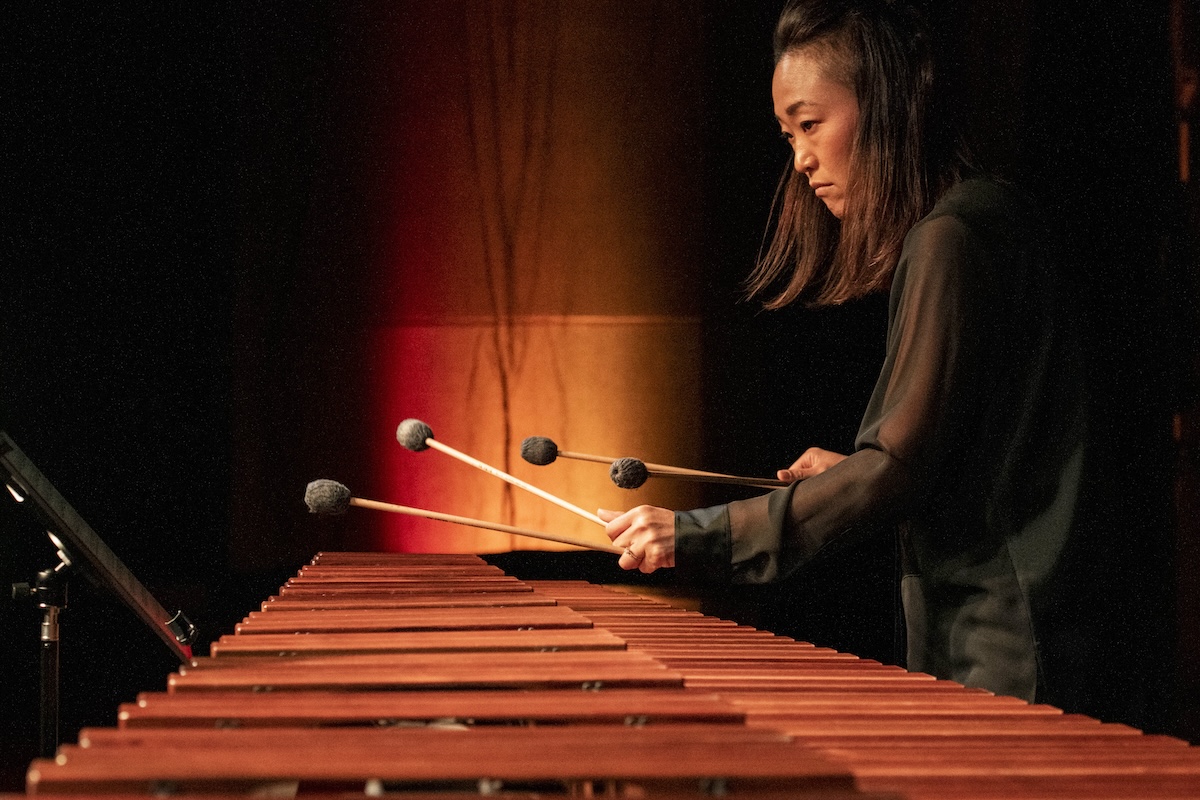
Camerata Pacifica Principal Percussionist Ji Hye Jung has been a part of the Santa Barbara-based, internationally praised chamber music ensemble for more than 15 years. She’s held the position of associate professor of percussion at Vanderbilt University’s Blair School of Music for more than a decade. Since she began performing in her native Korea at age nine, she has commissioned and premiered works by several important composers including Kevin Puts, Alejandro Viñao, Paul Lansky, John Serry, Lukas Ligeti, and Jason Treuting – several of which she premiered with Camerata Pacifica. She frequently performs with esteemed conductors and instrumentalists in symphonic programs, including serving as soloist under David Robertson’s baton for an all-Olivier Messiaen program at Carnegie Hall.
But rarely has Jung been as excited for an upcoming series of performances as she is for the concert that closes Camerata’s 36th season. The latest percussion-heavy programming brainchild from Artistic Director Adrian Spence includes the California premiere of Dmitri Shostakovich’s “Symphony No. 15, Op.144,” arranged by Viktor Derevianko for piano trio and percussion. As if that isn’t excitement enough, Jung will be playing alongside Treuting, Ayano Kataoka, and Svet Stoyanov.
“They’re all friends from Yale from long ago, where we all did the master’s program. We know each other well, and I’ve worked with them on and off, but we’ve never played the four of us together,” Jung said. “So we are all very excited to make music together over the four performances of the program. It’s going to be a very special, rare event.”
Of course, the rest of the personnel for the concerts aren’t too shabby either, as Adam Sandler would say. Principal Cellist Ani Aznavoorian and pianist Gilles Vonsattel, and violinist Grace Park, who replaces the recently-departed former principal violinist Paul Huang, are familiar to Cam Pac audiences and treasured for their capabilities and camaraderie.
“I love making this really high-end music with people from all over, those I don’t normally play with,” Jung said. “But we rehearse and make magic happen and I treasure the whole time, and how the pieces transform with a different personality over our time together.”
The concert, on May 15 at Hahn Hall, opens with another installment in Cam Pac’s ambitious three-year “Beethoven 32” project, with Vonsattel taking on “Piano Sonata No. 2 in A Major, Op. 2, No. 2.”
Next up is Thierry De Mey’s pure percussion piece “Musique de Table,” the title a sly musical in-joke as “table music” originally referred to light or diverting pieces to accompany feasts (scarcely comparable to today’s “background music” but you get the idea). Here, though, the tables are actual tables – rather tabletops that Jung has fashioned at home in Tennessee, honed to produce sound as the performers interact with the wood, including tapping, flicking, sliding, and more.
“It’s all gestures, and it’s his own notation,” Jung explained. “It’s three sets of hands dancing on the table, a highly remarkable musical piece but also very visual. Our hands are almost like dancing a beautiful ballet, although it’s complex music, rhythmically very intricate.”
Jung shared how when her mother saw a video clip of her performing the piece, smacking and brushing her hands along a table, she had her own humorous response.
“She said, ‘Oh, finally you’re doing things that I told you not to do and making a living.’”
Kenji Bunch’s Transcontinental, which pairs the percussionists with violinist Park (It was originally commissioned for Huang, and Jung played it with him at the Kennedy Center), honors the Chinese workers who provided much of the manual labor for the first transcontinental railroad, offering a corrective to sanitized stories of the American West and correcting stereotypes about Asian men in American culture. The percussionists partially act out the day’s activities, while the violinist is the piece’s protagonist, expressing the feelings of the workers with a variety of techniques. Despite the serious subject, there is also a fun theatrical aspect and some lighthearted moments in the piece, Jung said.
“It’s really fun to play,” she said in anticipation of offering the piece’s West Coast premiere. “We act out the railroad spikes with a hammer and shovels, recreating the sound of the workers laying the rails. And it finishes with what Kenji does best, a bluegrassy sort of dance. It’s really beautiful in celebrating people coming from different places and making the best home as we can. At the end, it’s a celebration.”
The Shostakovich, the pièce de résistance that closes the concert, is well known as the composer’s last symphonic work, seen as both a valedictory farewell from a composer confronting death and exhibiting optimism for a recovery. The transcription for violin, cello, piano, celesta, and percussion is new to Jung as it has only been performed five times previously.
“The symphony is powerful and devastating and this version is too,” she said. “There are so many musical quotations. And with only a few musicians we percussionists get to do a lot and bring a lot of colors. It’s eerie, and beautiful, and at times almost funny. But it’s also very intimate.”
You might also be interested in...



