
Kronos’ Bone to Pick
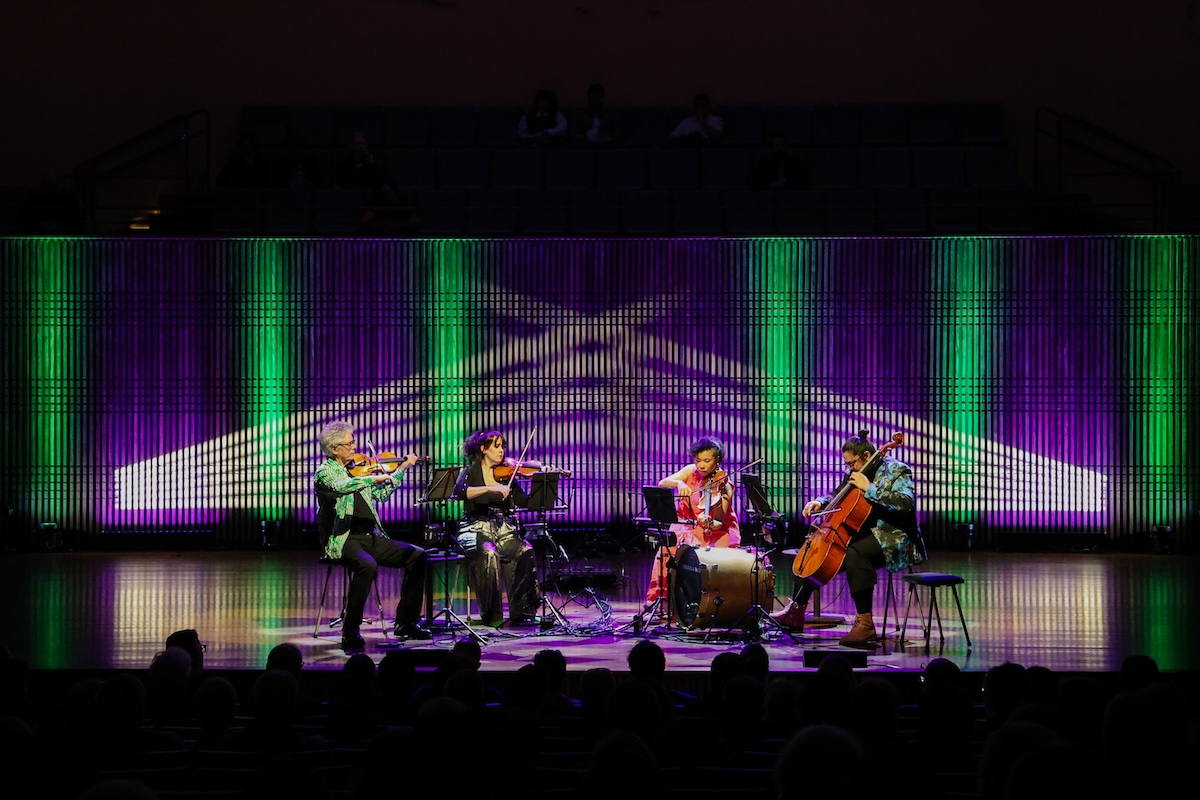
San Francisco’s Kronos Quartet has, for more than half a century, been a leader in expanding the environment and extent of what a string quartet can do. The Quartet’s CV now boasts more than 70 recordings, thousands of concerts across the globe, constant collaborations with composers and other adventurous musicians – and a seemingly endless desire to keep growing. At least that’s true of violinist David Harrington, who founded the quartet back in 1973, and recently recruited all new members (cellist Paul Wiancko, violinist Gabriela Díaz, and violist Ayane Kozasa), the last two following the retirement of two longtime members after the 50th anniversary tour.
Now comes Three Bones, Kronos’ latest large-scale project, a multimedia opus that carefully stitches together live performance, original videos, visual art projections, archival recordings and environmental sound to explore three historically subjugated communities in the United States. More than three years in the making, the work is a triptych, each panel featuring an acclaimed guest performer (see page 35) and at least one world premiere in a highly curated compendium. The project’s title follows a suggestion by poet Nikky Finney that zeroes in on three tiny bones in the middle ear that amplify faint vibrations from the outside world, transmitting them to our minds. That’s also the goal of the new work, which premiered at Carnegie Hall last weekend, and gets its second performance on May 2 at UCSB’s Campbell Hall, a frequent Kronos haunt.
Between plane trips and rehearsals, Harrington shared some insights over the phone from New York on Monday.
Q. I wanted to start with all the personnel changes in Kronos in just the last three years. How did you decide who to add and what flavors or qualities you were looking for in the new members? All of the new musicians grew up with Kronos already a force having shaken up the classical world – which is a radical shift.
A. In searching for another violinist and a violist, the first question that we needed answered was about the sense that we want Kronos to be the activist musical group. Not only being a conscience in our field but also finding ways of bringing important information and issues to the stage – and to this world that has been carefully cloistered from some of the important realities. One of the powers of the world of the string quartet is how deeply it can impact listeners right to their hearts and very core. Haydn, Mozart, Beethoven, Schubert – the four founding fathers of the string quartet – they understood that and they made works that are still important. Throughout the history of the string quartet, composers have poured some of their most personal thoughts into this medium. It was paramount to me to keep Kronos vital and responding to current things, to make music that can reach deeply into the consciousness of our listeners.
Gabriela, Ayane, and Paul did grow up knowing about Kronos. Ayane tells a story of first encountering us when she was eight, when Kronos played on Sesame Street. It made her think that somebody who played an instrument like she played could do that. Paul first encountered Kronos when a sister played (the 1990 Kronos album) Black Angels (the 1970 George Crumb composition for electric string quartet that inspired Harrington to found Kronos three years later), which starts right out with that piece. I always wanted our listeners to have to encounter it the same way I did when it just came out of the radio one day and completely floored me.
I’m imagining that process was rewarding and validating for you.
It feels incredibly rewarding and it makes me very happy. We’d like to make a TV series that young people can relate to. That’s in the future for us, for sure.
When Carnegie Hall asked you about creating a piece for America’s 250th anniversary, you immediately came up with the concept for Three Bones. Why a triptych and why these three communities to focus on?
My favorite visual triptych is “The Garden of Earthly Delights” by Hieronymus Bosch. One of my favorite musical triptychs is Black Angels and another one we played last night, Different Trains, which was written for Kronos by Steve Reich. There’s something about the power of three views and I wanted to tap into that. When I think about our country, there are three main groups of Americans that have had the toughest time here: the indigenous community; the African American, specifically Gullah Geechee people; and Chinese Americans. Almost selfishly, I wanted to focus on those three groups – their music and their culture, trying to learn everything we can to make something that can be fun. My goal was for people to come away from the concert thinking, “I had no idea.” Which is what it was like for me to dive in.
Our education system is lacking in using what has happened in the past to hopefully create a future that might be better for others. That is the driving force of Three Bones. Paul, Ayane and Gabriela jumped into this in such a powerful, beautiful way, excavating it and molding it and unlocking what had been in my brain for years.
There are a lot of stories I can tell. But come to the concert to find out firsthand.
There are three distinct segments, but it’s still a limited time. How did you distill the wealth of information, music, new and archival material, the multimedia and all the different ways you’re approaching things. How did you find the balance?
That took a whole team of people. Those of us on stage are just the face of Three Bones, including our powerful guest artists – the Apache violinist and composer Laura Ortman, percussionist Quentin Baxter from South Carolina; and Wu Man, the great Chinese pipa player that Kronos has worked with for the past 34 years. They bring real depth of experience and guidance. We try to get the most incisive, accurate information we possibly can, and then use it in a way that feels right to us.
When we premiered it at Carnegie Hall two days ago, someone told me that it felt like the audience became a different one for each of the bones. The response at the end was absolutely incredible. I was incredibly encouraged and proud to be a part of this. And we hope our audience can get there and experience what we’ve spent years putting together… Our music is becoming newer all the time and it’s getting refreshed. That’s a wonderful feeling and our audience is cheering us on… I think it does say something about our country that a work like this can be made at this time with everything going on.
Speaking of which, you’re already on to another project, having been appointed the first ever Doomsday Clock Artist-in-Residence.
We’re playing our first concert for them at Carnegie Hall tonight, for a United Nations delegation. I’m kind of on the edge of my chair because it’s such a thought-provoking situation. I’m heading off to rehearsal to see if we can get it together to play a new piece about the effects of sound and decibels, starting with very minute sounds going up to the point of 200 decibels which is totally destructive. It kills life, and that’s what nuclear bombs do. So as long as I have breath in my lungs and energy in my body, I’m going to try to bring issues like that to the forefront.
Visit https://artsandlectures.ucsb.edu for more information and tickets
You might also be interested in...



