
DEI Still Gets its Due: Sphinx Rises Again in Town
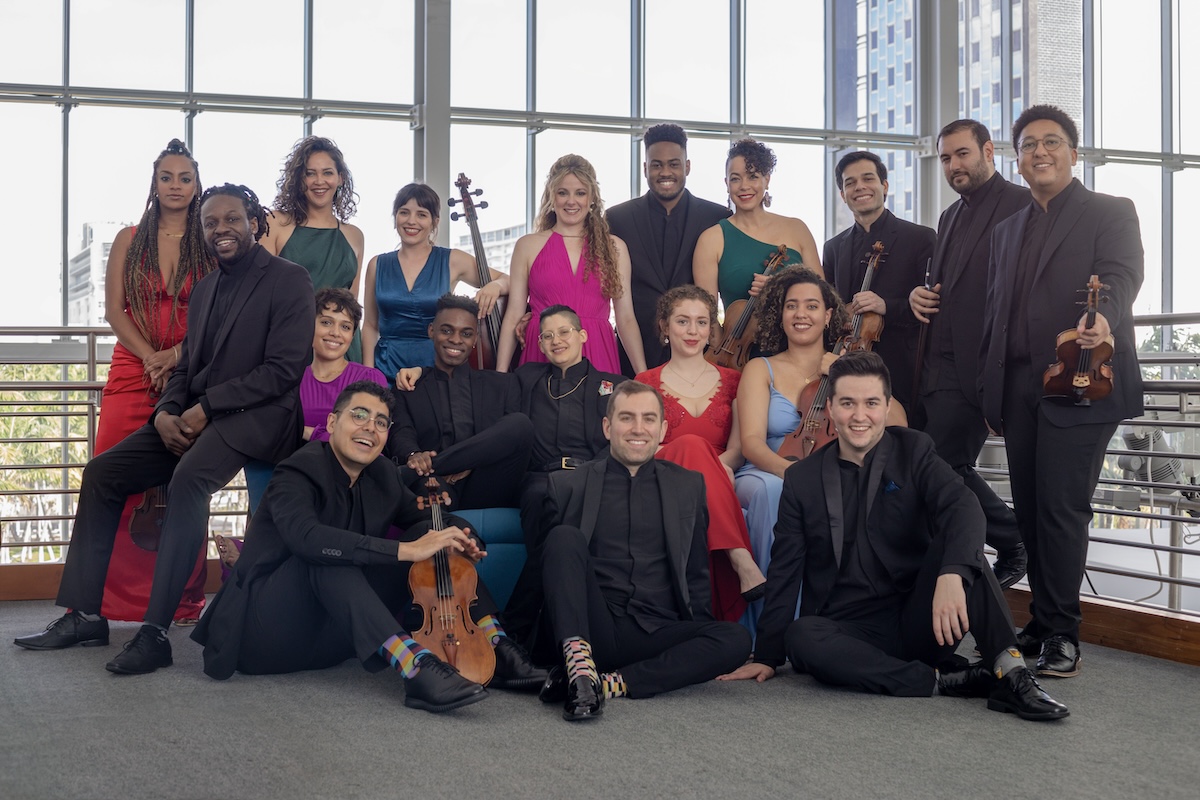
Maybe the headline is a bit misleading, as some things have changed at the Sphinx Organization, the classical music umbrella founded in Detroit in 1997. Sphinx’s program initiatives include education, artistic development, and arts leadership, in addition to its more visible performing artists priorities, which includes the Sphinx Virtuosi, the nonprofit’s premier touring ensemble.
It’s only been two years since the 18-member ensemble made its Santa Barbara debut under the auspices of CAMA’s Masterseries at the Lobero. In that short interval, the organization that champions Black and Latinx musicians has excised the operative word in its mission statement about transforming lives through the power of diversity in the arts.
It didn’t go unnoticed by Quenton Xavier Blache, the cellist-composer who has been a member of the group for almost five years, and whose piece “Habari”was a virtuosic highlight of the 2024 concert tour.
“Our statement now is transforming lives with the power of art,” said Blache, whose session credits include playing on the score for the current Oscar hopeful Sinners. “It is different from 2021, which was the year after George Floyd and the Black Lives Matter movement when you could feel a real surge of interest. But the tide has turned. The Sphinx people told us that something like $5 million in federal funding has dissipated due to the current political climate. It’s obviously not easy for an ensemble like us right now, but I do truly believe that times can swing the pendulum back. And I’m grateful to be able to play music by incredible composers of color and spread the love of that kind of music to audiences.”
Fortunately, what hasn’t changed is the high level of musicianship among the ensemble’s players who tackle a wide-ranging repertoire and still champion work by historically excluded composers as well as new pieces it commissions. Among those is the latest from Blache that actually serves as the title of the current Sphinx concert program that will be performed at the Lobero on March 12: “Visions of Peace,” a moniker that could scarcely have better timing.
The title came with the commission, as did the other pieces on the program, which includes 19th century Afro-Cuban composer José White Lafitte’s “La Bella Cubana,” contemporaries Clarice Assad’s “Impressions” and Jesse Montgomery’s “Chemiluminescence,” violinist Randall Goosby’s arrangement of William Grant Still’s “Suite for Violin or Cello and String Orchestra” (with Goosby, one of last year’s Mosher Guest Artists at the Music Academy, as soloist), and Venezuelan violinist Rubén Rengel’s arrangement of “Prokofiev’s Piano Sonata No. 7 in B-flat Major, Op. 83, ‘Stalingrad.’”
“That gave me guidance on how my piece could fit in, but the freedom to figure it out by myself,” Blache said. “I immediately thought about the global conflicts that were happening at the time in Israel and Palestine, Ukraine and Russia, and so many other places throughout the world. You have to look to history to understand why these conflicts are happening. I vaguely remembered a quote about having to study the past in order to wish for a better future.”
That’s why, Blache said, there are motifs from the Baroque and Renaissance periods meeting modern elements, representing dichotomy and the duality of conflict and harmony, a reflection on the mosaic-like nature of peace, rather than simply a clear vision for peace.
“There’s even a prayer section a little more than halfway in, where after going through a lot of emotions with moments of tension and dissonance and lots of angst, there’s a serene landscape,” said Blache, who at 24 is still one of the youngest members of the Virtuosi. “I was influenced by the sterile beauty of Bach, Circle of Fifth chord progressions, and Gregorian chant, all of which are in there. And then the latter third of the work is what I call the epilogue, a recall of the very, very first violin motif, but in a more major tonality, the somberness of the beginning played a little brighter. It’s not instant peace, but evidence of hope. The piece was a perfect opportunity for me to put on paper what had been on my mind and what I’ve been feeling for so long.”
Blache is one of two of the Sphinx ensemble members who will participate in the free educational presentation on the morning of March 13 at the Music Academy’s Lehmann Hall. The cellist and violinist Alejandra Switala will coach local string students in a masterclass, followed by a panel discussion and audience Q&A.
Visit www.camasb.org.
You might also be interested in...



