
In the ‘Jaws’ of Creation
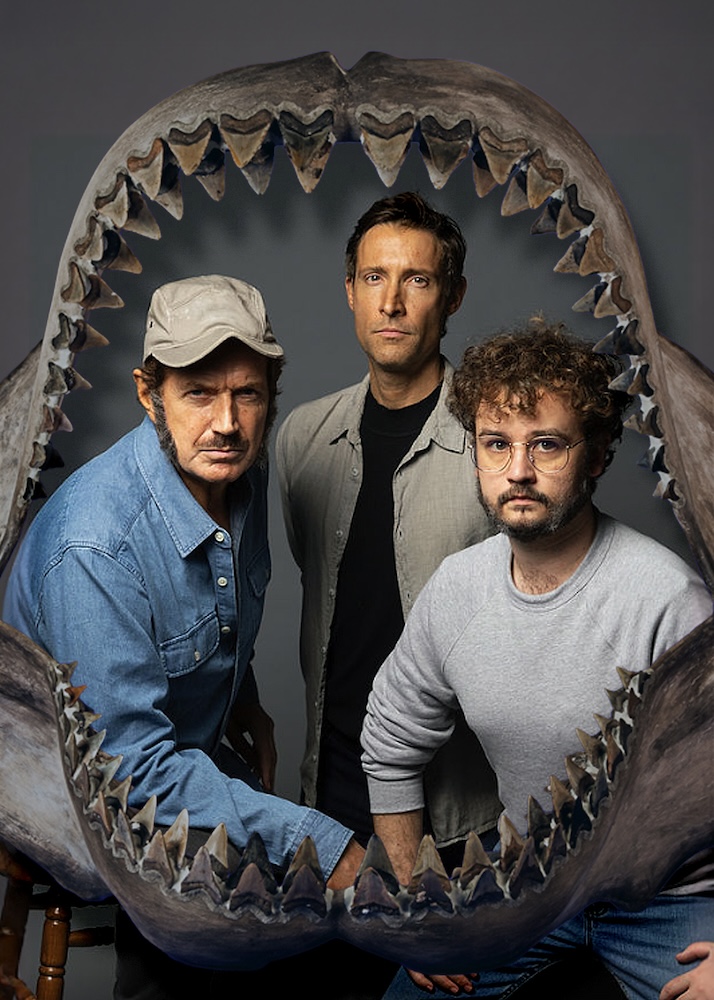
After the leather-jacketed Fonzie literally leapt over a shark while waterskiing in a famously foolish episode of Happy Days, the absurd scene birthed the phrase (and industry concept) “jumping the shark.” The damning term is applied when a creative endeavor has so run out of gas it wanders untethered into vibrant twaddle wholly divorced from its original animating spark. Once the shark is jumped, even loyal, long-suffering fans defect.
But in the new play opening at Ensemble Theatre this week, the shark itself is the problem. Bruce, the mechanical shark constructed for the filming of Jaws, won’t always even swim, let alone jump – or execute most of the moves director Steven Spielberg wanted, leading to the three actors at the heart of the film – Robert Shaw, Roy Scheider, and Richard Dreyfuss – spending long hours stuck on a small boat in the waters off Martha’s Vineyard waiting for Bruce to work.
The Shark is Broken, the hit Broadway play making its West Coast premiere at the Ensemble from February 4-22, is less about Bruce balking than it is the booze-fueled battles of will and ego that befall three actors stranded together on a boat just offshore at Martha’s Vineyard. The show is a sharp, spectacularly funny behind-the-scenes vignette on the making of the now 50-year-old iconic film.
The fish-(not)-out-of-water tale was written by Shaw’s son, playwright Ian Shaw, who developed the script from personal stories, interviews, and his father’s “drinking diary” from the set, with a story that encompasses hierarchical struggles, philosophical discussions, and vulnerable reveals.
“I was drawn to the honesty between these three actors at three very different points of their respective careers, and to the tremendous amount of humor,” director Pesha Rudnick said about making her ETC helming debut with The Shark is Broken. “To me, the spine of the play is the impact of the relationship of these three people on the final product. Their competitiveness, their humor, their process fueled the specificity of these three characters, Quint, Hooper, and Brody. The chemistry between them and the circumstances actually led to what ultimately became the brilliant parts of Jaws.”
Rudnick was founding artistic director of the LOCAL Theater Company in Boulder, Colorado – where she produced, developed, and directed more than 40 new works. She also helmed productions at the American Repertory Theater, the Kennedy Center, and La Jolla Playhouse, among others, before joining UCSB’s Theatre Department in 2021. She did quite a bit of her own research before casting began, including re-watching the movie, and “getting very intimate with the research and the stories from the shoot.”
“It was chaotic from the start; obviously the production element, but they were also getting new script pages every single day. They had not agreed to a final script. There were seven different writers who were taking stabs at it. It was, if I can say it, a s–- show.”
Fortunately, the play isn’t. Shaw balances the insanity with lots of character development and behind-the-scenes fun.
“Over the course of the play, you get to see the film in production three times,” Rudnick said. “Each time, you see the impact of the relationship, the conflict, and the banter on the actual art. I hope that by the end, you’re convinced that it was only these three people at that time in history that could have made what we ultimately saw on the screen in the final movie.”
Although the story behind The Shark is Broken is more than 50 years old, sharing it on stage now couldn’t be more timely, Rudnick said.
“At a time when our country feels quite unmoored, and as we become more digitized and rely more on robots, it’s even more important for humans to be together and in community. Shared spaces where we laugh together and reflect on humanity are vital. The theater is one of the few places that keeps that sacred.”
Visit www.etcsb.org
You might also be interested in...




You must be logged in to post a comment.