
The Art of the Down-island, Downwind Paddle

I could see the dark rippling water off the port side of my kayak as we paddled southeast toward the northwest end of Santa Cruz Island.
After paddling east, away from Carrington Point on Santa Rosa Island, and halfway across the Santa Cruz Passage, I searched for a favorable down-island current to propel myself and Zack Yates to the largest island in the Channel Islands National Park.
Sea conditions are a large part of the art of the down-island, downwind paddle, while taking advantage of Mother Nature’s favorable moods in the open ocean. Wind, swell, fog, currents, and tides all play their part. It’s not just paddling.
As soon as I saw the rippling, cobalt blue current, we immediately kayaked into it. It was easily identifiable. It was as if we went from the slow lane and into the fast lane. There wasn’t a wisp of wind coming from any direction, but a strong down-island current was running, short interval wakes were cresting, momentarily white capping, which propelled us to Santa Cruz Island.
In Our Rearview Mirror
Two days earlier, we left my favorite California Channel Island, San Miguel. A light, northwest wind was steadily pushing us southeast to sandy Challenge Point where we had an excellent visual of nearby Santa Rosa Island.
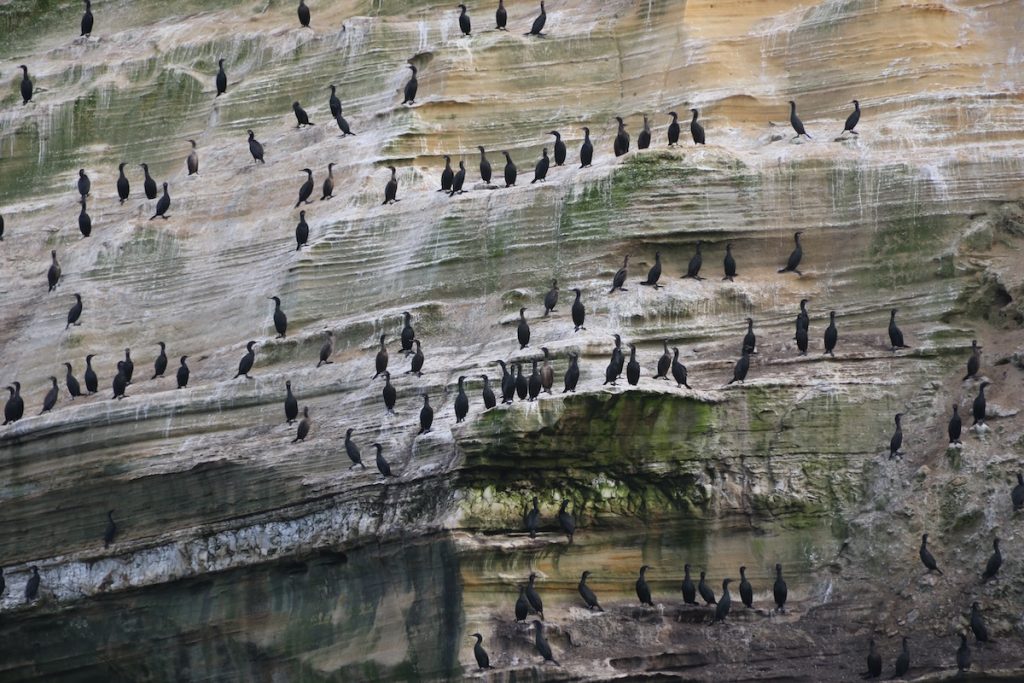
Only three miles southeast of us, Santa Rosa was seemingly right off our bows. It’s a windswept island surrounded by distant shoals, dense kelp forests, and wave-battered bluffs. There were also some inviting pocket beaches coveted by spotted harbor seals, and subadult northern elephant seals. However, the legions of Brandt’s cormorants clinging to seemingly sheer, gritty sandstone cliffs were impressive. Awkward in flight, these sleek-swimming seabirds can dive effectively to over 200 feet deep.
As hundreds of them clung to the cliffs, we paddled beneath, searching for a place to land. Suddenly, they took off. All it took was a steely peregrine falcon to disrupt the seabird nirvana. The fastest flying bird in the world made several high-speed dives angling at the cormorants that fled their sandstone perches. The incessant hum of the cormorants’ wings nearly drowned out the heaving surf. With so many cormorants in the air, we lost track of the opportunistic peregrine. Many of the seabirds huddled on the surface, safety in numbers while bobbing in choppy seas. For the moment, it appeared the peregrine was unsuccessful.
We found a sweet pocket beach to camp for the night. Beaching our kayaks was a little tricky, while timing short interval swell. The berm was steep, the sand gritty beneath our feet, but standing on solid ground after a day of paddling down-island was a great way to finish on Santa Rosa Island. We also had the benefit of a full moon rising above Carrington Point before sunset, a lunar gem as pink and purple hues swept over the Santa Barbara Channel.
Year-round freshwater creeks flow on Santa Cruz and Santa Rosa islands. The combination of pounding surf, and steady creek flow was the ideal rhythm as we drifted off to sleep, a hydrological melody driven by the islands.
Sandspits, Marine Terraces, and Cobbled Pitstops
At least visibility was stellar. There’s nothing worse than paddling from island to island when pea soup fog rolls in. No, we didn’t contend with dewy overcast. Instead, we drifted away from an angry blowhole at Coati Point on the easterly fringe of Santa Rosa Island and situated ourselves within that favorable down-channel current.
We kept the long gritty finger of Skunk Point on our right and powered across the Santa Cruz Passage in two hours. We aimed toward the scenic marine terraces of Santa Cruz Island, veering wide of Fraser Point to avoid the daunting, Mordor-like cliff face of West Point on Santa Cruz.
One of the most exposed regions across the entire national park, we paddled just outside heaving swell that propelled us along several miles of nothing more than wave-battered cliffs. Toothy sea caves went unexplored as swell surged into barnacle-encrusted grottos, and then drained out towards us, that consistent ebb and flow increased our already steady pace down-island.
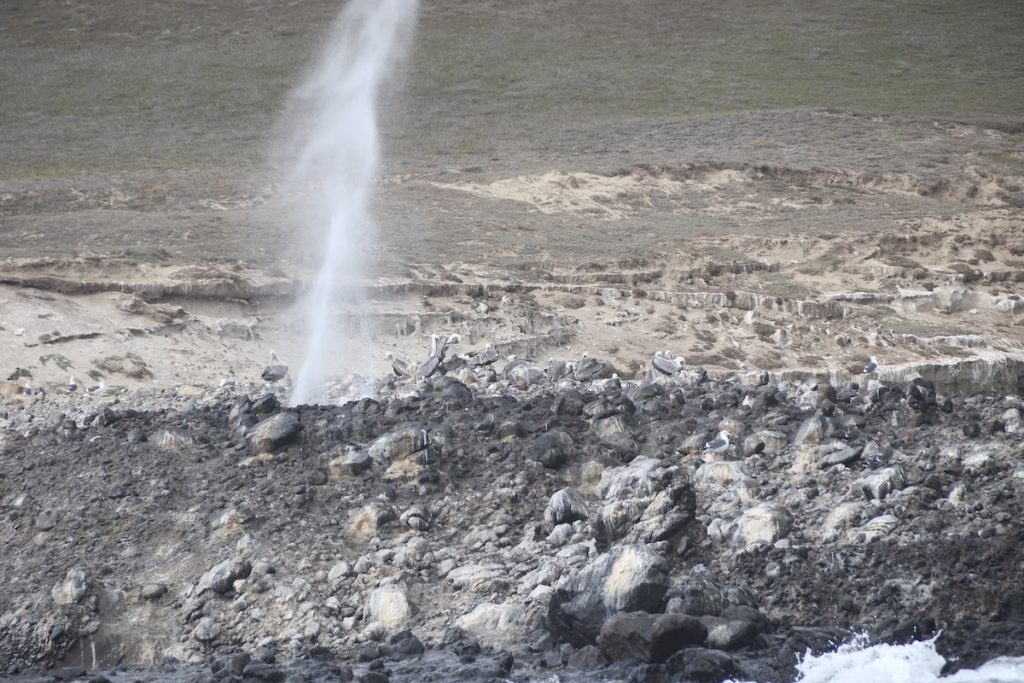
Besides throngs of seabirds, such as black oystercatchers, western gulls, and California brown pelicans perched like pelagic centurions, it was majestic bald eagles roosting on the highest cliffs and soaring in light northwest winds that had us gazing upward.
Even more so than a peregrine falcon, the keystone species of the island ecosystem demanded all the attention of the seafaring birds. As a pair of eagles flew overhead and down-island, in the distance hordes of seabirds took flight, an impressive display of seabirds flying away from the largest island off the coast, even though the bald eagles showed zero interest in the mass exodus from the shadows of the cliffs.
After touching down and stretching our legs at Cueva Valdez, we marveled at its uniquely intricate sea cave system. We exited a huge cave and kayaked east toward multiple geological wonders. Sea caves and cathedral-like archways beckoned, but our pace increased because of two offshore bottlenose dolphins. Arguably the ultimate down-island, downwind experience is paddling with marine mammals.
Offshore bottlenose dolphins are big, animated animals. They slashed through the water on either side of our kayaks. Some of it was playing, and some of their movement was hunting. They remained with us for several miles from Cueva Valdez, east to Frys Harbor.
They forced us to pick up the pace, our downwind, down-island paddling experience artistically pelagic, and induced by natural forces.
You might also be interested in...




You must be logged in to post a comment.