
Kaleidoscope
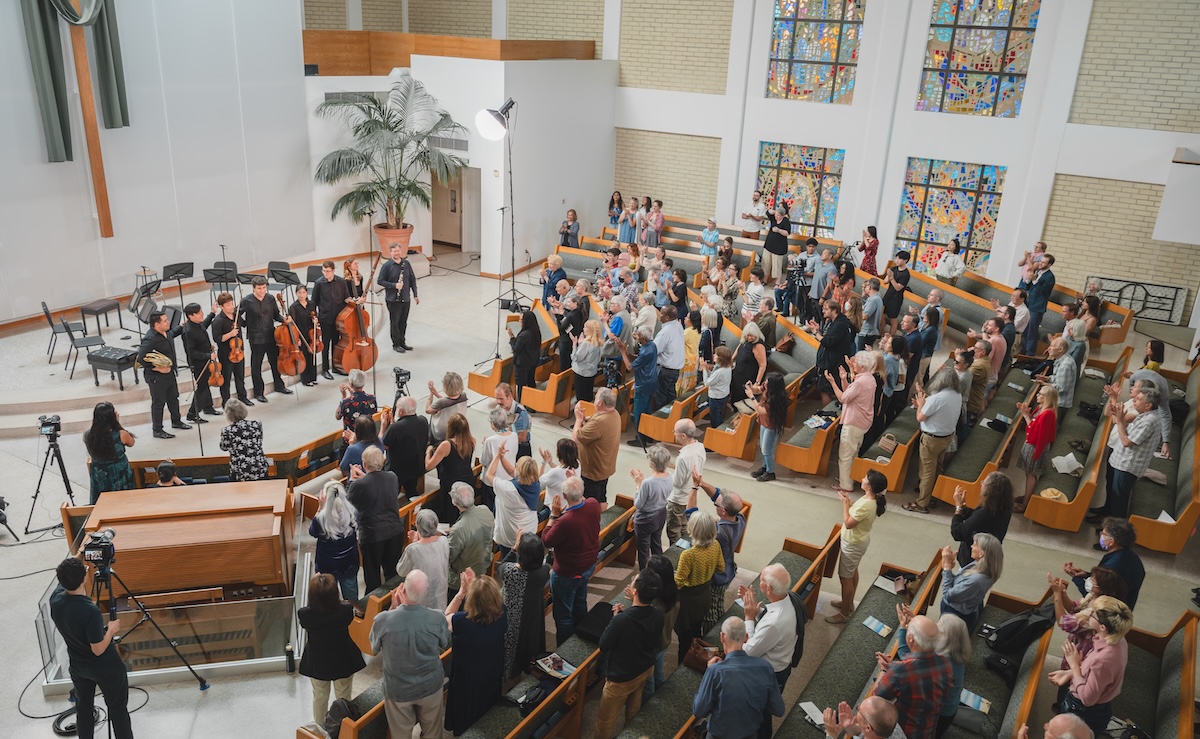
Thousands turned out in Santa Barbara and across the country for last Saturday’s No Kings rally protesting the increasingly autocratic administration in Washington. So it feels important to point out that there are no kings in the Kaleidoscope Chamber Orchestra, meaning no music director, no artistic director, not even a conductor. Everyone who is part of the ensemble more or less serves in all of those roles, as the ever-evolving and personnel-rotating Los Angeles-based collective takes collaboration to a new level.
That’s been among the chief values that first drove clarinetist Benjamin Mitchell to form the Kaleidoscope Chamber Orchestra back in 2014, along with his difficulty in landing a position in a professional symphony that would let him make a living in the area – despite his holding three graduate degrees in clarinet from prestigious institutions.
“The initial impetus was wanting to perform at a very high level and have this very collaborative democratic (repertoire) selection and rehearsal process without a conductor, like what a string quartet does, which really wasn’t being done in Southern California at the time,” Mitchell recalled. “Most of the orchestras were doing things in a pretty similar way with their programming and their process.”
So after spending a year or so freelancing – including his first professional orchestral gig after returning to L.A. from Europe in 2013 with the Santa Barbara Symphony – the clarinetist decided to become an entrepreneur.
“I shared with some musician friends my vision of creating a self-conducted orchestra where all the musicians would have equal say, be able to discuss the music and decide on the tempo and interpretation, etc. Usually in a professional orchestra, there’s one person in charge, which creates a very big power difference between the conductor, almost always a man, and everyone else. You can’t say in the middle of the cello section, ‘Maestro, I’m sorry, I don’t agree with your interpretation.’ That would be insubordination.”
While it’s less efficient, the format allows for everyone to share ideas about the music, which in turn makes them more committed to the performance.
“It brings the musicians together in a really special way, even though the rehearsal process can be a little chaotic or messy. But people have to really collaborate to make it work, so musicians will generally have to study the score a lot more, have more visual interaction, and be listening across the whole orchestra and in a way that sometimes they don’t when there’s one person in the front waving a baton.”
Soon after forming the group, Mitchell realized he wanted to expand the egalitarian concept to the orchestra’s potential audience, considering the question of who they wanted to share music with and why. Kaleidoscope quickly developed partnerships with Title 1 schools, hospitals, homeless shelters and retirement communities, where they still generally perform about 75 percent of their concerts at no cost to attendees.
The “what” question also arose regarding the repertoire, which led Mitchell and colleagues to not only put considerable focus on living composers, but also meet a value for diverse and inclusive programming – a very unusual process that periodically asks composers from around the world to submit compositions for the orchestra to consider performing.
Over the years, Kaleidoscope’s call for scores resulted in concerts that featured works by then undiscovered composer Viet Cuong, Gabriella Smith, Christopher Cerrone, and Emma O’Halloran, among many others, all of whom the ensemble later commissioned.
Kaleidoscope also began appearing regularly at Hahn Hall by 2017, performing three to four times each year, often as the last performance of each program because the ensemble also posts videos of many of its concerts recorded at the venue on its YouTube channel.
The new season at Hahn begins on October 27 with music by Kaija Saariaho, Caroline Shaw, Sam Wu, Fabien Waksman, David Baker, and Robert Schumann, all smaller scale pieces that represent the musicians’ broad taste and range.
Continuing financial challenges – especially since the pandemic – means Kaleidoscope needs to charge for performances in regular venues, but the initial core values including democracy and diversity are not only still valid, they have extra resonance in the last eight months.
“Part of what’s kept me going personally and keeping the organization going is everything that’s happening in the world now,” said Mitchell, who now enjoys a thriving freelance career in Europe and the U.S. “We’re hoping people will be inspired by our process to work together in more civil and collaborative ways themselves.”
Visit www.kco.la
You might also be interested in...



