
Sanremo & The Royal Hotel: A Riviera Dream
When travelers dream of the Italian Riviera, their minds often picture the pastel perfection of Portofino or the glittering allure of nearby Monte Carlo. Yet just beyond, along a sun-drenched stretch of coast, lies Sanremo, the storied “City of Flowers.” Nestled between the mountains and the sea, Sanremo is where the Riviera truly reveals its soul: sandy beaches kissed by the Mediterranean, palm-lined promenades that whisper of the Belle Époque, vibrant markets bursting with color, and the lingering romance of old-world Europe.
Sanremo is the gateway to the Italian Riviera, perfectly positioned for travelers weaving their way along the coast. Just 45 minutes from Nice, 90 minutes from Genoa, and a short sail to Menton or Portofino, it is both a destination in itself and a gateway to some of the Mediterranean’s most glamorous addresses. Beyond the coast, the medieval villages of the region are irresistible: Dolceacqua, famous for its Rossese red wine and Monet’s depiction of its stone bridge; Apricale, perched high on a hillside; and Bussana Vecchia, an artist’s colony reborn from ruins.
For culture lovers, Sanremo offers more than flowers and sea breezes. Each February, it becomes the center of Italy’s musical universe during the Sanremo Music Festival, a glittering spectacle that has launched legends, inspired Eurovision, and turned the town into a stage of glamour and song. While we were there, we couldn’t help but drop a hint: we would love to return for the festival someday, an invitation we would accept in a heartbeat. Until then, music still lingers year-round in Sanremo. The Sanremo Symphony Orchestra, founded in 1905, remains one of Italy’s most respected ensembles, performing seasonal concerts and, in summer, often bringing its symphonic magic to the Royal Hotel’s own gardens.
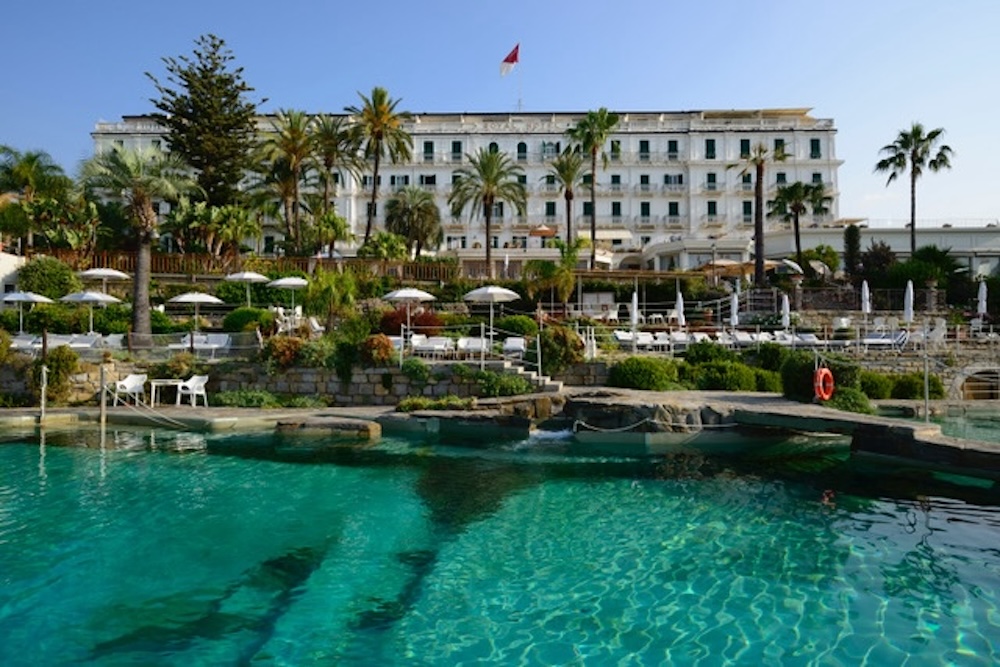
At the heart of this cultural and natural beauty stands the Royal Hotel Sanremo, a member of Leading Hotels of the World, the Grande Dame of Riviera hospitality. Inaugurated in 1872, it quickly became the choice of Europe’s aristocracy, drawn by Sanremo’s climate and its position along the Riviera. Empress Elisabeth of Austria, King Farouk of Egypt, Gustav V of Sweden, Grace Kelly, and Prince Rainier of Monaco, all found refuge here. Artists such as Maria Callas, Luciano Pavarotti, and Sting later added their names to the guestbook, cementing the hotel’s reputation as a cultural stage as much as a
place of rest.
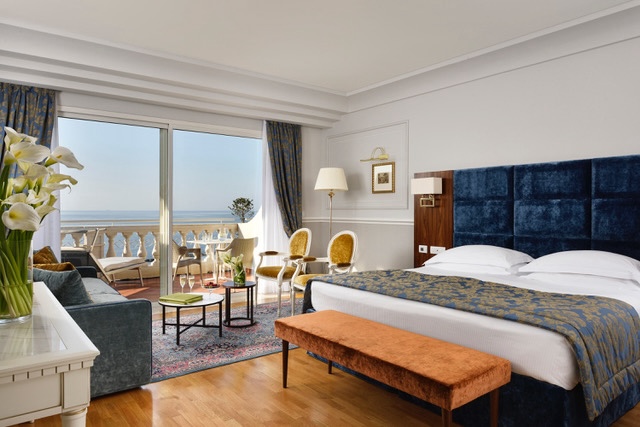
It was finally our turn. When my husband and I opened the doors to our Penthouse Suite, we stepped onto the wraparound balcony and were instantly struck speechless. Before us stretched the endless Ligurian Sea, sunlight dancing across the waves as sailboats, sleek speedboats, and elegant yachts drifted past. We lingered there for hours, local Italian bubbly in hand, watching the horizon melt into gold. It was the kind of view that quiets every thought, that makes you feel both small and infinite at once.
The suite itself was a sanctuary: two marble bathrooms gleaming with elegance, a serene bedroom bathed in light, and a grand sitting room perfect for unwinding after sunlit days. Still, it was the balcony, with its promise of sunsets, that remained our most cherished place.
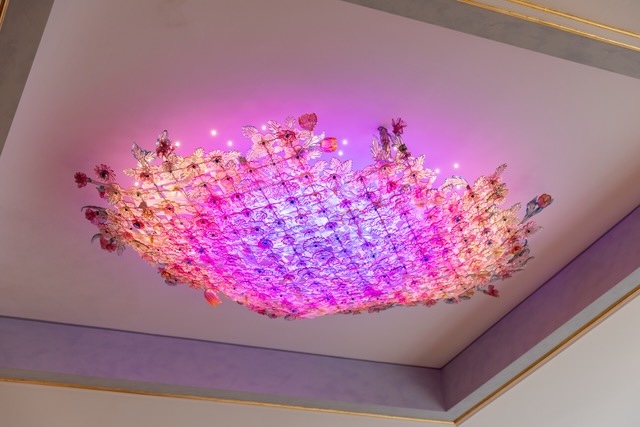
Evenings at the Royal Hotel are as memorable as the days. Dining beneath the Murano glass chandeliers of the Fiori di Murano restaurant was an experience that will stay with me forever. The chandeliers, designed as flowers in delicate glass, cascade across the ceiling in a dazzling display. It felt as though we were seated in a secret garden of light, each bloom glowing softly above the tables, the artistry as much a feast as the cuisine itself. Surrounded by this shimmering canopy, every bite became more than dinner; it was theatre, history, and Italian beauty combined.
By day, the hotel’s iconic saltwater pool, commissioned in 1948 by architect Giò Ponti, became our playground. Suspended between lush subtropical gardens and the open sea, it is more than a pool. It felt like a lagoonal oasis, a softly curved aquatic stage where Riviera life unfolds. Legend has it that Ponti detested rigid, rectangular pools – he believed water should flow like nature, not be boxed in. I couldn’t agree more, there is something luxurious and inviting about a pool that flows with curves, a design that feels alive and organic. We swam and floated under the Mediterranean sun, laughing like children. Lavender, rosemary, and palms perfumed the air, a landscape that reminded us of home on our own American Riviera in Santa Barbara.
Sanremo deserves to be a cornerstone of any Riviera journey, for its flowers, its medieval streets, its wines, and its music. But the Royal Hotel elevates that experience into something rare: the feeling of belonging to history, of stepping into a world where elegance still matters, and where beauty lingers long after you leave.
Our time here was a dream. And as we sat on our balcony, one last night, glasses raised to the sunset, we understood why this hotel has enchanted royalty, artists, and travelers for generations. The Riviera may be dotted with glamorous addresses, but the Royal Hotel Sanremo remains its true crown jewel.
You might also be interested in...



You must be logged in to post a comment.