
Camerata’s Season of Sonatas
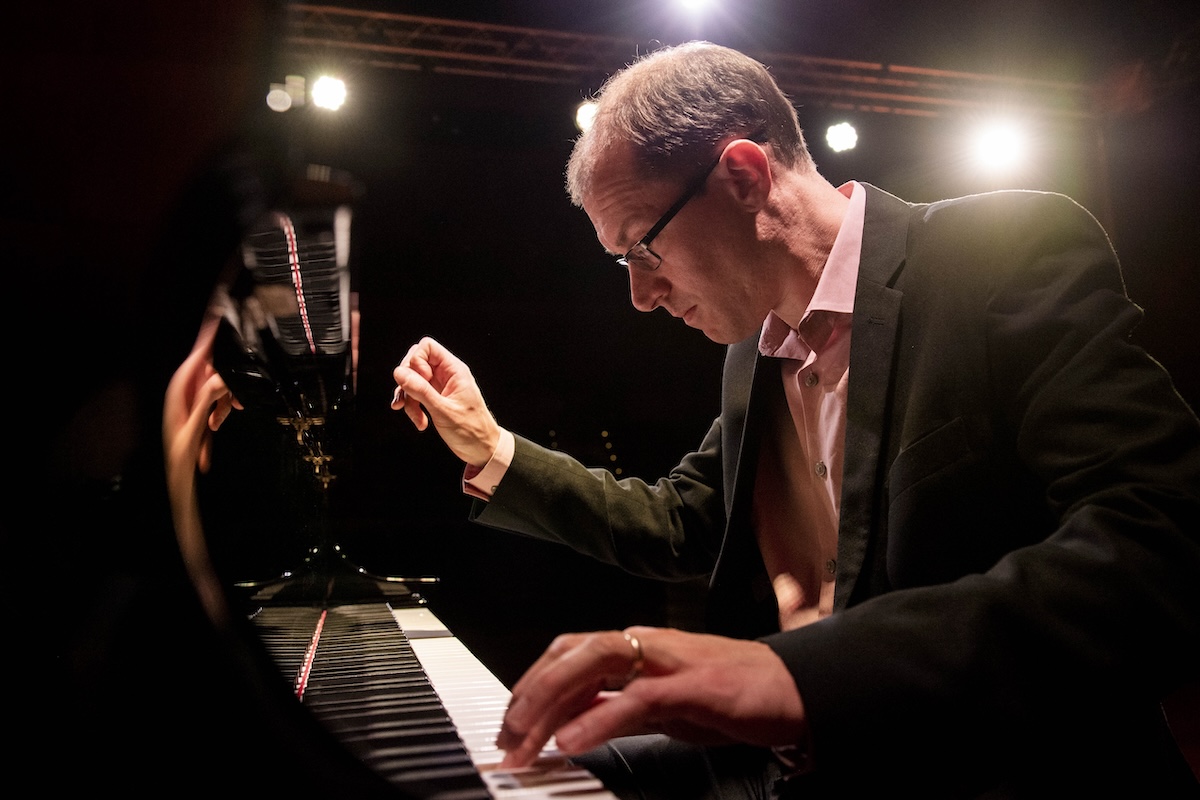
Camerata Pacifica, the Santa Barbara-based chamber music collective, has an international reputation for both exceptional artistry and laudable century-spanning repertoire. Camerata Pacifica continues to grow apace and now launches its 36th season with eight programs performed at four different venues across Southern California. It’s a fascinating season as it includes the launch of “Beethoven 32,” a monumental three-year project that features Principal Piano Gilles Vonsattel performing all 32 of Beethoven’s Piano Sonatas in a combination of solo recitals and integrative chamber programs.
There’s also a world premiere of another Camerata-commissioned piece, plus five musicians making their ensemble debut and a half-dozen returning guest artists joining the existing seven stellar musicians.
The Santa Barbara segment of the 2025-26 season gets underway this Friday, September 26, at Camerata’s longtime home of Hahn Hall at Music Academy of the West. We caught up with Adrian Spence, the ambitious, still young at heart, astonishingly forward-thinking founding artistic director. Here are his insights.
Q. There are quite a few guest musicians on the schedule for this season. How do you make decisions about who to bring in? Is it directly related to programming, or the other way around?
A. There’s been a large turnover of musicians twice in our history. Back in 2000 when we moved to bringing musicians in from all over around the world. And then COVID had a big impact on us. We lost eight musicians for one reason or another. So I’m auditioning players as guest artists and gradually rebuilding the roster. But it’s been great, because the musicians are pretty amazing, with great ranges of expression.
This is the first season of the ambitious three-year “Beethoven 32” project with Principal Piano Gilles Vonsattel performing all 32 of Beethoven’s Piano Sonatas in a combination of solo recitals and as part of chamber programs. I want to ask you about the opening concert, which is all strings. How do these works fit together?
It relates to the previous question in that I want to add a second cellist to Ani Aznavoorian, our principal cellist for 20 years. Santiago Cañón-Valencia was a guest last year, and now the idea was to program him with Ani. So the program is built around Brahms’ “String Sextet in G Major,” and we’re opening with Anton Arensky’s “String Quartet in A Minor,” which is scored for violin, viola and two cellos. It starts with a musical quote from the Russian Orthodox liturgy, a beautiful chant, which sets a tone for the concert. But what defines the program is the “Castillo Interior” for violin and cello by Pēteris Vasks. It has episodes of frenetic activity but it’s mostly a quiet little 12-minute piece that beautifully melds to the Brahms – to where I think emotionally as an audience member, you’re going to receive the Brahms in quite a different manner than you would in another concert program. It’s a program for the time that we’re in, one that will allow us to reflect on the beauty, the positivity, and the love that we all have in our lives, despite what is happening outside of the concert hall.
Are Camerata concerts generally meant to be their own journey over a single program? Or is it also about tying everything together over the course of a season?
I program the whole season, so strictly speaking, if we put all the concerts end to end, there would be a connective sense, a rewarding journey as a whole.
This season has a major thread of the Beethoven sonatas. How has that informed the programming all year long?
I have to react to the preponderance of Beethoven by creating balance. But it’s not that complicated because Beethoven was an iconoclast, an innovator. The idea that we’d only listen to 19th century Viennese repertoire would’ve had him wondering if something was wrong with you. So while I bounce off that and certainly look at other repertoire of his period, I also go in the other direction. We open our Beethoven series (in October) with the “Hammerklavier,” his most complex piano sonata statement, which we play with Chopin and a Mozart wind serenade. Then at the end of the season in May, when Gilles plays one of Beethoven’s earliest sonatas, we’re programming it with a piece for three percussionists by Thierry de Mey, Kenji Bunch’s “Transcontinental for Violin and Percussion Quartet” which was commissioned by our violinist Paul Huang, and an arrangement of a Shostakovich symphony for percussion and piano trio. That’s ideal company for Beethoven.
Individually, some of the pieces might seem a bit crazy. But in terms of the broad brush strokes, it should be cohesive, like a painting that you can see develop through the season.
These 19th century classics have become so iconic, almost covered with varnish, such that listener familiarity may have dulled the impact the pieces had when they were new. Hopefully because of how we present these programs, we help renovate those pieces.
Music Academy did something similar last summer where Jeremy Denk played several piano sonatas paired with a wide-range other works over the course of three evenings. Devil’s advocate style: Why would someone want to hear Camerata’s similarly conceived effort in the very same hall?
People get defensive or territorial if they don’t have confidence in their own product, which I do. Indeed, I see great value in having heard Jeremy’s interpretation and comparing to Gilles. There could be something said for doing the same program four nights in a row with four different piano players… Gilles has complete intellectual command of the repertoire that he engages with. He knows where a piece stands in relation to the collective output over centuries, and I can hear that in his music. And of course, he’s a flawless musician.
If I forced you to pick a single concert from the season for non-subscribers or other newcomers to attend, what would you say best exhibits Camerata Pacifica?
My advice: If you want to sample Camerata, just go to the next concert. You are going to have such a good time that you’re going to want to come to more after that.
You might also be interested in...



