
Truth and ‘Lies’ in Theater
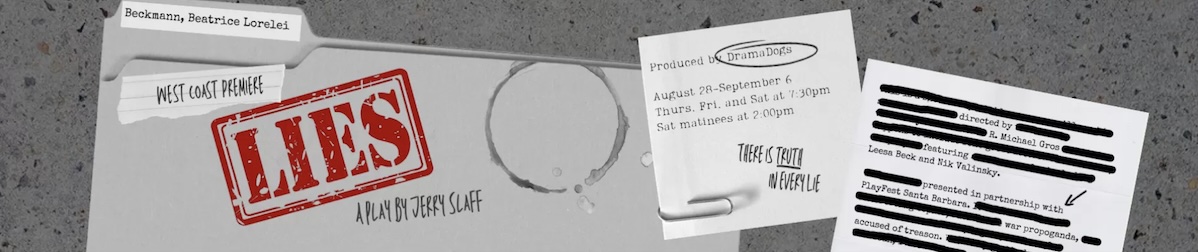
There are only two characters, but that’s enough to explore major subjects in Jerry Slaff’s Lies, his play that has its official West Coast premiere August 28 to September 6 at Center Stage Theatre. Lorelei is based on Mildred Gillars, an American who took to the airwaves in Germany during World War II, spewing Nazi propaganda to English-speaking troops and later convicted of treason. Benjamin is the young and ambitious Brooklyn Jewish lawyer appointed by the court to represent her at a parole hearing.
The conflict comes from the fact that Lorelei doesn’t want to leave prison, while Benjamin desperately wants to score a lawyerly win against all odds. The play consists of three conversations between them in prison.
“She doesn’t want parole because she realizes she’s done horrible things and deserves to serve her sentence,” explained Slaff. “His determination is that, because he is very inexperienced and green, he wants to get her out to prove himself and make his name.”
The two characters grapple with the predicament and butt heads, Slaff said.
“They’re very wary of each other. He tries to put on a big important face, and she’s reluctant to talk about what happened to make her do what she did,” he said. “The question becomes, because he’s puffing himself up, who’s the biggest liar? They spend their time lying to each other, and it’s up to the audience to figure out the truth. It’s almost like a boxing match, and you see the relationship change.”
The complexity of Lorelei and her relationship to her lawyer is what drew Leesa Beck to reprise the role she first performed in a reading when Lies won the Santa Barbara PlayFest Honoree Award in 2022 (then as now opposite Nik Valinsky’s Benjamin, with PlayFest founder R. Michael Gros also directing the Center Stage premiere).
“She’s a pretty despicable character at first, but you begin to see her humanity,” Beck said. “It’s a fascinating dynamic that plays out over the course of the show. How these characters come to understand each other draws you in from the start.”
As suggested by its title, the play serves as an allegory about lying – in government, in law, and in our personal lives – that becomes an investigation into the nature of truth.
“Lying gives you power, and the power of lying is so invigorating that you can’t stop,” Slaff said. “People do it just as easily as breathing.”
Beck said that the play shows how lying builds upon itself.
“Little lies, including the ones that we tell ourselves, can snowball into bigger situations that we don’t expect or even understand,” she said.
The play has taken on a certain resonance over the last eight months as political upheaval has thrown the country for a loop. Beck said she sees Lies, which was supposed to premiere last fall, as a cautionary tale for how situations like Nazi Germany happen.
“I think it’s more poignant now,” she said. “It’s much more meaningful in this environment.”
You might also be interested in...



