
You’re Gonna Need a Bigger Band
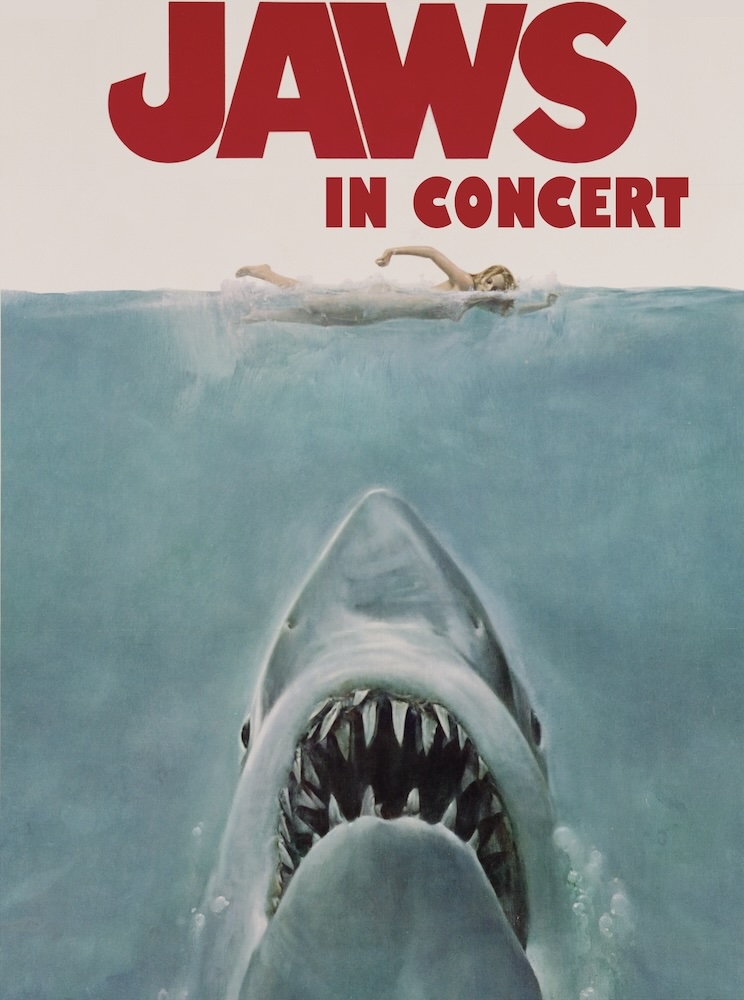
Great White sharks are known to patrol the waters off Santa Barbara and even the coastline on a regular basis – an occasionally toothy swim zone barely a few hundred yards away from the Music Academy’s Miraflores campus. Tonight’s opening concert –by the fellows-powered Academy Festival Orchestra (AFO) – takes place Saturday night at the Granada, a little further away from the shoreline. Thankfully so, as the concert, which represents MAW’s first live-to-film performance in its history, features a screening of Jaws; Steven Spielberg’s career-launching and terror-inducing 1975 movie. In the film, a great white shark terrorizes swimmers and boaters on a fictional New England vacay destination called Amity Island.
Also new to MAW is the evening’s conductor, Ben Palmer – Artistic Director of Covent Garden Sinfonia, and Chief Conductor of the Orchestra da Camera di Pordenone and Babylon Orchester Berli. Palmer is one of the world’s most sought-after specialists in conducting live-to-picture with nearly a dozen years’ experience. Palmer accompanied his wife, then-London Philharmonic Orchestra guest cellist Morwenna Del Mar when the LSO performed three concerts for MAW in 2019. Here he shares his process and his plans for the AFO via Zoom from his London office.
Q. Let’s start with why you have specialized in conducting live to film concerts?
A. Doing the timing is quite hard, but I love the challenge. It takes a lot of preparation, a lot of homework, and I do hours of study going through the score, even with films I’ve conducted many times before. There are not many conductors who can do it with really great accuracy whilst also enjoying themselves. Most don’t care about it the way I do. It requires a certain kind of temperament, because even as I’m throwing myself around conducting, I’m actually ice-cold inside. I don’t allow myself to have any adrenaline, any excitement because you have to keep the orchestra perfectly synchronized with the screen. Once play is pressed to start the movie, it just keeps running no matter what happens.
To me it’s like a historical performance, which I love, because unlike with Beethoven or Brahms, we know exactly what the composer wanted and how it was performed originally. We know the number of players, how the orchestra sits, how they were arranged, because we actually have firsthand evidence. For me, all the things that make me tick as a musician are still engaged when I’m conducting a film. There’s real excitement in Jaws to have the orchestra hit the musical (cue) at the moment (local fisherman) Ben Gardner’s severed head suddenly appears.
I will make the Academy Orchestra play exactly how the orchestra on the soundtrack played.
To be the devil’s advocate, what’s the point? Why have a live orchestra if they’re simply trying to recreate the soundtrack?
Everything that you see on the stage is dangerous because it’s live, it’s fragile, it’s beautiful. It can even be spontaneous to a degree… I’m not just kind of hacking through to make sure things are in the right place. I’m actually trying to create a symphonic experience for the musicians and the audience. There are places in Jaws where you can let the soundtrack serve as a guide, and within that have a tiny bit of freedom. Some of the slower music is quite free. There is a lot of possibility for expression because John [Williams’] score is so orchestral.
Also, there’s often a battle in film between the spoken dialogue and the orchestral track, which was even more true in 1975 with a movie made on the sea. Jaws is problematic because a lot of the dialogue was mumbled and you don’t really catch it very well. So one of the things that I do conducting it live to picture is to have the orchestra drop down to make way for the dialogue and effects track then suddenly pop back up again in a few spots. You can actually make art – albeit in a really controlled way. It’s a nerdy thing to do, but I love it.
It’s also incredible to hear the audience reaction in a way they wouldn’t for a typical symphony concert.
An orchestra playing live to film is not new for Santa Barbara audiences as our symphony has been doing it for years, and a fair percentage of the musicians are from L.A. and actually work in studios on TV and film scores. But it will be new to a great number of the Music Academy fellows. What’s the trick to making that work in less than a week, especially since it’s also the first orchestral performance of the festival?
Most of us who are involved in the film with orchestra industry want to protect it, which is why not everybody’s allowed to conduct the films. We try to make sure they’re good orchestras playing these films. There are very stringent technical requirements so that it’s great wherever you go and watch Jaws all over the world. It’s rare to work with – essentially – not-quite-yet professional musicians for this. But I did it earlier this year in London and it was absolutely extraordinary. It only took about 25 minutes of the first rehearsal for me to stop making any kind of allowances for the fact that they weren’t professionals, which is what I’m expecting there and why I’m so excited about it.
I tell the musicians that they should interpret my gestures very literally, and I will make it perfectly clear to them when I’m just really happy with things and they can carry on as they are, and the moments that I want it to just settle down or the moments that I need stuff to move on. It’s just tiny, miniscule, incremental adjustments so that, say, in 28 seconds, we hit something exactly on time for the screen. They have to balance listening to each other and playing well as an orchestra; but also in every single moment being open to the idea that I might need to put a little bit of gas or a brake.
At MAW there’s definitely also an educational alignment, in that we’ll use a click track for some of the cues – which I normally never do for any John Williams films – so that they have the experience. The whole experience is incredibly important because any orchestra that they might get hired by will be doing live to film concerts. But it’s really fun and the music is incredible. With Williams, the composing is absolutely of the highest order. There are quite contemporary modern sounding sections, a pastiche baroque piece with trilling trumpets, and at one point it’s a Bach-like fugue, with a brilliant counterpoint that just happens to be perfectly synchronized to a movie. When we hit that point, my head kind of explodes – I can’t even really process how it’s possible. There are so many disparate musical styles, yet somehow they all actually work together.
I know you said you have ice water in your veins, but are you really not affected when the shark suddenly appears, taking up the whole screen?
Honestly, I get more affected by the music, by the intensity of a 90-piece orchestra really going for it. That’s emotive to me. It’s how my brain and heart are wired.
Jaws in Concert will be on Saturday, June 21, at the Granada
Friday, June 20: The annual Solo Piano Competition has a new twist this year, one that hearkens back to the bygone all-instruments Concerto Competition. In that original setting, the winner received not only a cash award and accolades, but also got to perform the full piece with the Academy Festival Orchestra later in the season. Today, five Solo Piano fellows will all be playing Beethoven’s “Concerto No. 3,” and the winner will later star in the Santa Barbara Symphony’s weekend concerts in January, when the ensemble will perform all five of the composer’s piano concertos, each with winners of competitions as soloists (11 am-5 pm; Hahn Hall; $55-$60)…
MAW’s Lobero Nights series gets going with the annual recital by the Takács Quartet, who celebrate their 50th anniversary (same age as Jaws!) with a program that features Haydn’s “String Quartet No. 59 in G Minor (‘Rider’),” Janáček’s “String Quartet No. 1 (‘Kreutzer Sonata’),” and Beethoven’s “9th Quartet in C Major, Op. 59, No. 3.” (7:30 pm; Lobero; $45-$70)
Tuesday, June 24: MAW’s String Quartet Showcase features the two fellows quartets finishing up the two-week seminar. One will perform selections from “String Quartet No. 2 in A Minor, Op. 51, No. 2,” by Brahms and Gabriela Lena Frank’s “Leyendas: An Andean Walkabout,” with the other taking on Beethoven’s “String Quartet No. 16 in F Major, Op. 135.” (7:30 pm; Hahn Hall; $45)
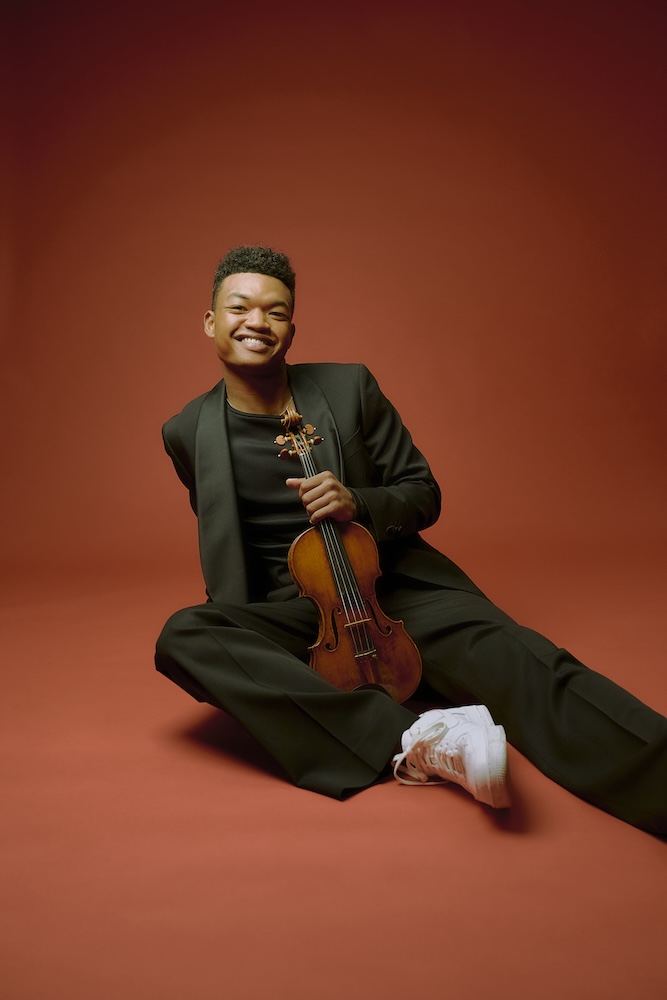
Wednesday, June 25: Three of today’s master classes are led by MAW veteran faculty, but it’s also the public debut of a new teaching artist – the first of 14 this summer – in Thomas Hooten, who (just incidentally) recorded John Williams’ Concerto for Trumpet and Orchestra, conducted by the composer back in 2019 (3:30 pm; Weinman Hall; $10)… Tonight, Mosher Guest Artist Randall Goosby, the violinist who received a 2022 Avery Fisher Career Grant, plays a generous program of violin sonatas and chamber music that features two MAW alums. Pianist Zhu Wang features on Joseph Bologne, Chevalier de Saint-Georges’ “Violin Sonata No. 3 in G Minor” and Ravel’s “Violin Sonata,” then the pair add Goosby’s brother, cellist Miles Tatsuo Goosby, for Mendelssohn’s “Piano Trio No. 1 in D Minor, Op. 49, Mvts 1 & 2.” The trio is joined by five current fellows for Beethoven’s “Septet in E-flat Major, Op. 20, Mvt 1,” thereby creating musical connections that bridge family bonds, artistic lineage and Music Academy history in a single concert. (7:30 pm; Hahn Hall; $65)
You might also be interested in...




You must be logged in to post a comment.