
Taking Theater to Court
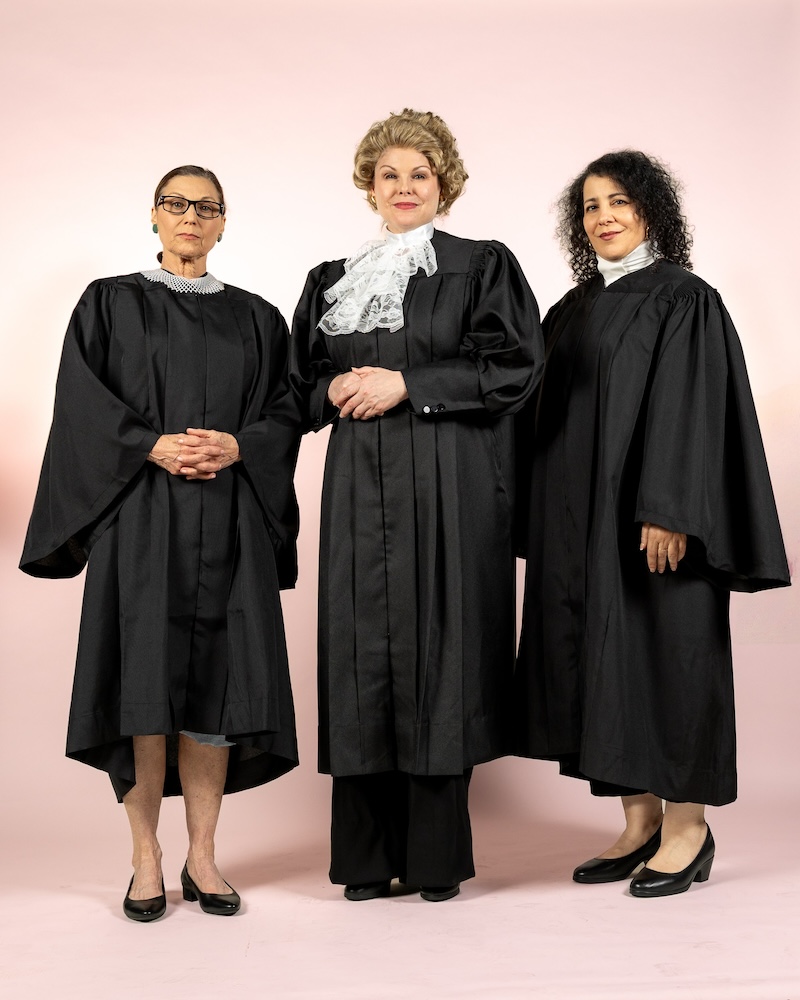
What theatrical subject could be more suited to serious investigation than the first three female justices of the U.S. Supreme Court; the ladies who broke through a more than 200 year-old glass ceiling to reach the highest court in the land? Not to mention that Sandra Day O’Connor, the groundbreaker, and Ruth Bader Ginsburg and Sonia Sotomayor – the latter the first Latina Justice on the Supreme Court – are pretty much political polar opposites.
But a musical?
“I know, I understand,” said director Jenny Sullivan, the longtime Santa Barbara resident who has helmed myriad productions at Ensemble Theatre Company – as well as at Ventura’s Rubicon, multiple L.A. and SoCal theaters, and at venues all around the country. “I just love telling people I’m doing Justice, this play about the first three women on the court. Then I’ll take a beat and say… and it’s a musical.”
It’s not as crazy as it seems.
First, there’s the book by Lauren Gunderson – one of America’s most produced playwrights over the past several years – which follows the three women’s extraordinary journeys from law school to the highest court in the land. The story delves into the personal and professional obstacles they overcame in a male-dominated legal world, taking stock of their accomplishments, challenges, and relationships with a stirring mix of levity and drama.
“It’s a vast play in that it covers a huge swath of time,” Sullivan said.
But much of the story and emotional depth are experienced through Bree Lowdermilk’s music and Kait Kerrigan’s lyrics, Sullivan said, these songs given added presence by the addition of Santa Barbara musician Sio Tepper performing on stage alongside the actors.
“These four women on the stage, that alone is pretty powerful,” she said. “But the music is really the text of the play. I keep finding myself laughing or crying because I’m so excited about what they’re saying or doing, and that’s all revealed in the music.”
The songs lean heavily on modern Broadway tropes and power ballads, similar to the Wicked soundtrack,” Sullivan said.
“There are some really tough songs, with very difficult harmonies that these three do together very powerfully. But then they all have these solo numbers that are very eclectic. They reveal the inner self of these characters. For the Sandra Day O’Connor character, her solo songs have a guitar because she’s a ranch girl from Texas and Arizona, while Ginsburg’s songs are almost musical theater.”
Sotomayor at first serves as the narrator of the play, taking the audience through the story and the relationship – including conflicts – between O’Connor and Ginsburg before Sotomayor herself gets nominated for the court by President Obama. Sotomayor’s difficult confirmation hearing and approach to the Court is the subject of “Blaze,” her show-stopping solo number.
“It’s her inner monologue about how to step up to represent the Latina population of the U.S., and it’s a wickedly good song,” Sullivan said.
Bush v. Gore, the controversial decision that handed the presidency to George Bush in 2000, is actually the title of another catchy song in the show. But the melody doesn’t undercut the import of the ruling and how it has played out in the intervening years. Indeed, while they’re not characters in Justice, more recent Supreme Court justices, including Elena Kagen, Ketanji Brown Jackson, and even Amy Coney Barrett are name-checked in moments that look at where the court has gone in recent years, and how the progress of that earlier era has been largely dismantled.
“If there were the right materials in the lobby, people would make signs and walk out into the street after the show,” Sullivan said.
But Justice – which is having its Southern California premiere and only second production since it was reworked in 2023 – is also ultimately uplifting, she said.
“It’s a rabble rouser. But it’s not political. It’s really about us and our democracy and taking responsibility for it … We present something that says what we have as a democracy is really worth paying attention to and saving. The fact that the story really goes to that place of ‘our lives have changed – but we still have to get along the way the justices do’ – kind of forces you to be engaged.”
Sullivan said she recently came across a phrase she heard years ago and wrote down at the time, and it applies to Justice.
“Artists are the gatekeepers of the truth. I really believe that’s true. As artists, that’s what we have to do… We should be selling merch in the lobby, buttons that say ‘Equal justice under the law.’ That is what’s inscribed on the Supreme Court building, which is part of our set. One little play isn’t going to make much difference, but we all do what we can.”
You might also be interested in...




You must be logged in to post a comment.