
Little Miracle
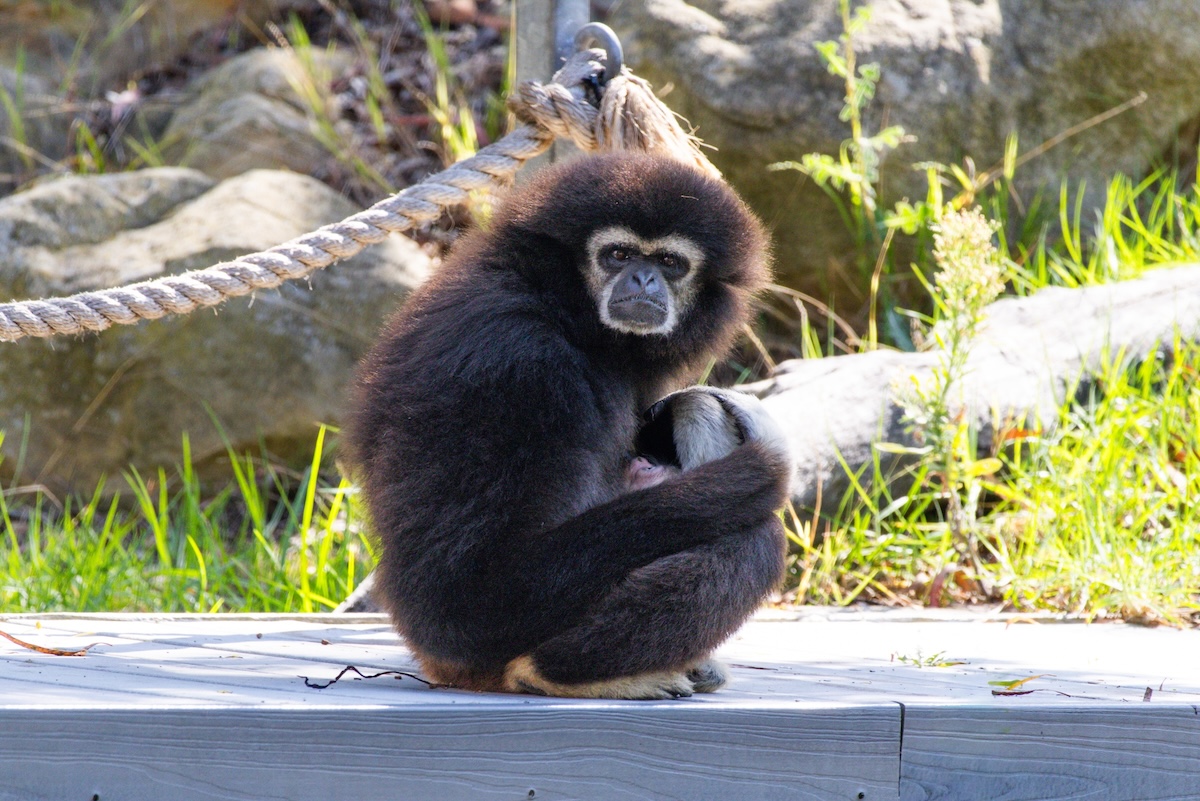
“There are only two ways to live your life: one is as though nothing is a miracle, the other is as though everything is a miracle,” goes the line attributed to Albert Einstein.
At the Santa Barbara Zoo, one tiny gibbon baby is making a convincing case for the latter.
The pairing of white-handed gibbons Chanee and Mel was science. What happened next felt a little like a miracle.
The two were brought together in 2025 at the zoo through the Gibbon Species Survival Plan, which coordinates pairings to support healthy populations. But compatibility on paper is only the beginning.
Their introduction was slow.
“They hear each other first,” explained Liz Cunningham, zoological manager at the Santa Barbara Zoo. Then came smells, sight, and finally contact through mesh.
“Good vocalizations,” Liz recalled. “They were curious, very curious.”
And when the door finally opened?
“They were right with each other. They actually started breeding right away.”
The chemistry and attraction lasted.
“These two get along really, really well,” Liz said. “There’s a lot of social grooming between the both of them. She grooms him, he grooms her. Not all gibbon pairs are so reciprocal.”
Keepers watched them relax together, napping on their favorite bridge and even “playing footsies.”
Then Chanee began eating more and developing a rounder belly. Keepers suspected pregnancy, but hormone testing had not officially confirmed it. Mel, nearly 26, had never been a father.
“We created a very detailed birth plan,” Liz said. Anticipation grew.
But Chanee had other plans.
“All of a sudden, it happened quickly, and everything went smoothly,” Liz recalled. “We said, ‘Okay, I guess we’ve skipped a few important pages in the birth plan and we’re on page four now!’” she laughed.
Visitors were there to witness it, late on the afternoon of Saturday, August 29.
Karina was visiting with her children when they noticed something strange.
“She was just rolling around on the bridge,” Karina recalled. “They see the gibbon all the time, so they noticed something was off.”
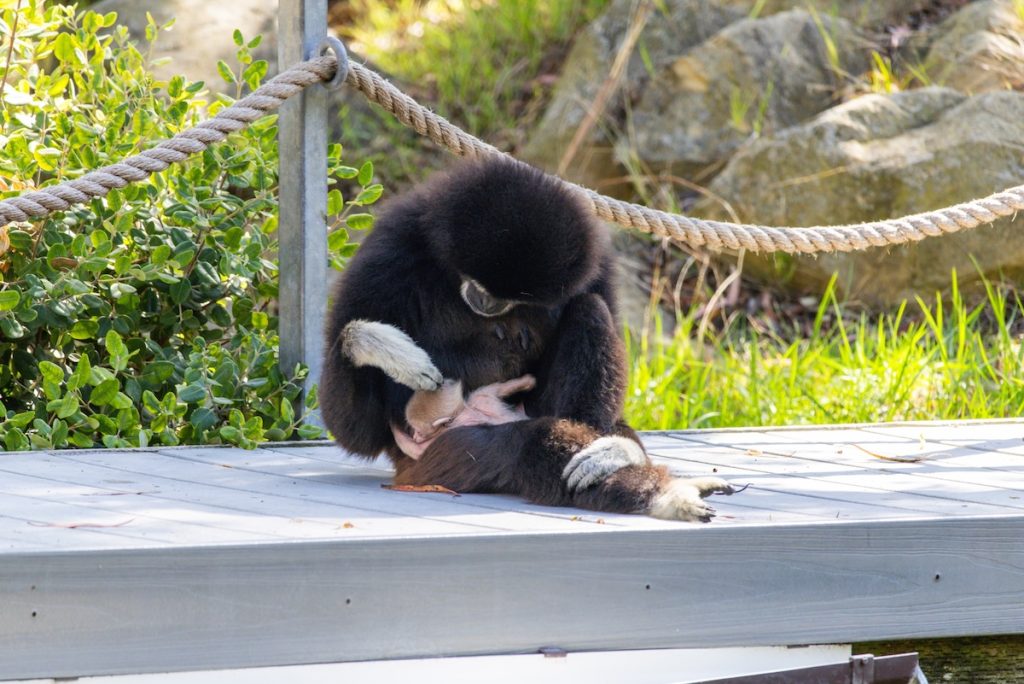
Her children refused to leave for the leopard exhibit.
“Mom, you gotta come see this. The gibbon is doing some really weird stuff.”
Then came the discovery.
“Mommy, there’s a baby! That’s an umbilical cord!”
Karina looked closer.
“I still couldn’t believe that there was an umbilical cord,” she said. “I still couldn’t believe the kids.”
The baby was wet, tiny and floppy, its blonde fur standing out against Chanee’s dark coat.
“It was definitely the most magical experience,” Karina said. “It was so sweet, and the kids were so excited. We were crying, hugging strangers, everyone around was crying, it was incredible.”
The kids ran to alert the keepers.
“They had no idea,” Karina said. “Every single zookeeper came over, and they’re like, ‘Oh my gosh!’” The keepers and veterinarian had been heading over to check on Chanee for the evening.
Even Mel seemed to know something extraordinary had happened.
“He swung over so happily,” Karina said. “I’ve never seen him so excited.”
“He became very protective.”
The zoo had gone more than 20 years without a gibbon birth.
For now, the baby is nursing and clinging tightly to Chanee while Mel stays close.
“We want the mom and the baby to bond naturally, without unnecessary intervention from us, unless we absolutely have to, and they are doing absolutely great,” Liz said. “She’s a great mom.”
Science made the introduction. Chanee and Mel supplied the chemistry. Nature chose the surprise timing.
And after more than two decades, the Santa Barbara Zoo got its little miracle.
You might also be interested in...




You must be logged in to post a comment.