
LCO Spearheads Open-Source Software for Astro Data

The Las Cumbres Observatory (LCO) announced a successful test of its highly specialized global “end-to-end” data alert system AEON+/TOM software. This software system matches incoming requests for specified astronomical data from astrophysics and scientists worldwide, with real time data supplied from a leading global network of observatories.
The AEON+/TOM system is the brainchild of LCO Senior Scientist Dr. Rachel Street and her team who tested it in collaboration with scientists at the NOIRLab.
Dr.Street is a science collaboration mentor on the Vera C. Rubin Observatory’s Legacy Survey of Space and Time (LSST) in Chile. Street joined the Las Cumbres Observatory in 2007. The alert system built for the Rubin Observatory is a national-level effort, of which Las Cumbres Observatory’s software is a key component.
LCO with NOIRLab conducted a proper field readiness test of the new software system in March 2026. That test concluded at the end of May and yielded the following results:
1. Rapid Response: Upon receiving an observation request from the NOIRLab TOM, LCO’s network was the first on sky, returning data within 30 minutes.
2. Scientific Validation: Multiple new objects were discovered with data acquired from the test, including a Type II Supernova.
3. Seamless Integration: Every software component functioned perfectly.
The Background Science
Dr. Street and the LCO are featured in the Montecito Journal twice or more annually for astro-science updates. Once operational, Rubin’s LSST project will produce about 20 terabytes of data per 24-hour period. The data includes high resolution still images and video mapping of our galaxy and beyond. Street explains, “We [the Rubin Science Community] had to build a survey [LSST] that serves all areas of astrophysics, ensuring that it delivers discoveries of everything from microlensing to supernovae.”
Working with Dr. Mark Bowman and LCO’s software team, Street developed an open-source software called the “Target and Observational Management Toolkit” aka TOM. [We hear you singing Bowie’s “Major Tom.”] The TOM is a software system for scientists to interface with and augment their data, along with submitting requests for space observations directly. Often, scientists need data from a variety of telescope centers around the world. Instead of reaching out to each observatory, Street’s team sought to provide a one stop shop to match scientists’ requests for data with an entire network of observatories, including the large-scale data from the LSST.
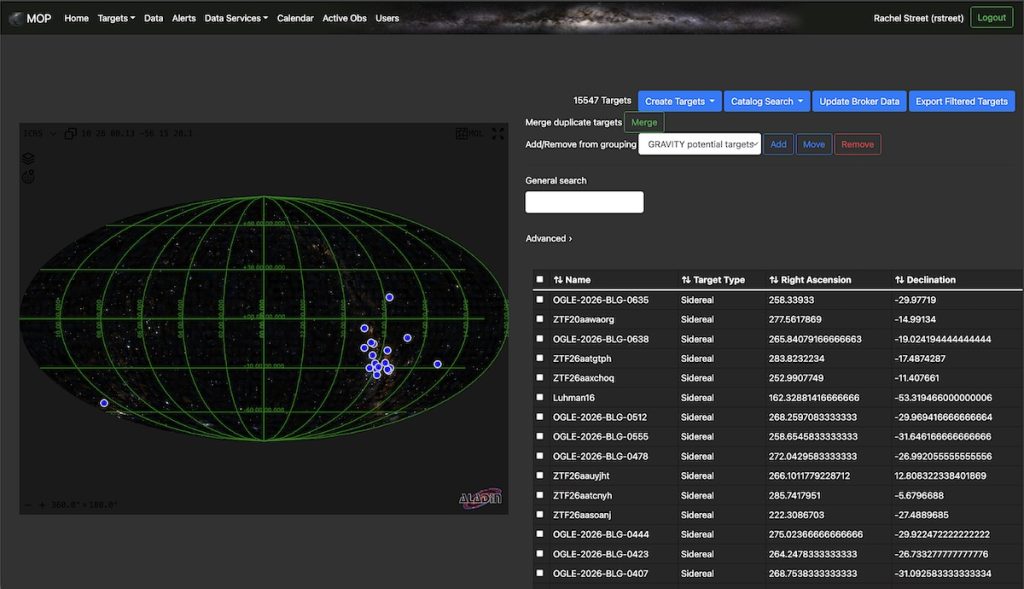
Paired with TOM is Dr. Street’s AEON+, which is “a collaboration of world-class telescope facilities with the goal of enabling real time domain and multi-messenger astrophysics. Astronomers will be able to request observations from any participating facility using standardized, programmable interfaces, which will be supported by the TOM Toolkit.”
Currently, the AEON+ centers are LCOGT, SOAR, Gemini, NOIRLab, CFHT, Liverpool Telescope, NRAO, Keck, and the SkyNet Telescope Network; with new partner facilities encouraged to collaborate. Data capture options range from using multiple observatories; to observing data instantly for astronomy alerts; to monitoring an object over a long period; for intensive observations for specific periods of time for catalogs of objects; and of course, keeping the data streamlined and the costs down.
Dr. Lisa Storrie-Lombardi, Las Cumbres Observatory director, added,“The Rubin Observatory LSST 10-year survey of the night sky is very close to starting. Las Cumbres Observatory was built to be a follow-up facility for LSST – observing new transient object discoveries – and we are really excited and ready to go as soon as the survey starts.”
I reached out via email to Dr. Street who is currently working in her UK office. I asked her what she is most looking forward to from the LSST project and she explained, “Rubin will explore regions of our Universe that no other survey has been able to see before. I’m especially looking forward to what it finds in the center of our own Galaxy. Rubin will be able to map its complex structure and find hard-to-detect populations like isolated black holes. But the most exciting discoveries will be those that are entirely new… the unknown unknowns.”
Q.Could you clarify the Rubin Observatory’s “fully operational date?”
A. I think all of astronomy is eagerly anticipating a firm date for the start of Rubin’s LSST! The project has been working to improve the data quality and operations which has caused an unavoidable delay. The latest information I have heard is that the project is aiming to start the survey very soon – but I’m afraid they haven’t announced a firm date yet.
On average, how much data from the Rubin observations will the LCO receive in a 24-hour period?
Rubin will produce around 10TB per night, but that data doesn’t go to LCO directly. The Rubin data is processed by the Rubin project and the resulting alerts are distributed to the alert brokers. The image data and processed data products are made available through the Rubin Science Platforms (RSP). Astronomers use both the brokers and the RSP to choose specific targets of interest to their science, and where appropriate, they request follow-up observations on the LCO network and other telescopes.
Who can utilize the TOM Toolkit?
Our user base for the TOM Toolkit consists of professional research teams distributed around the world. Their members are typically at universities or research institutes, though the TOM Toolkit has also been used to build educational programs for students as well. LCO’s own science team also use the TOM for their own science. The TOM Toolkit is designed to provide a self-contained software platform which can run a science program “out of the box.” But we recognize that every researcher has their own goals and preferences, so we have designed the software to be easily customizable by the user.
Which of the data brokers does your system use?
Each of the brokers is designed to focus on a different subset of astronomy, but the TOM Toolkit is designed to support all of astronomy, so we aim to support all of the brokers. We have upgraded the TOM’s interfaces with broker services, and we primarily support Alerce, ANTARES, Lasair, and Fink, in addition to other services such as JPL/Scout (which is designed for solar system science). We are keeping pace with rapid development by the brokers themselves, so we are adding more capabilities in response to user feedback.
Is the LCO working on other software/hardware infrastructure dedicated to Rubin data?
I’m delighted to say that the TOM Toolkit recently received a new grant from the NSF, which will enable us to expand the Toolkit’s capabilities, integrate it with AI tools, and continue to support our user community. LCO supports a number of open-source software packages in addition to the TOM Toolkit. Hermes: a platform for sharing results in real-time; and Open Observatory Control System: a full stack open-source package for operating an observatory. All LCO’s software packages are designed to be interoperable – i.e. they communicate seamlessly with one another. LCO is of course supporting the operation of AEON facilities such as SOAR and collaborating with the NOIRLab team who are making the Blanco Telescope AEON-compatible. Gemini is already on board in the sense that they are a founder member of AEON. They have recently upgraded their full software stack for the Rubin and the redesign focused around ensuring AEON-compatibility.
You might also be interested in...




You must be logged in to post a comment.