
A Brilliant Epilogue, a Stirring Farewell
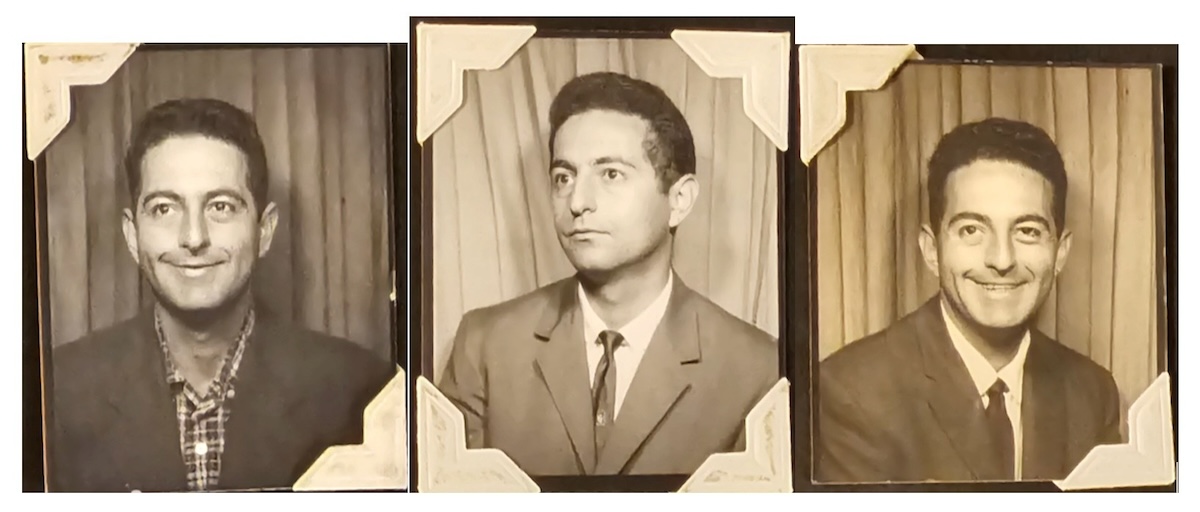
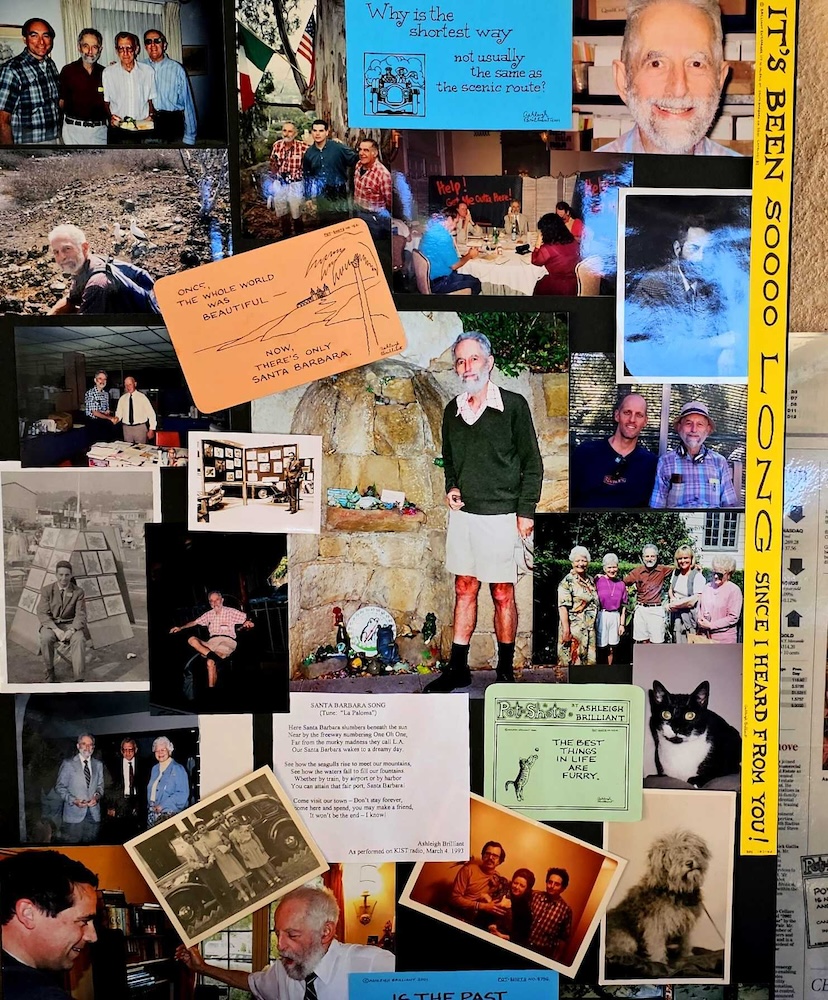
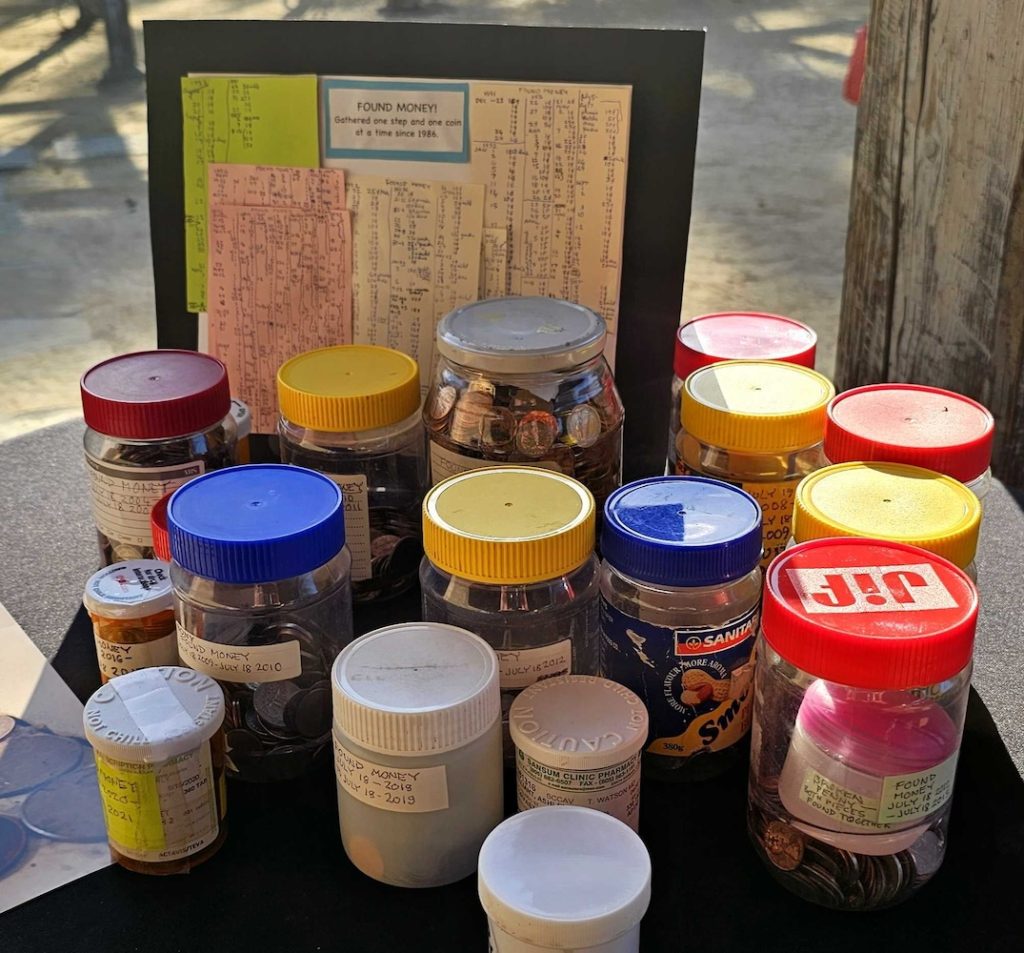
The Ashleigh Brilliant commemorative gathering on October 21 saw the SB History Museum’s lower courtyard outfitted as an Ashleigh tribute, the space’s perimeter an alfresco exhibition of archival photos, news articles, Pot-Shot memorabilia, and a Brilliant hodgepodge of amusingly diverse “found” mementoes plucked from the ground over decades of the restless gentleman’s walks around town. Attendees seated themselves at the draped dinner theater tables or stood around in groups and gaggles, partaking of finger foods and beverages and laughter. Writer, humorist, iconoclast, publicly anointed King of the Epigram and irascible enemy of the gas-powered leaf-blower – Ashleigh Brilliant was, and remains, both beloved and inscrutable. So it was that, following bittersweet opening remarks by Stacey Wright, a succession of friends (and one surprise family member) took their turns before a mic and attempted to describe the indescribable Mr. Brilliant.
A German woman named Alma flew in from Paris just for this occasion and delivered herself of a stirring, teary, and very personal paean to Ashleigh that absolutely hushed the place. A young woman who finished in tears grew up across the street from Ashleigh and recalled him biking around the neighborhood in his bathrobe and engaging her in meaningful literary conversations. His old friends Robert Bernstein and Sol Morrison shared anecdotes, and Brilliant’s longtime caregiver, Chassidy – too saddened to speak – ceded the mic to her son, who read out her heartfelt and eloquent tribute.
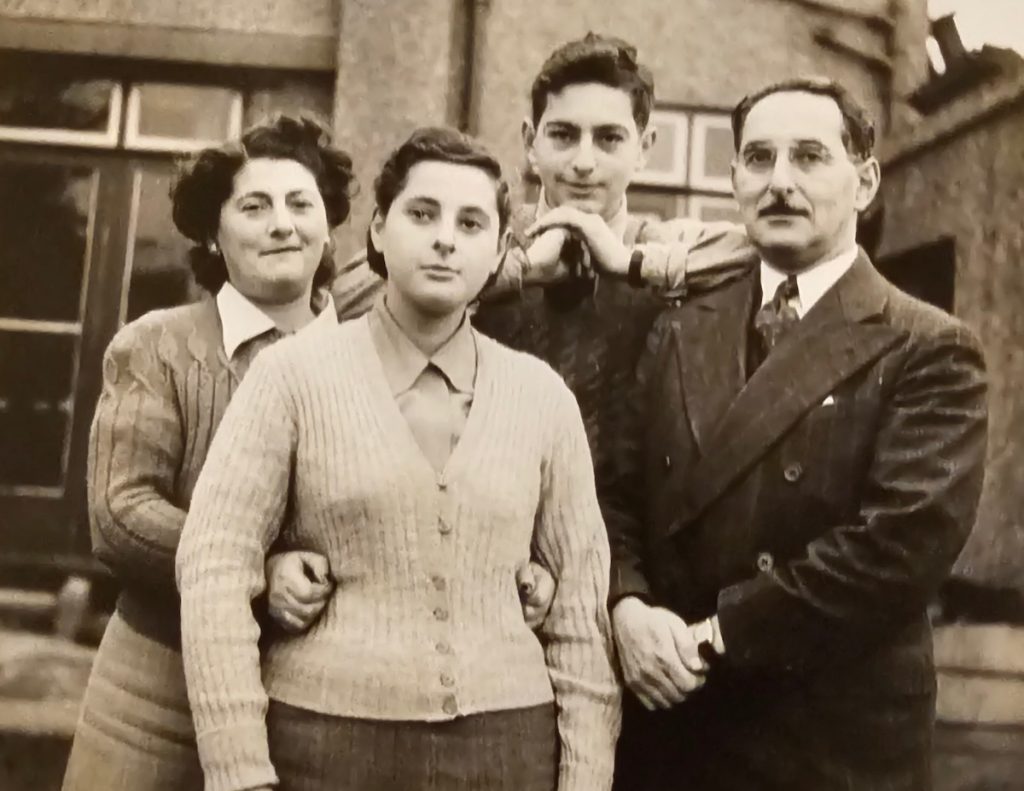
The late afternoon remembrance was conceived by Ashleigh’s trustee and dear friend Stacey Wright, who referred me to two she says did the heavy lifting.
“Laura Zoltan was the one who made the displays and decided on how to present the photos, objects and minutiae,” Stacey told me. “Cindy Ambriz was the one who decided on food, beverage and flowers. They worked hand in hand to make the event happen.” Wright continued.
“Ash the man was vibrant, witty, irreverent, stubborn and positively wonderful. In his autumn years he grieved the ebb of fame he’d enjoyed and lamented his failure to achieve greater status among writers. Yet, he lived each day truly grateful for the simple things – fresh air, sunshine, his personal independence, the care provided to him, and his own, unaffected mind. I will miss Ash the man for the rest of my days.”
***
What follows is Ashleigh Brilliant’s final column for the Montecito Journal, where he has been writing since 2016. Rest well, Ashleigh. Thanks for the years of sharing that perspective of yours, which was – and is – as exceptional as your name.
***
Home On The Range by Ashleigh Brilliant

“Oh, give me a home where the Buffalo roam,
Where the Deer and the Antelope play —
Where seldom is heard a discouraging word,
And the skies are not cloudy all day.”
This song is probably one of the most loved in American traditional music. But the first thing anybody unfamiliar with it might want to ask is: What or where was the Range? The term tends to be used, or confused, with the “Great Plains,” the “Grasslands,” or the “Prairies.” There are actually “Ranges” all over the world, under different names. In Argentina they are the Pampas. In Russia, they’re called the Steppes.
The main characteristics of these ecosystems are plenty of grass and small shrubs, but very few trees, and a generally level or undulating landscape. It was this topography with which American settlers became so familiar, moving westwards in their covered wagons along the historic Oregon Trail. Given the slow pace of their oxen, it seemed to go on forever. Only when they at last caught sight of a different kind of range – a mountain range called the Rockies – did they know they were finally leaving that great “Desert” behind. (It was at such a juncture that the city of Denver was founded.)
But the easternmost reaches of that vast area comprise the “Range” which Brewster M. Higley – an Ear Nose and Throat doctor – envisioned when he wrote a poem he called “My Western Home.” Higley had moved from Ohio to Kansas in 1872, taking advantage of the new Homestead Act which offered free land to settlers who would live on a specified number of acres and farm it for a specified length of time.
Higley’s poem was published in a local magazine, where it was seen by Daniel E. Kelley, a musician and a friend of Higley, who composed (or is at least generally credited with composed) the melody of our familiar song.
Looking now more carefully at the lyrics, we are immediately struck by the reference, at the very beginning, to the Range as being a place where “the Buffalo roam.” Indeed it was, and had been for many generations, but would, sadly, soon be no longer. This period (the 1870s) happened to be the very time when that creature was being hunted to virtual extinction. One notable white hunter, named William F. Cody, was indeed so proficient at his role in the slaughter that he was widely known as Buffalo Bill. And that reputation led to his thenceforth traveling the world as a showman, with a whole troupe, calling itself “Buffalo Bill’s Wild West Show.” It was this entertaining circus-like spectacle which brought to a vast public actual Indian Chiefs. These included Sitting Bull himself – the leader of those tribes which had, only a few years earlier, massacred General George Armstrong Custer and his men at the infamous “Battle of Little Big Horn.” But the Show also included such celebrities as Annie Oakley, the sharp shooter, later to become the fictionalized heroine of “Annie Get Your Gun.”
But getting back to “Home On The Range;” I am not sure about the zoology of western Kansas, but I have no doubt that, whatever deer or antelope were still to be found there in the 1870s, their activities could hardly be described as being in the nature of “play.” What really bothers me, however, is the next line, with its report that, on this Range, “the skies are not cloudy all day.” What on earth does that mean? Does it mean that there are some days there which are never cloudy, or places which are cloudy, but not all day?
Then there is what is usually sung as the second stanza:
“How often at night,
when the heavens are bright,
With the light from the glittering stars,
Have I stood there amazed,
and asked, as I gazed,
If their glory exceeds that of ours.”
This may be fine poetry, but I have trouble extracting any sense from it. It almost reeks of intoxication. What sober man looks upward on a starry night, and asks such a question? Who or what does “ours” refer to? – Our glory? – and what does “glory” mean here anyway? It took considerable poetic license just to rhyme “ours” with “stars.”
The song actually goes on for several more verses. But we are not obliged to. Let’s just leave Dr. Higley, there in his Kansas cabin, never knowing how much posthumous fame his “Western Home” words will bring him.
You might also be interested in...




You must be logged in to post a comment.