
Your Apartment Building Just Became a Bond
Santa Barbara’s new rent law caps the coupon on 13,000 apartments at about 2%. What that does to income, value, and exit, why it may not be the last word, and how to keep up.
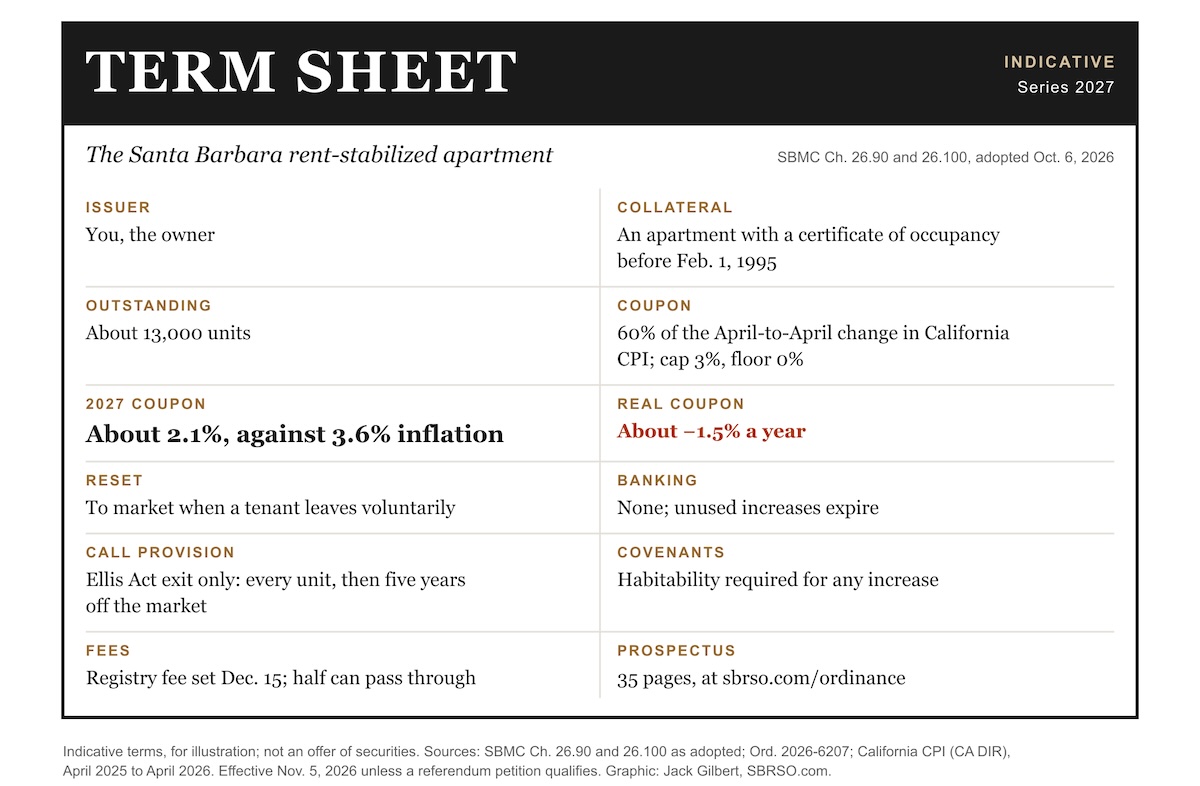
On January 1, roughly 13,000 Santa Barbara apartments start behaving like bonds. The coupon is capped at about 2.1% a year, in an economy running 3.6% inflation, and the issuer, which is you, still owns the roof, the insurance bill, and the property tax. A bond like that trades at a discount. So will these buildings.
On October 6, by a single vote, the City Council adopted the 35-page ordinance that makes it so. Unless a referendum petition qualifies first, it takes effect November 5, and its rent limits begin January 1. Here is the term sheet.
The Fine Print
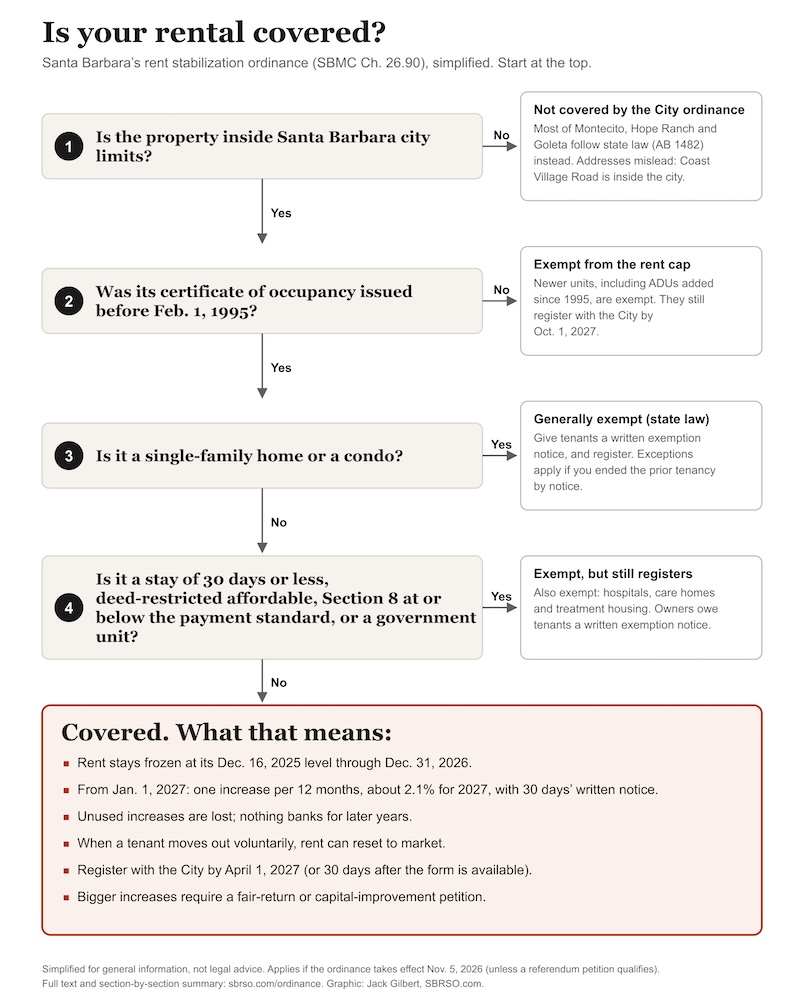
Coverage: Rental units in the city with a certificate of occupancy issued before February 1, 1995. State law exempts newer buildings and most single-family homes and condominiums; the City added a short list of others, such as Section 8 units at or below the Housing Authority’s payment standard. Owner-occupied duplexes are covered. “Year built” is only a clue: a unit added in 2019 behind a 1962 duplex is generally exempt, while the duplex is not.
Coupon: One increase every 12 months: 60% of the April-to-April change in California’s consumer price index, capped at 3% and floored at zero. An increase not taken in its year expires. The first one works out to about 2.1%. State law, by comparison, allows up to 8.6% this year on many rentals outside the city.
Freeze: Covered rents stay at their December 16, 2025, levels through December 31.
Reset: When a tenant leaves voluntarily, rent resets to market. Turnover is now the most valuable line in the pro forma.
Registration: Nearly every rental unit in the city must register, exempt or not, starting as early as April 1, 2027, with the fee set in December. That includes the Coast Village Road strip, which sits inside city limits despite its Montecito address.
Governance: A seven-member Rent Stabilization Board, at least four of them tenants, approves the regulations and hears appeals.
Pricing the Bond
I underwrite apartment buildings for a living, which makes me the person at the dinner party who brings up cap rates. Here is the arithmetic.
Start with yield. Older Santa Barbara buildings have recently traded at cap rates around 5%, below the 5.2% a 10-year Treasury pays, with apartment loans pricing near 7%. Investors accept a below-Treasury yield and negative leverage largely because they expect income to grow.
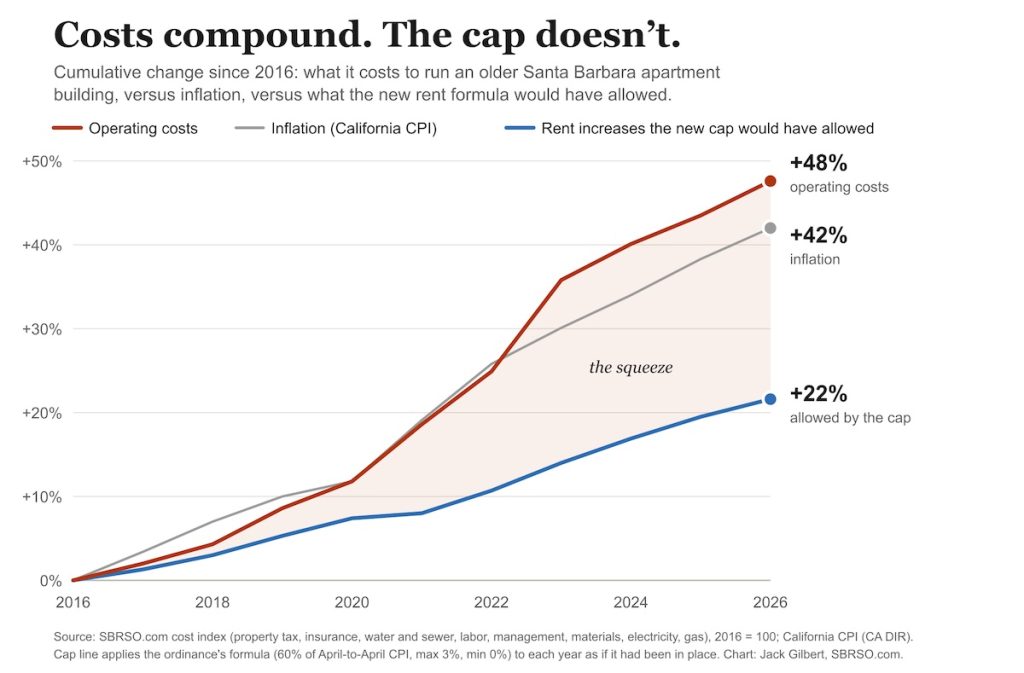
Now grow it. Over the past 10 years, the cost of running an older Santa Barbara building rose about 48%. Insurance nearly doubled, and electricity more than doubled. Had this formula been in place, rents could have risen only about 22%. Looking ahead, if rents rise 2.1% a year while costs keep rising 4%, a typical building’s net income grows about 1% a year. After inflation, that is a loss of roughly 2.5% a year, before a single roof is replaced.
Then price it. Investors pay for growth, so less growth means a lower price. When St. Paul, Minnesota, capped rents in 2021, property values fell about 5% within months, and even homes the law did not cover lost value.
Not every covered building will lose value; land, location and turnover all matter. But every covered building now needs different math.
When Empty Beats Occupied
Here is the strangest result. Because rent resets to market only when a unit turns over, an empty apartment is now worth more than an occupied one. Say a long-term tenant pays $800 a month below market. That is $9,600 a year of loss-to-lease; capitalized at 5%, it is roughly $190,000 of value per unit, unlocked only when the tenant leaves. Vacant buildings will command a premium, and the incentives point toward turnover rather than stability. San Francisco and Los Angeles, where this math has run for decades, now regulate tenant buyouts.
Somewhere along the way, this stopped being a housing debate and became something closer to class war: tenants against landlords, settled 4–3 vote after 4–3 vote. The sharper divide may be between tenants who already hold a covered lease and everyone still looking for one. In St. Paul, researchers found that higher-income renters gained the most.
The Safety Valve
The state and federal constitutions guarantee owners a fair return. Santa Barbara’s version presumes a building’s 2025 net operating income was fair and lets it keep pace with the full rate of inflation, which on paper is more workable than many California ordinances.
In practice, it is a hearing, not a formula. By the City’s estimate, each petition will cost about $27,000 to process, before the owner has paid an accountant or attorney a dime. Santa Monica, with more than 27,000 controlled units, received zero landlord increase petitions in 2023 and again in 2024. Los Angeles County has approved one of 63 fair-return applications since 2020.
Nor is the City sure what it adopted. Its own consultant told the Council there is “no actual legal definition of fair return,” and in September one of the two councilmembers who first proposed the ordinance said, “I thought it was a formula.” This summer I asked the City Attorney’s office to check whether the fair-return calculator I built reads the formula correctly. The office declined “to review or opine on” it, citing neutrality. My read: City Hall has not yet worked out what its own standard means. The City wrote this formula. Owners, and the new rent board, should hold the City to it.
The lesson: your 2025 books are now the most important financial documents you have.
Not the Last Word
Rent control is not arriving alone. In March, facing a projected $14.6 million deficit, the City Council steered staff toward a November ballot measure that would have added $9.50 per $1,000 to the transfer tax on sales over $3 million, taking the combined rate from $1.10 to $10.60. On a $5 million apartment building, the tax at closing would rise from $5,500 to $53,000, and nearly half of the Santa Barbara apartment sales we have tracked since January 2025 cleared that threshold. Staff also modeled a top tier of $60 per $1,000, a 6% tax, on sales over $6 million. Councilmember Meagan Harmon said that option was “where I personally would be leaning”; Councilmember Wendy Santamaria called it “a scary number” but worth taking to the community. Both opposed exempting apartment buildings. In April, staff recommended dropping the measure for this year, citing uncertain polling and a pending statewide measure, and closed most of the gap with cuts described as mostly temporary, leaving a budget the City Administrator called “precariously in balance.” Los Angeles passed its version, Measure ULA, in 2022.
Statewide, the November 3 ballot carries Proposition 40, a one-time 5% tax on the net worth of California’s billionaires, and Proposition 3, which would make the state’s top income-tax rates permanent.
You can be for or against any of these. Read together, they describe a direction: income capped while you hold, taxed when you sell, and wealth asked to carry more of the public budget. Underwrite accordingly.
Keeping Up
This summer my team and I launched SBRSO.com, the Santa Barbara Rent Stabilization Observatory, because the answers to the questions I hear every week were scattered across more than a dozen council meetings and hundreds of pages of staff reports. It holds the adopted ordinance with a plain-English summary of every section, a timeline of every vote, a decade of local cost data, more than 120 verbatim council quotes linked to the meeting video, and the fair-return calculator. It is free, and every number is sourced.
My short list for owners, trustees, and their advisers:
1. Confirm your certificate-of-occupancy date.
2. Close your 2025 books carefully.
3. Re-run your pro forma at a 2.1% coupon, with your real turnover.
4. Watch December 15, when the registry fee study comes back.
5. Get updates at SBRSO.com, and talk to counsel before serving any 2027 rent increase.
Every bond comes with a prospectus. This one runs 35 pages. Read the parts that apply to you before they apply
to you.
You might also be interested in...




You must be logged in to post a comment.