
Sanctuary Centers’ Six-Story Village
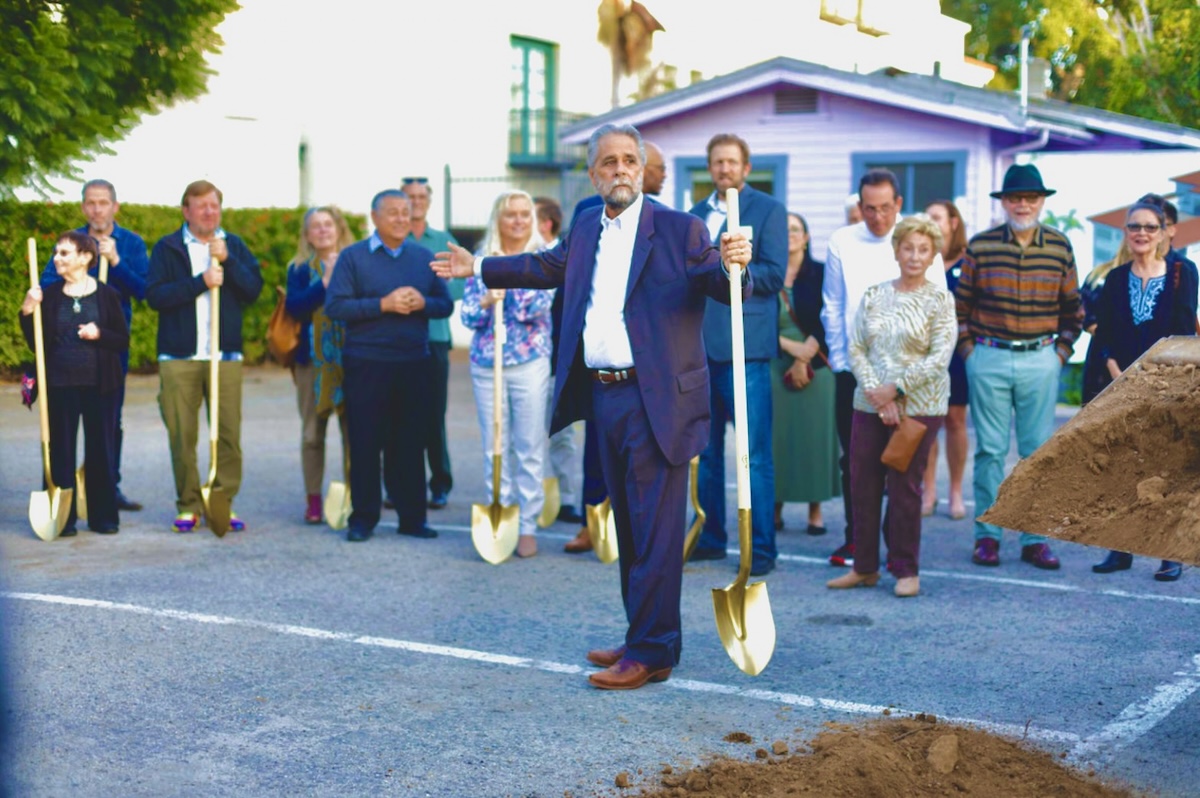
Barry Schoer, president and longtime driving dynamo of Sanctuary Centers, is walking me around the half-completed structure on west Anapamu. This capstone project has been a long time coming. What does “long time” mean,exactly? The A-Team (remember Mr. T?) made its splashy TV debut the same year Barry Schoer’s ideas began coalescing – a marker historians refer to as “1983.” That year Schoer signed on as executive director with an outfit called Sanctuary House, whose then-President had inveighed upon the young firebrand to join the team.
Schoer moved out here from NYC in the mid-seventies, having worked post-grad at a number of places in NY, including the spirit-breaking Bellevue Psychiatric Hospital. As a kid some years before, Schoer had glimpsed Santa Barbara in the company of his cousin, to whose poppy-fueled California bakery the precocious 11-year-old runaway had made a cross-country pilgrimage. Schoer the kid had been in full flight from a home life destabilized by his mother’s tenuous mental health. Yeah, same Barry Schoer [see Part I]. To what degree any of this early Candide-stuff explains the driven adult Schoer – I’ll leave that to you, reader. Suffice it to say the guy’s passions were not pulled out of a top hat.
“The first floor is counseling, case management, and psychiatry,” Schoer explains as we approach the frightening cage that will hoist us to the building’s mid-section. “The second and third floor are independent living, similar to our two other apartment buildings. The fourth and fifth floor…” he says, and reconnoiters.

“I first started scratching my head about 15 years ago. There’s a certain number of clients who are never going to live fully independently. They live at home and their parents are in their 70s, they’re in their 80s. Their parents are aging out and when they’re gone, these people may wind up in horrific board and care homes, of which we have a fair number in Santa Barbara.” Schoer turns to look at me. “What happens to these people?”
That perennially vexing question is the To Be or Not to Be of this build. Sanctuary Centers, begun some 50 years ago as the pharma-free Sanctuary House, has taken many evolutionary forms over the years under Schoer’s direction, long since embodying residential treatment, co-located integrative care, and even Supportive Housing. The goal? Ushering the formerly hopeless into lives of nourishing independence.
This consolidating build now unifies and burnishes those elements and could be described as Sanctuary Centers’ penultimate expression. At completion, each of the building’s floors will play a differentiated, synergistic role in the lives of its residents – some of whom will be permanent residents.
A Cheery Former Acrophobe
We enter the cage, and Carmen – a cheery former acrophobe in full PPE regalia – pushes a button. Once an RN at St. Francis Hospital and later a hospice worker for 27 years, she’d applied for the jobsite’s lift operator gig to help conquer her fear of heights. It worked. When interviewed, her lifetime of nursing made her a shoo-in. “She’s bandaged up a dozen workers,” Schoer says. The cage rises and I fight the urge to grasp at empty air. Carmen’s warm smile seems to precede empathetic laughter.
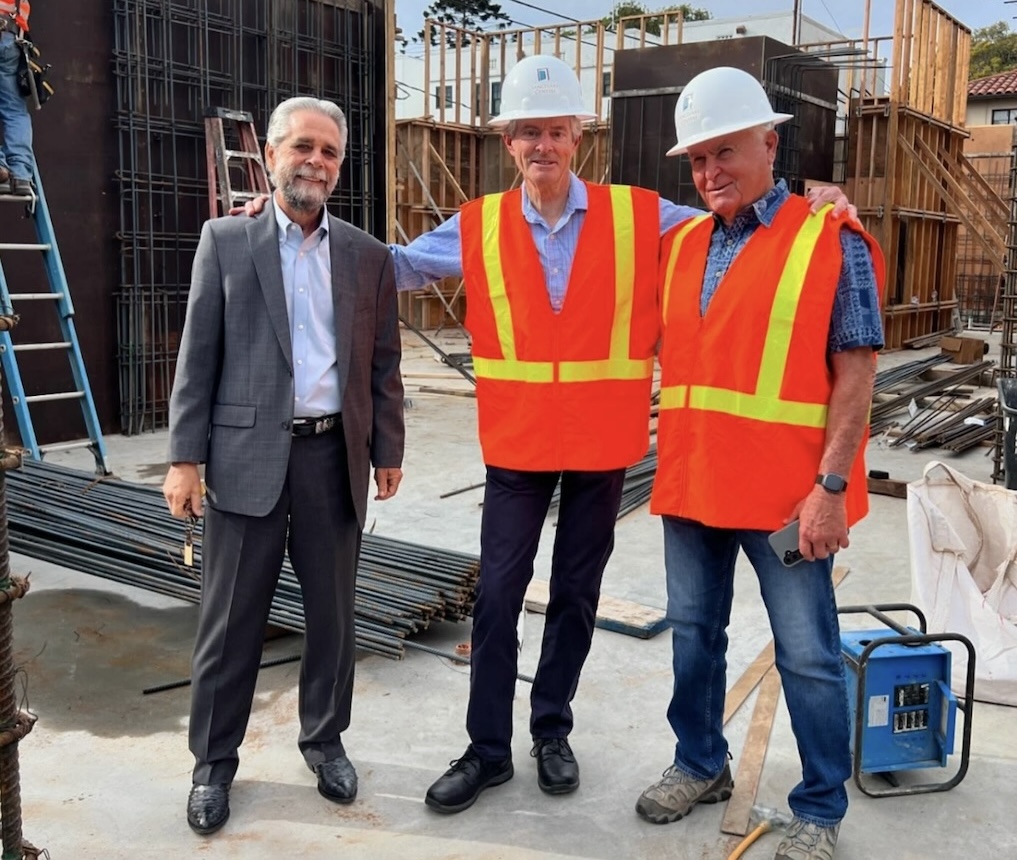
I’d swaggeringly waved away Schoer’s attempt to demonstrate my hard hat’s adjustment gizmo. Now it’s slipping around my sorry head and I’m clutching it throughout the tour. Schoer’s dream materializes through his narration.
“This will be a commercial kitchen here, a dining room over here, dining area over here, TV watching area over here, and then a game table over here…”
The build’s ADA-compliant apartments and community-fomenting common areas will share square footage with a fully equipped clinic providing medical and dental health care. Residents will also have at their disposal comprehensive mental health care – individual and group therapy, psychiatry, and co-occurring disorder treatment.
What has been called an “integrated care model” puts residents and the truly comprehensive care they need in one self-contained Sanctuary Centers neighborhood. Call it a “building,” a Salvation Parfait, an Ark: This single structure will effectively be a six-story village, a new approach to clinically managed Mental Health Care and – it is hoped – a template for consideration of other towns and cities. To be clear, though, the idea is not a hermetically sealed community in a box. Quite the opposite.
Some of the residents will be addressing mental health issues, some co-occurring disorders (a mental health disorder simultaneous with a substance use disorder). The healing these residents need will in part be intrinsic to community itself, as Schoer explains.
“We have a community kitchen, community dining room, community TV room, community game area, all of those things. In addition, up on the fourth and fifth floors we’re doing recreation and socialization. So every day we’re going to do outings – recreational outings, social outings, shopping outings, trips to the mountains, trips here and there. And everybody has to participate in at least a couple of them a week. And then we’re going to have dinners, and then every night there’s another outing.” Schoer looks me in the eye. “That was what we all agreed was the best thing we could do; reward them for being stable and for being accomplished and getting to this point. And make sure we get the supports wrapped around them so that they don’t slip.”
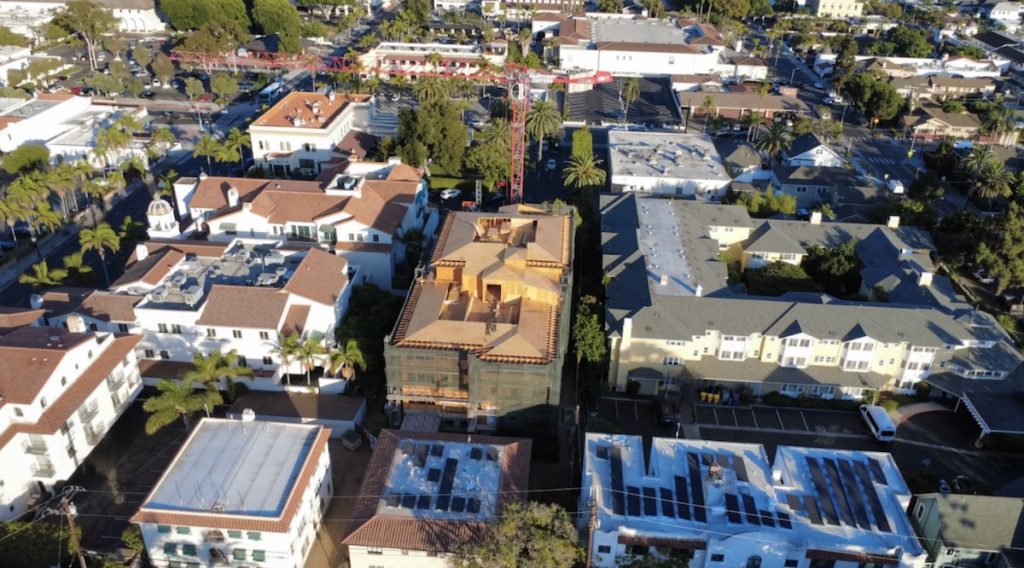
All this largesse came with the usual sides – the permitting gauntlet, the volatile hearings, city council and planning commission approval. SB’s height limit restrictions at the time were the rock that wouldn’t roll. With exceptions.
“We were originally putting up a four-story building,” Schoer says. “We were halfway done with the permitting process and then Steve Amerikaner over at Brownstein – who was our land use attorney for 30, 40 years – he said the city just tweaked their ordinances. They said they’d allow building above 45 feet up to 60 feet if it’s a community benefit project.”
Schoer and team had a tough decision to make, but there was really no question. He looks at me with attempted puppy eyes. “I thought I’d be retired by now,” he says with a poorly executed ‘downcast expression’ (the act needs work). “But we voted to pull the project, voted to go higher. We had to start over. We pulled the project and redesigned it.” That procedural blockage removed, adversaries began spreading rumors, some almost deliciously inept.
“These guys sent a lawyer who had the cojones to get up in front of the planning commission and say, ‘Sanctuary Centers is lying. As soon as they’re done with this, they’re going to convert it to condos, and this patio is going to become part of a disco.’” Schoer looks at me with a ‘cat that ate the canary expression. He’s all but shooting his cuffs. “So when we have our grand opening next fall, I’m going to invite members of that family to come over and dance under the mirror ball.”
Sanctuary House is Where the Heart Is
We’re in the jobsite meeting room and joined by Sanctuary Centers CEO Stephanie Drake, PhD. At a glance, the two bearings are screenplay complementary. Schoer’s seated posture hints at a preincarnate sprawl, while Stephanie’s comportment exudes a more buttoned-down, ‘ready for anything’ vibe – that variety of energized cheer that suggests roaring internal combustion awaiting the turn of a key. “She’s a lot more coherent than I am,” Schoer says of his CEO at the outset.
In more relatable terms – those of Olympic Curling – Schoer is the teammate who calmly launches the 40lb granite knob, Stephanie the motivated soul who follows it down the ice with furious anticipatory sweeping. This yin and yang describes Sanctuary Centers’ all-embracing brio. From admin to “client,” the place is wall-to-wall family. “The amazing staff are truly the backbone of this agency,” Schoer says.
Sanctuary Centers’ work and reputation in Santa Barbara are foundational to this much-anticipated new build’s DNA. Stephanie explains the Sanctuary Centers’ model as it’s been practiced since 1989 in their Sanctuary House, a twelve-bed residential program.
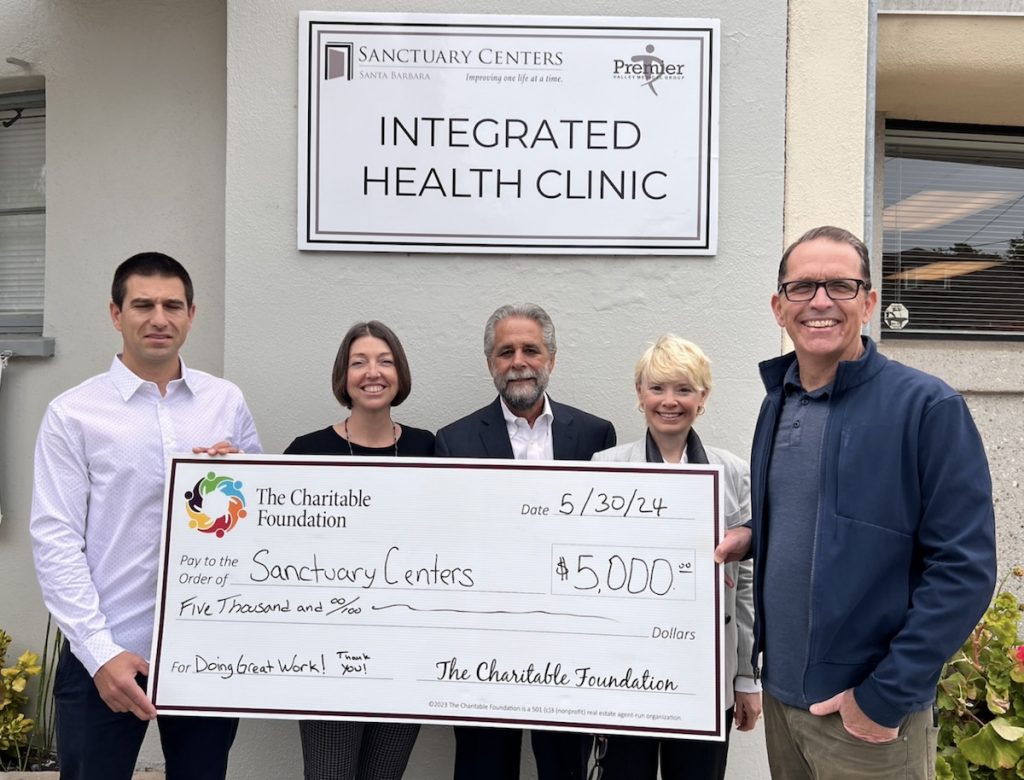
“People in the house prepare meals together. Some folks that are coming to the house have never lived independently and they don’t know how to do that,” she says. They don’t know how to take care of their own space. They don’t know how to plan a meal and how to execute that meal. So they’re gaining all those self-help skills while also being able to access treatment. They all have chores that they’re assigned to contribute to their living environment.”
Beyond Sanctuary House, Sanctuary Centers’ Supportive Housing program comprises two downtown apartment blocks and conditional residency based in part on a tenant’s willingness to integrate with the community for at least 20 hours a week.
The home-like environment and necessary assumption of those ordinary responsibilities of daily life are as essential to Sanctuary Centers’ heartfelt mission as the inpatient and outpatient clinical work. “Community” is paramount. The word itself has been reduced to a fridge magnet through over-use, but the concept – anthropologically, functionally, emotionally – is central to everything Sanctuary Centers does.
“They come together once a month and they look out for each other and are able to bring their concerns to their community,” Stephanie says with increasing animation. “They meet with their individual therapist or psychiatrist, and they start working on things that either get them into a school environment or get them into work, or volunteering.
“And now this building gets to be the pillar,” she says. “Quite literally. This is now an integrated care campus. And Santa Barbara… I think 10 more of these buildings and we could wholly take care of the population that we need to.”
She looks over at Schoer, the former runaway whose shoulder-to-the-boulder effort has been singular for literal decades. And for what? What is the fruit of Sanctuary Centers’ long day of labor? Nothing particularly cinematic: people living their lives in peace and sunlight – buying groceries, doing laundry, chatting with a pal on the street corner amid ordinary birdsong; garden variety gold the rest of us enjoy at our leisure.
“I’ve heard so many stories,” Stephanie says, glancing again at Schoer, whose growing smile is just visible through that beard of his. “I’ve heard wonderful stories from Barry over the years. We’ll be going somewhere and he’ll say, ‘Oh, he was in our program, and that gentleman over there, he’s got three kids now.’ And it’s just…it’s just…”
####
YOUR NAME HERE
Sanctuary Centers’ much-anticipated downtown center nears completion and a handful of naming opportunities remain. If you are interested in publicly associating your philanthropic legacy with this watershed monument to Mental Health Care – in perpetuity – please visit the page below to see what naming opportunities are yet available.
You might also be interested in...




You must be logged in to post a comment.