
Wildland Firefighter Explains All

Jorge’s nephew is a curious kid who wants to know stuff. That bodes well for the youngster growing up to be an interesting adult. One day, though, he stumped his uncle with a fairly straightforward question. “What’s your job, uncle Jorge?”
East Camino Cielo Road in the Los Padres National Forest is the northernmost boundary of the Montecito Planning Area, and that 2,700 square miles of woodland also happens to be Jorge Hurtado’s day job. But as the man smilingly tried to explain his work in the Los Padres National Forest, he found himself stammering. The more he spoke about his work, the more confused the kid got. Same thing happened with his extended family and friends. Frustrated by his inability to cogently explain his profession, Jorge Hurtado did what any sensible person would do. He began a children’s book series.
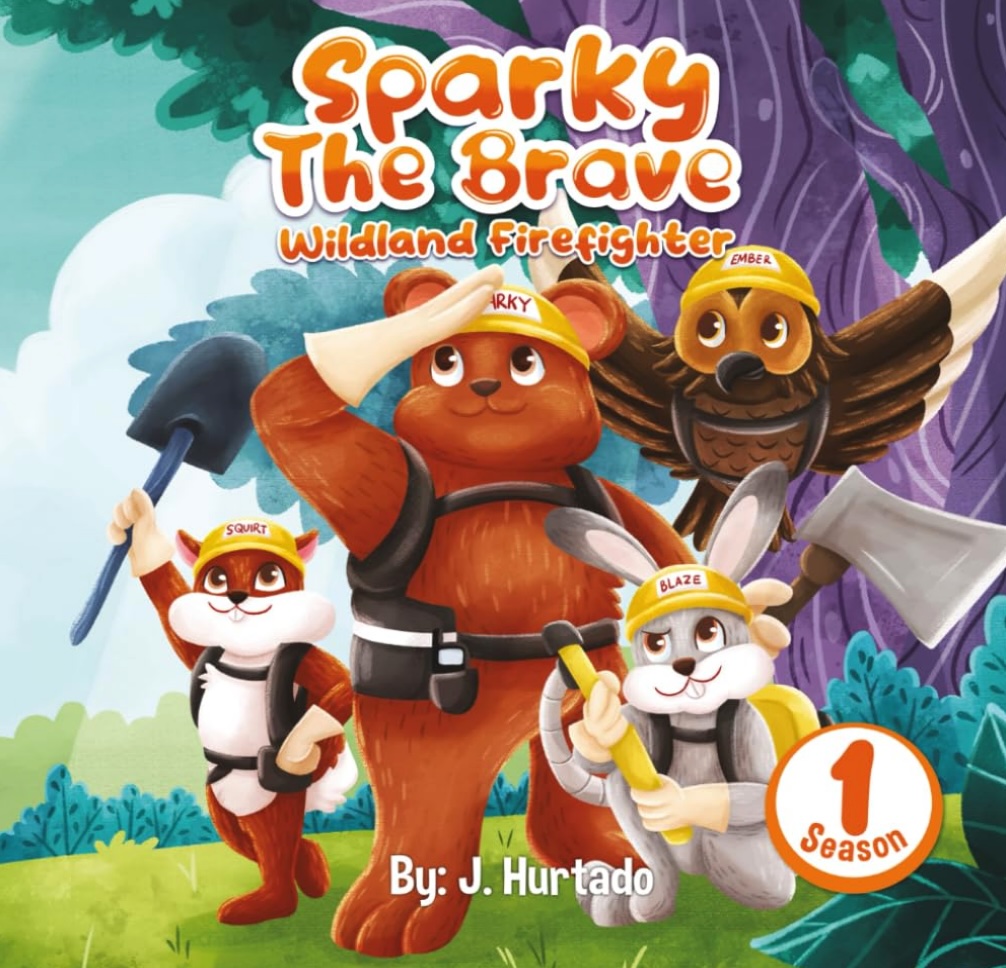
Sparky the Brave Wildland Firefighter [Season 1] sets the series up, and Year of the Hotshots [Season 2] wades into but one of the specialized roles that comprise the Wildland firefighting whole. The introductory Sparky features a team of forest animals who each take a collaborative role in battling the forest fire that is the book’s central emergency.
Sparky is a fearless bear and the group’s de facto leader. Squirt the Squirrel races around the treetops, keeping an eye out for distant trouble. Blaze is the “speedy rabbit” whose job it is to throw water on the flames, and Ember is the wise owl who, in the throes of emergency, uses her acute vision (and handy power of flight) to guide them to the trouble spots. The beautifully illustrated book – 36 involving pages long – teaches love of nature, the surprising power of teamwork, and an affection for wildlife; all without browbeating or finger waggling. Hurtado’s way with a story is laudable: use plain speak and the simple human emotion that is food, drink, and object lesson to open hearted kids. Storytelling continues to rule Life’s lesson plan.
“I just did this just so my nephew, my family, and my friends understand my work,” Hurtado says, like writing a book was almost an afterthought. “All these years that I’ve been with this agency, they don’t know what I do,” he says, and smiles. “Now they will.”
Okay, let’s get right to it.
Wildland and Structure
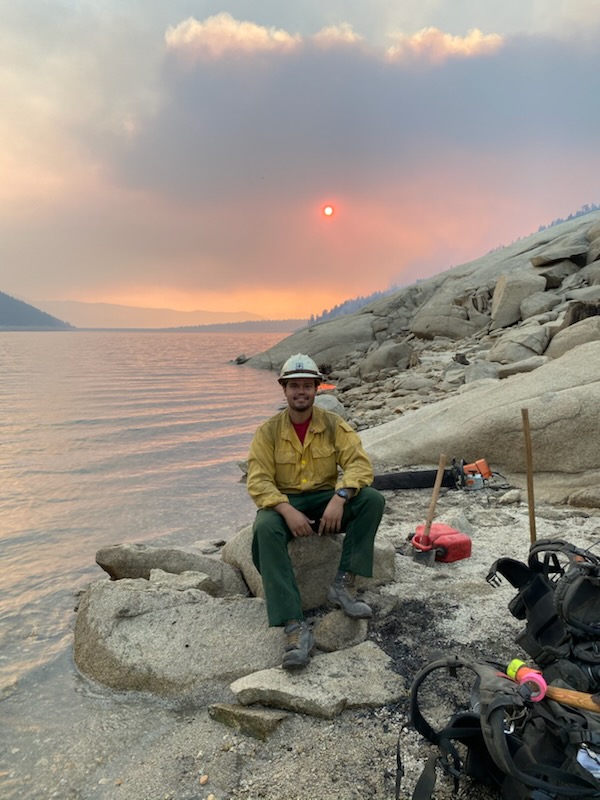
You know the men and women who go tearing down the city streets on those enormous red fire engines, sirens blaring (the neighborhood dogs replying in cacophonous, howling chorus) until they reach the building engulfed in a bale of roaring fire, at which point the firefighters surround, battle, and defeat the conflagration with pressurized city water? Well, he’s not one of those guys.
“So wildland firefighters are pretty much working with wildland, like the forest. Anything that doesn’t have to do with structures and vehicles. So we just focus on the forest or brush.”
Reader, we live in an astoundingly beautiful, many-faceted paradise whose nature it is to periodically burst into flame. To our good fortune, these highly trained firefighters are specialized. Urban firefighters, sometimes called structural firefighters, rush toward and often into burning buildings and other constructed things swaddled in flame. Wildland firefighters work in the outback – forests, meadows, ravines, prairies – where the “structures” are trees and grasslands. How might this differentiation manifest in a real time situation? Hurtado lays it out.
“We help the city and county, but in those cases have a specific role to play there. So as an example, if there’s a vehicle fire on Highway 154, we’ll show up and throw water on the vehicle, but we don’t have the equipment – like the SCBAs (Self-Contained Breathing Apparatus) and other heavy equipment. So once we tame the vehicle fire our priority in this example is the brush. We will be there to prevent the fire from getting into the brush on the 154.”
Why wouldn’t a wildland firefighter be given a breathing apparatus? Because wildland work involves lots and lots (and lots) of hiking into fairly impassable reaches at times, and a certain lightness on the feet is critical to attaining these remote, fire-prone places. Packing an SCBA tank and some of the other heavier equipment structural firefighters use would be dangerously fatiguing. wildland firefighters carry hand tools like shovels, chainsaws, hoes, fire rakes, and lightweight axes.
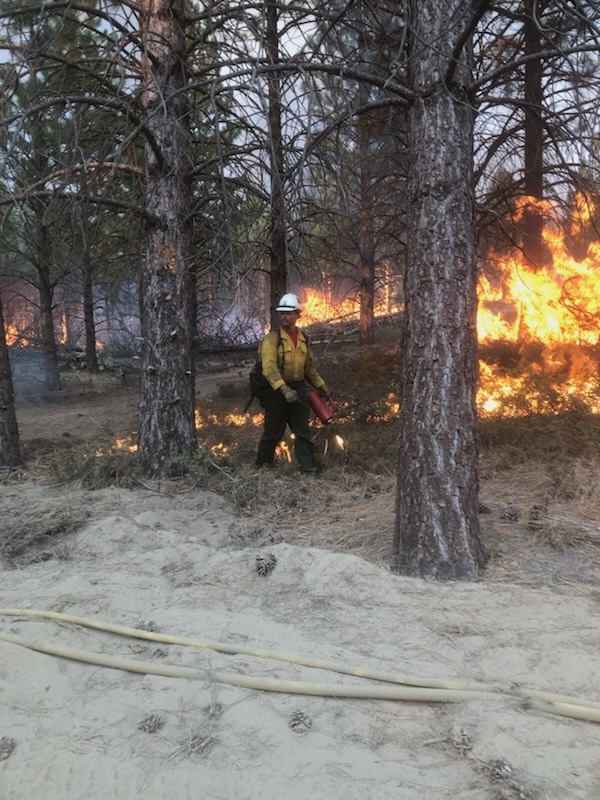
And whereas a structural firefighter is typically responding – to a structural fire, a vehicle fire, an injurious traffic accident, a hazmat emergency – a wildland firefighter’s gig also has a pre-emptive component. These can include clearing brush, managing vegetation, cutting fire breaks, and effecting controlled burns in the wild to reduce available wildfire fuel; that is, addressing the fire before it appears. And yeah, for a wildland firefighter this work all typically takes place in the proverbial Middle of Nowhere. The scenery in these far-flung places can be breathtakingly beautiful when not riven with towering geysers of flame. And sometimes even then, one can imagine.
When a wildland fire occurs, of course the wildland firefighter’s job is to contain and extinguish the fire, but once a wildland fire has been put out, the wildland folk set to raking and tilling through the burned aftermath to assure there are no lingering hotspots, such as the one now thought to have sprung back to life and caused the devastating Palisades firestorm. Wildland firefighters will also work, post-fire, to repair and manage fire-ravaged lands to mitigate erosion and flooding that might cause a secondary cataclysm.
Hurtado’s Odyssey
Jorge Hurtado works for the U.S. Forest Service. Why? Since when?
“A friend told me about wildland firefighting. He just said, ‘Hey man, I’m applying. You should apply too.’ And I was like, what is that? I had no idea what the green engines were or any of that stuff. I got hired as a seasonal in 2016, and he did, too.” This inaugural training and experience was as a seasonal wildland firefighter on the Cleveland National Forest near San Diego. Having got a taste of the wildland firefighter life, Hurtado was all in.
“I applied to work on the Angeles, and then that’s when I got hired as a permanent in 2018.” Since 2023, Hurtado’s territory is Los Padres National Forest.
The wildland fire organizational structure is department-based, each complementary role augmenting all
the others.
“That’s what I’m doing. All the different departments in the Forest Service, I want to hit every one of them. Each one will get its own book,” Hurtado says.
Aviation, Fire Management, Smokejumpers, Engine Crews, Hand Crews, Dozer Operators – Wildland Firefighting has many interlocking aspects which beg the colorful explanation unique to children’s nonfiction. Hurtado is in fact being shamelessly lobbied by colleagues in various Forest Service departments.
“I get messages from everybody. ‘Can you please do dispatch? Can you please do dozers? Aviation?’ Patrols want their own book…” No rest for Hurtado the scribe. Everyone wants to be understood, particularly those whose work may not be as widely known or appreciated. Hurtado found something that captured him; work on behalf of his friends, neighbors, and inquisitive strangers.
“I just want people to know what wildland firefighters are,” he says. “Honestly, that’s my goal. I’m not going to say my books are inspiring kids, but ever since I started this, I’ve been getting messages and pictures of kids saying they want to be this when they grow up. ‘I want to be a Hot Shot.’” Hurtado smiles and shakes his head. “That’s a hundred percent cool.”
Hurtado will be at Beautification Day on November 8, giving away free copies of his Sparky books, including his coloring books. You can also find Sparky on Hurtado’s site, https://sparkythebravewff.com. Look for him at Beautification Day; he’ll see you there!
You might also be interested in...




You must be logged in to post a comment.