
Why You Should Give a Flying A (The Brief Shining Moment)
In 1923, two builders named Woodruff and Shoults built a huge promotional gimmick on Mt. Lee above Los Angeles. The row of standalone white block letters, each measuring 30’ x 50’ and visible for miles, would proclaim their new housing development in those hills: HOLLYWOODLAND. Nine years later a forlorn actress would leap to her death from the top of the letter H, and the melancholy story arc of Tinseltown would proceed apace through an ongoing burst of flash bulbs.
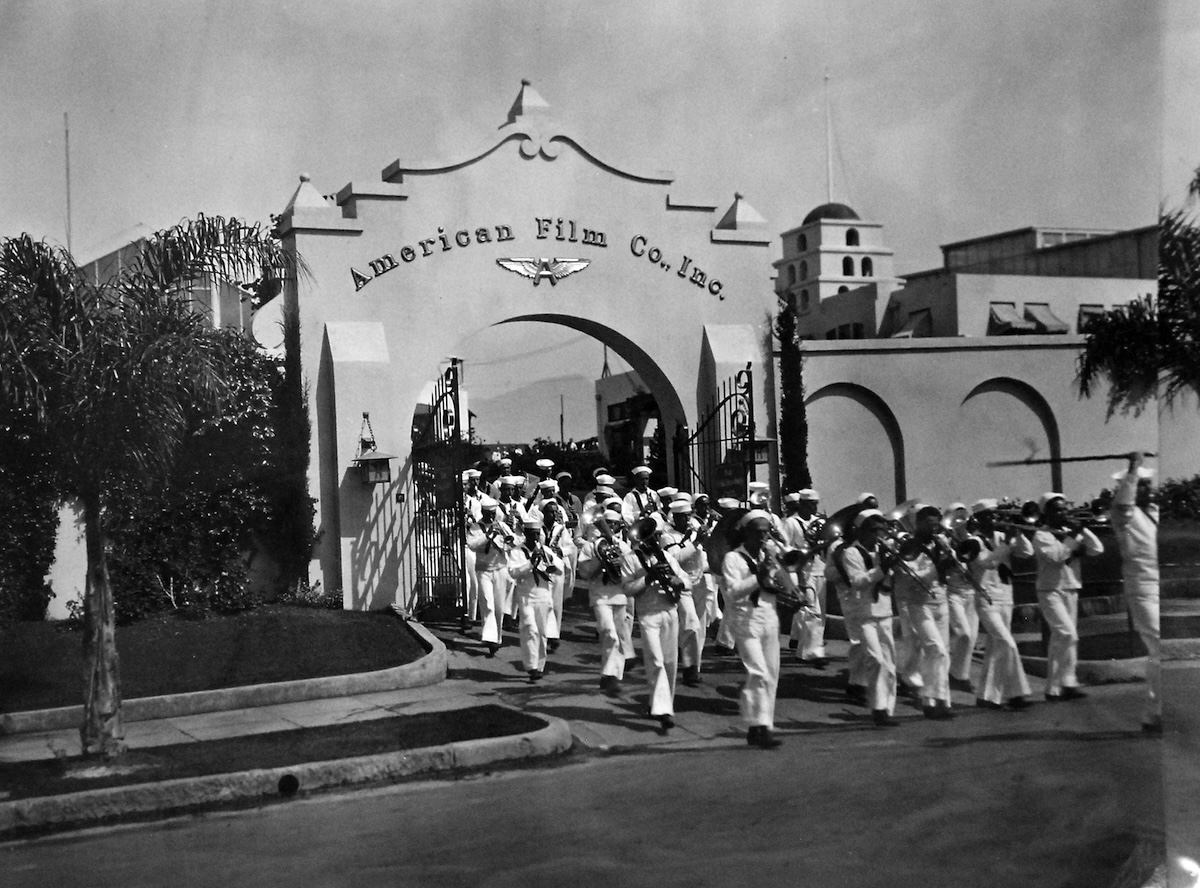
BUT ten long years before the Hollywoodland sign made iconographic prehistory (the “LAND” suffix would be removed in 1949), a raging movie studio in Santa Barbara had already conquered the realm. Here’s a snapshot.
Once Upon a Time in La Mesa
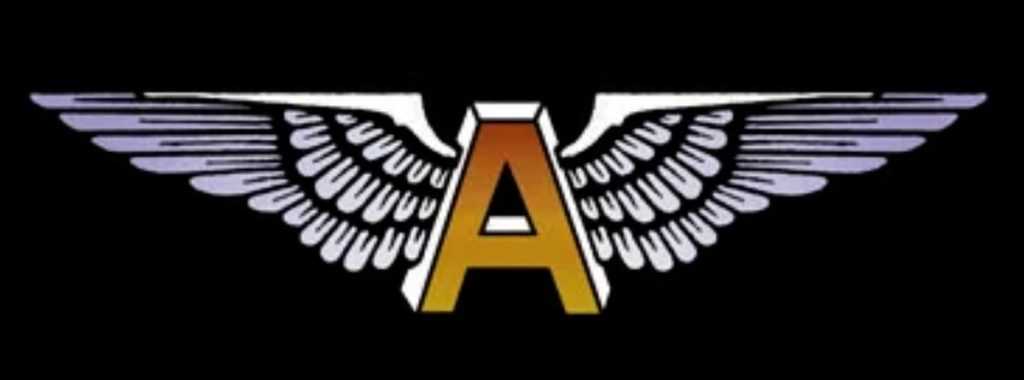
It’s fair to assume that the numbingly titled American Film Manufacturing Company – founded in Chicago in the fall of 1910 – did not see itself as first wave producer of an art form that would one day reshape the world. Fortunately, its distinctive logo – an “A” with wings – would allow the strictly business movie factory to sport a slightly more swinging nickname: Flying A Studios.
As the American Film Manufacturing Company (*sigh*) was cobbled together in Chicago, three separate shooting units emerged. Two of the production teams would work at American Film’s Chicago studio and in the surrounding Chicago neighborhoods. The third unit was assigned westerns as a genre – and was sent out west (if you can imagine) to scout locales more visually conducive to cowboy storylines than the already skyscraping, soot-stained Chicago.
This roaming “western unit” would explore New Mexico, Arizona, and a place called California. The latter would ultimately be chosen as Flying A’s western headquarters. What now seems inevitable (Hollywood! Lana Turner! Grauman’s Chinese Theatre! Schwab’s! Humphrey Bogart! The disturbingly owl-like Louis B. Mayer!) was not in the least inevitable. Roy Overbaugh, Flying A’s star cameraman, once explained the prosaic characteristic that would quietly anoint California the future moviemaking supernova it became.
“At this early date artificial light hadn’t been developed to the point where it was suitable for proper lighting,” Roy told an interviewer. “Consequently, all scenes were photographed by daylight. This meant that scripts and scenarios and stories had to be written so that no interior scenes were necessary.”
Those “interior scenes” that were necessary were shot in ceiling-free rooms in broad daylight so the moviegoers could actually see the actors – to this day a critical element of filmmaking. California’s indomitable sunshine sealed the deal. Flying A’s western unit due-diligently explored the west coast and of course found their moviemaking Eden, putting down stakes in the world’s preincarnate movie capital; La Mesa, California. This means, among many other things, that in an alternate universe a 1965 television game show launched called La Mesa Squares.
Large Flightless Glamor
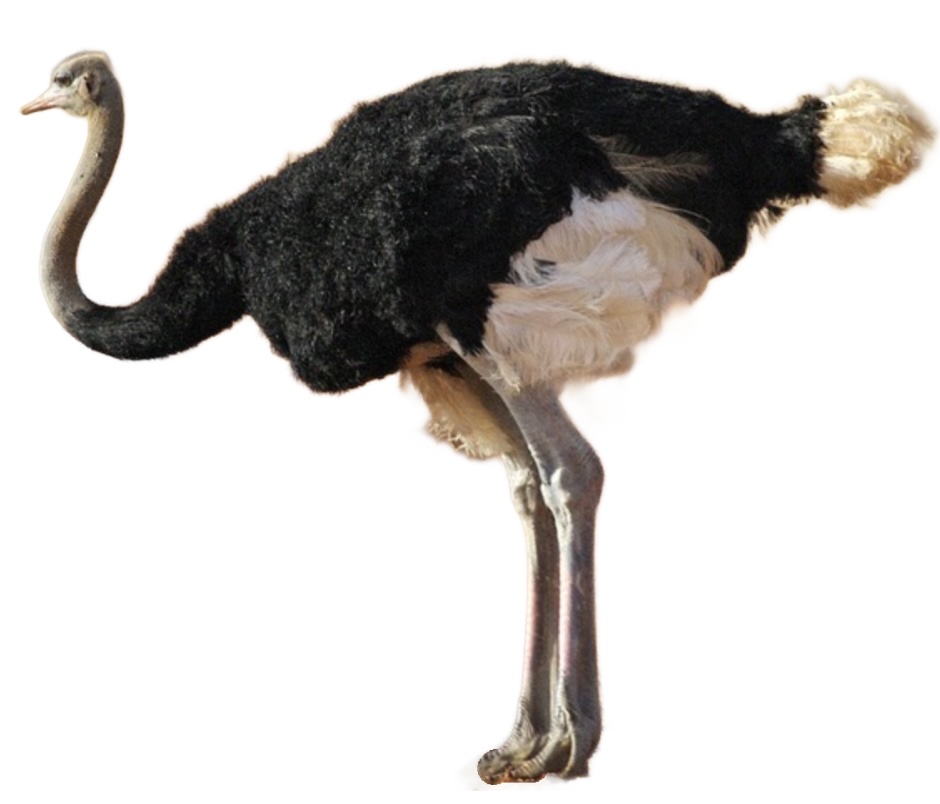
After two years and some 150 films, Flying A grew weary of La Mesa, having filmed in just about every favorable square foot the area had to offer, including the whole of the El Cajon valley. The studio sought a different California town with a more interesting variety of settings and topography, the improbably cloudless skies which their enterprise required, and a proximity to Los Angeles’ gritty urban set pieces. When they stumbled onto Santa Barbara – with its mountains, canyons, sea, and largesse as a place to lounge between film projects – they knew they’d found Flying A’s new base of production. They planted themselves in SB with such haste they had no complex to move into – no magisterial arched entry proudly emblazoned with the Flying A logo, no night sky-sweeping klieg lights to announce the presence of the star making movie factory. As one does in these situations, the arriviste little studio found an ostrich farm on upper State Street near Pedregosa, signed a lease and moved in. A couple days later they started shooting.
Flying A’s movies at that time were one-reelers and the backbreaking production schedule called for producing two movies per week. By the time they got to SB, the Flying A folk had the routine so buttoned down they would typically shoot an entire movie between breakfast and lunch. In practice this meant the transplanted Chicagoans could spend most of the week helling around Santa Barbara.
“‘Life can be beautiful’ was a familiar phrase,” cameraman Overbaugh later smilingly told an interviewer. “Well, it certainly was. Most of our time was spent at the beach.” In the meantime, the leisurely Flying A was making money hand over fist, and after a few months at the ostrich farm, decided to build their moviemaking compound.
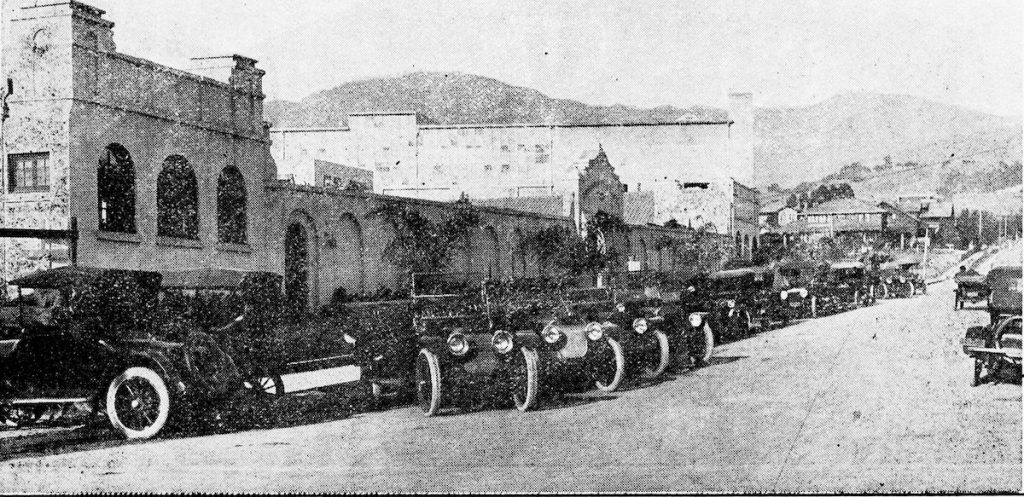
The company picked a site on West Mission Street and ultimately took up the entire block of Mission between State and Chapala streets. Yes, they got the photogenic arched entrance, beautifully landscaped grounds, and a high, imperious wall along Mission to contain the whole Xanadu. The largest remnant of the once-sprawling Flying A is located at 34 W. Mission. Today these are the offices of Becker Henson Niksto Architects, but were once upon a time the lushly appointed green room and lounge for Flying A’s actors. It’s a fact: for one brief, shining moment (to quote King Arthur in Lerner and Loewe’s Camelot), Santa Barbara was, as a matter of record, the home of the best equipped and most artistic motion picture studio in the country.
Still. Moviemaking in those very early days was a somewhat improvised art form. Cameras were hand-cranked, lighting was by nuclear furnace (the sun), and on-set accidents were not uncommon.
Brakeless and Drowning
One Flying A script called for a scene featuring a downtown collision, one car plowing dramatically into the side of another. They set the scene up at the intersection of State and Victoria streets and planned the shot exactingly. To preclude any possibility of injury they populated one of the cars with laudably lifelike dummies the prop department spent hours detailing. A stuntman would drive the car full of dummies, set the steering wheel and throttle, and leap off the car (out of frame) just before it entered the intersection. At that point the other car, this one with a stunt driver, would fly into the intersection and thrillingly T-bone the dummy-mobile.
In the event, the driver leaped off the dummy car which, lighter now by some 150 pounds or so, picked up unplanned-for speed. The surprised stunt driver missed his target by a country mile, the driverless dummy-stuffed ride sailing through the intersection and speeding down State Street.
Entranced locals who’d crowded round to witness moviemaking magic scattered and ran for their lives. About a block down State, the dummies’ front wheels struck something in the street and the car lurched wildly to the curb, smashing into a Montecitan’s parked limousine and ejecting a gang of expertly-crafted dummies onto the sidewalk, where several onlookers reportedly screamed themselves hoarse with horror.
In another instance of misfired cinematic wonder, at the word “Action!” a Flying A movie hero leaped fully clothed into the ocean to save a drowning woman, his knit necktie contracted in the water and begins to strangle him, and the helpless damsel swam over like a champ and hauled her flailing hero to safety.
Flying A Studios would go off like a roman candle and just as quickly succumb to the integrated film and movie house business further south. Out on the East coast, Thomas Edison’s Motion Picture Patents Company held the rights to most moviemaking equipment in those early days, and Mr. Edison was a litigious sort not averse to shutting down a film production if he found his equipment was being used without the proper clearances (payments).
An L.A. neighborhood called Hollywood became a handily far-flung getaway for moviemakers hoping to avoid Edison’s patent violation radar, the province’s proximity to Mexico providing an easier escape hatch should Edison’s lawyers come to California with their briefcases and stern expressions. By 1921 Flying A was shuttered.
You might also be interested in...




You must be logged in to post a comment.