
Mortgage Lending: Monthly Mortgage Payment Options
I frequently hear “The Market,” referred to, in a “who-knows-what’ll-happen-next” tone of voice, as if it was your awkward cousin, teetering from the bar at a family wedding, with eyes locked in on the dance floor. Certainly, it is easier to predict what would happen next in that scenario than stay ahead of news headlines about real estate, mortgages, and “the average homeowner.”
As we continue to see adjusting prices, flattening rates, and yet more inventory on the market since pre-COVID, the focus for so many remains on their monthly cash flow. The most commonly asked question we get is, “How do I get my payment down?” Fortunately, for many buyers there are a few tactics that can be used for success.
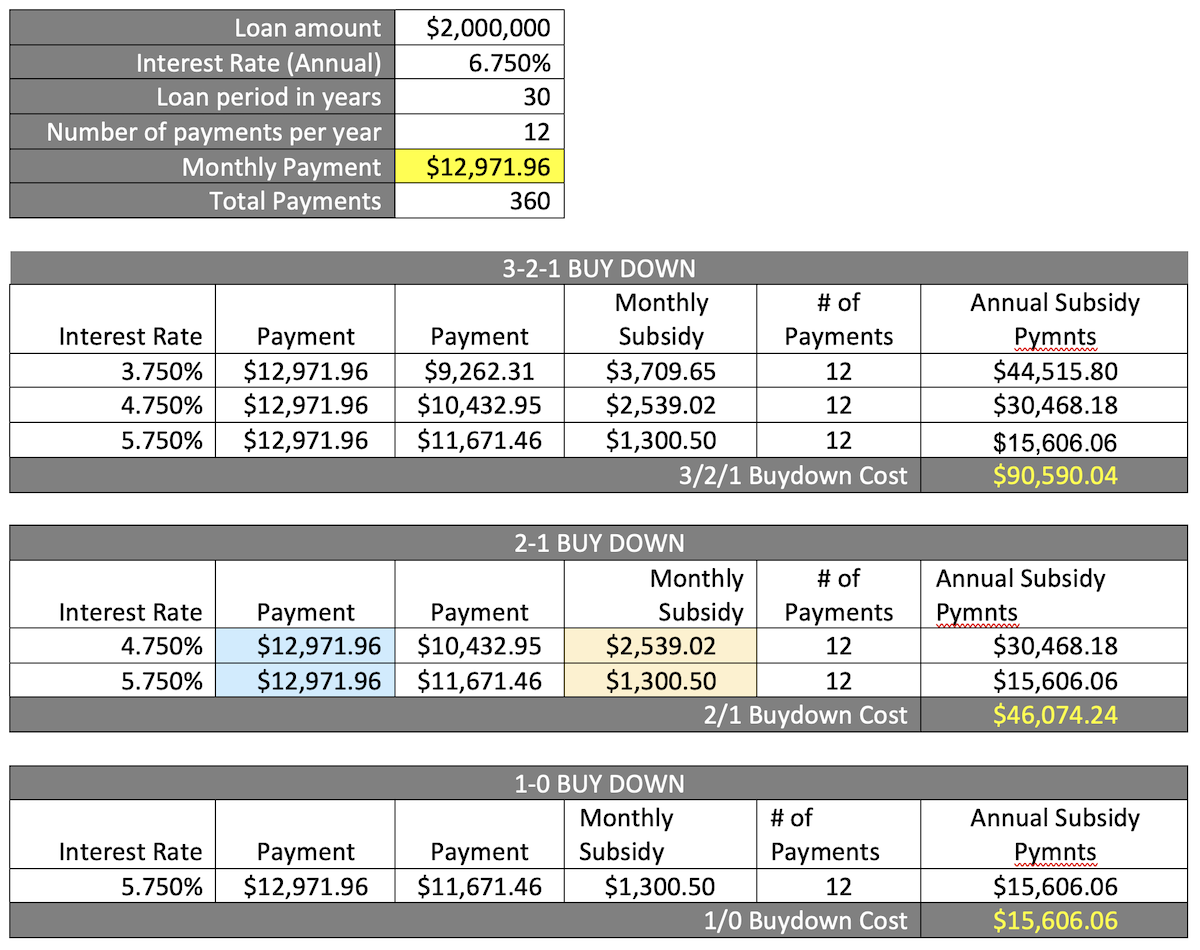
Two ways to lower your monthly mortgage payment are a Temporary Buydown and a Permanent Buydown. The first is one which requires seller participation, as such that they are contributing to offset the interest you pay for up to three years. In a Temporary Buydown the seller, or realtor, gives funds through closing which the lender holds on hand to supplement the buyer’s interest due, and at a rate 1-3% lower than the market rate. For example, a 2-1 Buydown would mean that the buyer’s rate starts at 2% lower than current market for the first year, then shifts up to 1% below that market level for the second year, moving to where the market would have been at the inception of the loan on the third year. The buyer can refinance at any time, and any funds not used towards the offset are instead put as a principal reduction. The buyer does still have to qualify at the original rate, however.
See sample grid at the top right on a $2M loan.
A Permanent Buydown is what is commonly known as “points.” Most anyone can contribute towards this type of buydown: buyer, seller, agent, even family gifts could apply. This would see the benefit of the payment reduced for the longevity of the loan, as well as that the buyer would qualify on the permanently reduced rate. The downside is that there is no refund in this situation – if you happened to refinance quickly, then that initial cost is sunk.
Looking at either one of these options is a great strategy to use if negotiating price. As a buyer your cash to close is certainly lower with a price reduction, yet if a lower monthly payment is your goal the reduction in property taxes is usually much lower than could be from a buydown standpoint.
Conversely, interest-only loans remain popular for many situations. We are currently funding a 1031 Exchange where the buyer would like a certain cash flow of the property for a window of time and aren’t concerned about any equity paydown. Keep in mind that qualifications for these types of loans can be more stringent, and rates can be higher than their principal + interest counterparts. I personally see these as a great tool for short-term leverage, and not a long-term strategy if your goal is to eventually own your home outright.
Just like the dance moves that’ll come flowing out of your awkward cousin, the market will continue to evolve and move forward. The best strategy that we can make is one that looks tightly into a five-year window, and more loosely past that. What we do know is that rates will come down again, just not when, or by how much. Being strategic in how you approach your housing expense planning can give you the financial freedom for which we all strive.
Stats courtesy of the Santa Barbara Association of Realtors, https://sbaor.org/news/statistics
You might also be interested in...