
Triple Bow-Back Windsor Settee
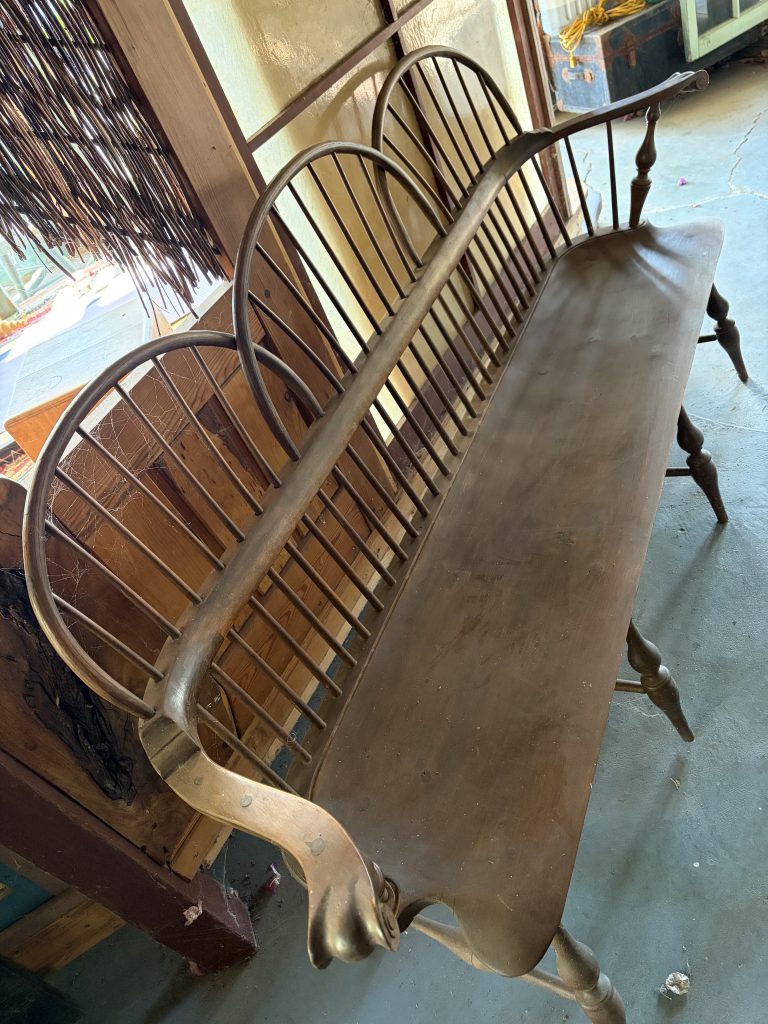
KL owns a triple bow-back Windsor settee that, at first glance, struck me as an example of 18th/19th-century Americana from the Mid-Atlantic states. This form was not especially prevalent in the grand capital cities of late 18th-century America: Philadelphia, Boston, and Newport. Windsor settees were found in taverns and wayside inns, in the “below stairs” quarters of large houses, and wherever a landowner wanted to seat three people without the expense of commissioning three separate Windsor chairs. At 72 inches long, the settee is one of the largest forms in the Windsor family.
Because these pieces were put to hard use – in taverns where travelers rested and drank, at dining tables where servants sat, or wherever a landlord wanted to seat three for the price of one – it is understandable that surviving examples are rare today. A New Hampshire bow-back settee has sold for $20,000 plus, although I could not find a comparable example currently on offer.
Windsor chairs were produced in both America and England in the late 18th and early 19th centuries, serving the middle classes on both sides of the Atlantic. More elaborate designs, such as American Chippendale furniture, were generally reserved for those born to greater means.
Examples described as “museum grade” balloon-back American Windsors are offered on sites such as Chairish. The market prizes several features: an elegant, continuous slope from the bowed back into the arms, characteristic of New England examples; an original saddle seat, with its raised central area designed to accommodate the sitter comfortably; and an undisturbed surface patina – one that has never been sanded, refinished, or painted.
There are also fine examples of a somewhat rarer variation: a modified bow-back Windsor with three spindles rising from the back and terminating beneath a shaped headrest. Fine New England examples, with graceful lines, strong provenance, and untouched surfaces, can bring $8,000 to $10,000.
And those prices are for a chair, not a bench.
The piece in the photo was made by craftsman Doug Dimes, a second-generation Windsor-chair maker based in Pittsfield, New Hampshire, or possibly by his father. A reproduction’s value is not necessarily measured by how closely it competes with an antique, but by the craftsmanship, tradition, and integrity of the work itself.
Dimes’ father began making authentic reproductions of American New England Windsor chairs in a small Northwood, New Hampshire, workshop in 1964. By the time of the American Bicentennial in 1976, he was producing Windsor writing-arm chairs – chairs with a writing surface attached to the side – commissioned by Independence Hall in Philadelphia.
His work attracted commissions from the Smithsonian and Old Sturbridge Village. In 1990, his son Doug joined him for a commission for Windsor chairs from Colonial Williamsburg.
Sadly, in 1991, just as Colonial Homes magazine was preparing a feature on the artistry of the Dimes family, the workshop burned to the ground, bringing production to a halt. A new building was constructed by 1993, and the business continued, including a 2004 commission for Windsors for the historic Charleston courthouse.
Then the fervor for Americana began to wane. Doug Dimes turned to finish carpentry. In 2018, he sold the business, returned to the family farm, and today makes Windsor chairs much as his father did in 1964 – working out of his barn.
If you wished to commission Doug Dimes to make a triple bow-back Windsor settee, you would spend approximately $5,400 and wait 18 weeks. The piece would feature the traditional maple turnings, oak bow and arm components, and a pine seat measuring approximately 70 inches long. It could be finished in traditional black or red crackle paint, with out-scrolled arms and “scrolled” knuckles – chair parts are often named after parts of the human body.
KL’s settee, however, has an estimated Fair Market Value of $1,000 in the secondary market. Reproductions generally do not retain their value in the same way as period antiques; you’ll pay more for a commissioned piece made by the master Dimes today.
Yet the Dimes settee presents an intriguing exception to the usual assumptions about reproductions, a piece made by a craftsman whose family has devoted generations to the study and practice of a historic American furniture form. Its value lies not simply in its resemblance to an 18th-century original, but in the quality of its craftsmanship, the continuity of the maker’s tradition; it remains a usable example of a nearly lost regional art.
A reproduction may not command the price of an authentic settee, but a fine one occupies a class of its own.
You might also be interested in...



You must be logged in to post a comment.