
Japanese Silk Bridal Uchikake
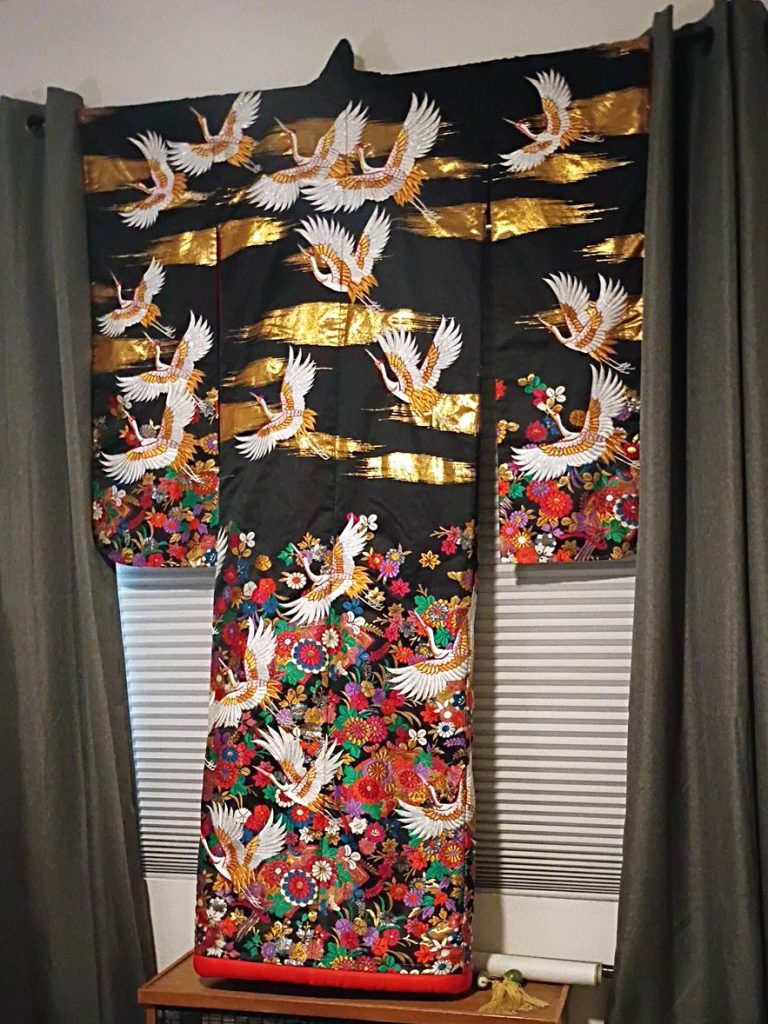
There is something quite extraordinary about a Japanese silk bridal uchikake. The example illustrated here is a 20th-century garment with a dramatic black ground, sweeping bands of metallic gold, and a profusion of white cranes in flight, surrounded by richly colored flowers. Its decoration combines hand-worked elements, including embroidery and painted details, with metallic embellishment. The padded lower hem is characteristic of the formal bridal uchikake.
The cranes are particularly meaningful. In Japanese tradition, they symbolize longevity, good fortune, and marital fidelity, making them especially appropriate for a wedding garment. The gold ornamentation and elaborate flowers add to the ceremonial splendor. A Japanese bridal uchikake offers more than a striking decorative surface. Its cranes, flowers, gold embellishment, and padded hem reflect a tradition in which clothing could convey auspicious wishes and mark one of life’s most significant occasions.
The silk, the intricacy of the decoration, the labor involved in its creation, and its excellent condition all contribute to its appeal, but sadly, not to market value in many cases.
When I examine a Japanese bridal kimono, I find myself asking how it came to be in an American collection. Most kimono I encounter have come to the United States through American military personnel and their families. Following World War II, servicemen stationed in Japan encountered Japanese textiles in shops and markets, and some brought garments home as souvenirs. These tell a poignant cultural story.
In postwar Japan, particularly from the 1950s through the 1970s, elaborate silk kimono formed part of the bridal trousseaux of some families. These garments could be expensive, carefully preserved, and worn only on special occasions. As customs changed and Western-style wedding clothing became more common, some were passed into the secondhand market.
Japanese textile dealers and import shops that catered to decorators also played a role. By the mid- to late 20th century, Asian decorative arts had become an important element in American interior design. Collectors and decorators sought textiles, screens, ceramics, and other objects that offered color, texture, and a sense of cultural history.
I have seen many of these garments hung as wall displays, suspended from a horizontal pole through their long, elegant sleeves. Some particularly elaborate, heavily embroidered examples were placed in lucite cases and displayed in more exclusive and expensive settings, where their intricate surfaces could be admired without the garment being worn.
Over the years, I have been asked to appraise many of these lovely garments. I have found that establishing their value can be difficult because the market fluctuates widely. The handwork, metallic decoration, rich colors, and sheer quantity of material suggest hours of skilled labor. The market is becoming more aware of the cultural importance of a kimono acquired during World War II, and the respect with which these kimono should be handled.
For the most part, collectors do not wear their collections, although I have one client who does. The market that once embraced them as dramatic interior decorations has changed. (As decor, these don’t resonate with simplicity, neutral colors, geometric stylings…)
At the lower end of the resale market, general auction houses may offer Japanese kimono for less than $200. Such prices can be disappointing. The finest examples are often pre-20th-century kimono, especially those from the 19th century, and it takes an expert to identify these. They can attract greater interest, particularly when they have exceptional decoration, excellent condition, or a documented history. Antique and vintage kimono attract an entirely separate market. For sellers of those garments, I would contact Dessa Goddard at Bonhams in Los Angeles, a genuine expert in vintage Asian
silk garments.
In my experience, Artemis Fine Art has been a useful platform to consider when selling 20th-century kimono.
Clients have sold in consignment stores, but I do not recommend this approach. A brick-and-mortar store will display the kimono: silk can be fragile, and the weight of a heavily decorated kimono may place considerable stress on it. Hanging one from a conventional American clothes hanger is devastating.
Respecting the uchikake means recognizing that it is more than a beautiful textile; it is a culturally significant ceremonial garment that carries generations of Japanese tradition, symbolism, and skilled craftsmanship. Its preservation and display should honor that heritage, treating the garment not merely as decoration, but as an expression of Japan’s cultural identity and artistic legacy.
The challenge is to balance the garment’s aesthetic significance with its importance to the culture itself. Selling these garments requires a finely calibrated cultural awareness. Beauty, history, and market value are related, but they are not interchangeable.
You might also be interested in...




You must be logged in to post a comment.