
Women in Film: The Female Lens
The 41st Annual Santa Barbara International Film Festival (SBIFF) has completed yet another voyage around the sun. Under the capable baton of Executive Director Roger Durling and his talented team the festival remains dedicated to discovering and showcasing the best in independent and international cinema and attracting Oscar nominated talent worldwide. Over 100,000 attendees reveled in 200 plus films, tributes and symposiums. Along with the festival, considered one of the top ten in the United States, the SBIFF, a 501(c)(3) a nonprofit organization, is dedicated to the education and support of young filmmakers and expanding Santa Barbara’s platforms and theater spaces. How’s that for a jewel in the crown of our city?
As a super movie geek, I’m thrilled that half the films screened were directed/produced by women. Women filmmakers now represent a paradigm shift… or could it be that film as art has simply returned to its roots? During the industry’s formative years women were the strongest presence behind the camera as directors, screenwriters, producers, as well as crew. When movies became commercially viable in the 1930s and ‘40s, women were ignored or pushed out. Dorothy Arzner and Ida Lupino come to mind as survivors.
Today’s cinema universe is increasingly populated by women… and in multiple capacities! As producer of the documentary film Gaslit, screened on February 5th at the Riviera Theatre, Jane Fonda blends her passion as a lifelong activist with her talents as an actor, producer, businesswoman and educator. Although born in New York City, the daughter of legendary actor Henry Fonda is very much a child of ‘Hollywood,’ the mythical land that extends across the globe. In the shadow of a difficult and distant father her childhood was complicated, body image and talent as painful themes. Being told by Lee Strasberg, the guru of Method Acting, that she had ‘real talent’ gave her courage and the self-confidence to launch an award-packed career as an actor, and to become the passionate political activist she is today.
In the film Gaslit, Fonda, as both host and producer, joined a group of local activists showcasing the devastation in the Texas oil fields and the processing plants along the Gulf Coast that refine oil for liquified natural gas, and related products. How the oil industry continues to expand – forcing residents from their ancestral homes, destroying the land, pumping methane into the atmosphere causing a tidal wave of cancer deaths – is mind blowing. As environmental concerns are at issue globally, 99% of LNG and related products are exported overseas at the expense of America’s health and the global environment. Post film, with director Katie Camosy and protestor Diane Wilson, Fonda stated, “It’s almost unfathomable when you see the destruction that’s happened to the lives of the people who live in Texas and Louisiana. We need to fight back…!” Ever the activist, she proudly announced, “I spent my 82nd birthday in jail!”
Cradled in Hollywood’s Golden Age Fonda embraced the family business. Chloé Zhao, on the other hand, arrived by a circuitous route… perhaps serendipitously? Born in Beijing to a well-to-do family and self-described as curious but rebellious and lazy, interested only in American Westerns, music, writing and drawing manga cartoons. After her parents’ divorce and a UK boarding school, she graduated from Los Angeles High School after
emigrating to the United States on her own. Massachusetts and Mount Holyoke College was her next stop, minoring in film. Finally, she found her way to New York University’s Tisch School of the Arts where her first films were made. Today she is the second woman, first Asian female, to win a Best Director Oscar for Nomadland.
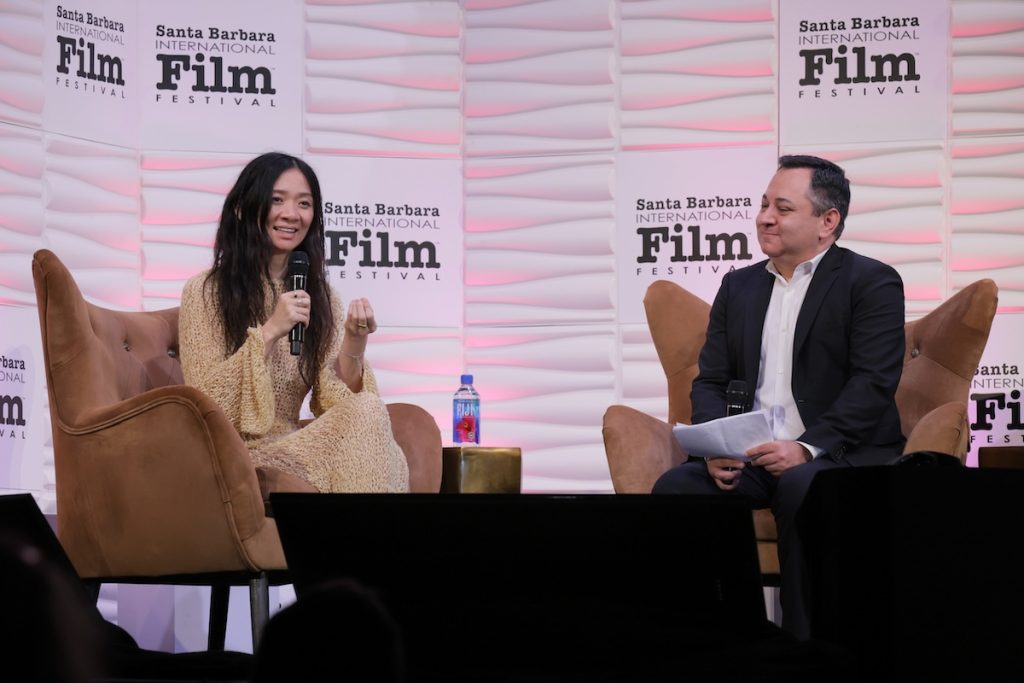
On Tuesday, February 10th, along with three other 2026 Academy Award nominated male directors, Zhao was honored with SBIFF’s Outstanding Director of the Year award. The recognition is for Hamnet, based on a novel by Maggie O’Farrell – Zhao’s co-screenwriter. Hamnet is an imagined story about Agnes Hathaway and William Shakespeare’s relationship before and after the death of their 11-year-old son, Hamnet. A tragic and grief-stricken journey separates them and informs the writing of Shakespeare’s greatest play, Hamlet. Seated on the Arlington stage with Hollywood Reporter’s Scott Feinberg, Zhao talked of her four-year hiatus between films. “I learned very humbly that there are four seasons to a person’s life, to a day, to a creative cycle, and I didn’t understand the importance of winter,” was her thoughtful response. “I made four films during my 30s, I did not have any time to winter… to let things die, to decompose and truly remake the soil.”
Zhao’s winter, as internal and creative dissonance, took several years just to ‘feel safe’ enough to examine what she called the Mother Wound, a sensitive and personal issue. She described the character of Agnes as “the Motherlode of mother,” therefore when approached with the script, she had reservations. “I came to realize that if I don’t work on that wounding it’s going to make the second half of my life unbearable.” In the course of the production Zhao realized that confronting the mother archetype on film was a part of her own healing journey. Speaking of her unusual style of directing, she referred to the sacred rites of the ancients. Zhao views performers as modern-day shamans who put themselves through profound physical and emotional states to channel a character; meditation and ceremony are used to create a safe space and act as a boundary between life on set and that of the outside world. “There is a proper opening and closing to that ceremony…” for the entire company to enter and exit together for a smooth transition into everyday life. Zhao’s exceptional sensibilities and methods translate to her films and apparently to her audience. Could another First be in Zhao’s future?
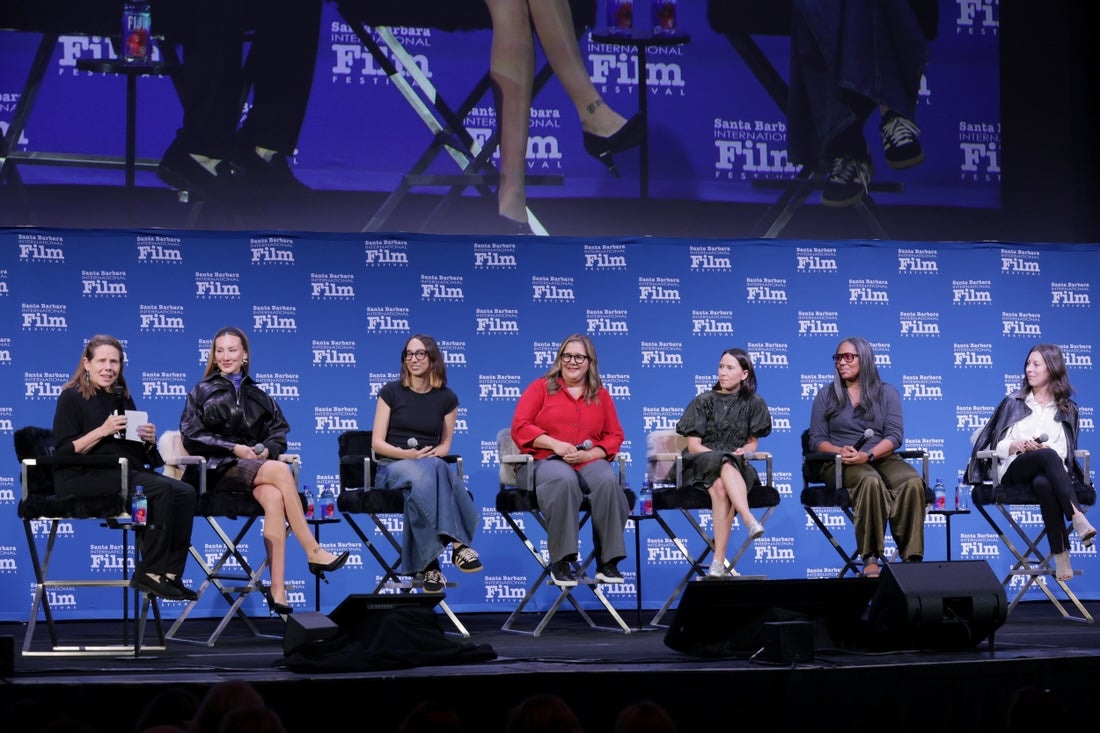
The Women’s Panel, held on Saturday morning, February 7th at the Arlington Theatre remains an event close to my heart. “When we started this panel with the great Madeline Hammond, who’s been hosting this for 23 years,” exclaimed Roger Durling, “…there were 4 people in the audience!” This year’s panel, greeted by a huge crowd, featured six Oscar nominated creatives, each with an individual story. Yvett Merino, a UCSB alum, produced Zootopia 2, which became the highest grossing film of all time, requiring five years to reach the screen. In complete agreement was producer Ashley Schlaifer, as Train Dreams took roughly 10 years. Sparked by women’s protests in Iran, writer-director Natalie Musteata’s short film, Two People Exchanging Saliva, emphasized absurdity as a reflection of the international consumerist culture and political climates. Laia Casanovas, sound designer for Sirat, described a 17-minute real life rave with ear splitting music while capturing the sound of actors speaking their lines. Costume designer Miyako Bellizzi, recalled that Marty Supreme required over 9,000 costumes for just essential background actors. The Perfect Neighbor, produced by Alisa Payne, is an innovative documentary visualized through police body and surveillance cameras alone. No surprise then – the Women’s Panel showcases artistic collaboration in tandem as essential to the creative process… and through the female lens.
Collaboration… I like that word! It sums up my 2026 SBIFF adventure attending projects helmed by women. I felt like a kid in a candy store… and I was! Jane Fonda with her frequent use of the word ‘we’ in almost every sentence, even in her 80s, remains a collaborator as both artist and activist. Chloe Zhao notes that collaboration is the backbone of filmmaking and ideally takes both the ‘yin and the yang,’ one half being the female lens. Having an opportunity to view the Women’s Panel and their generous focus on one another, sharing both admiration and challenges was a real treat. Thank you to all the talented ladies and to the SBIFF for another awesome experience. See you next year!
You might also be interested in...




You must be logged in to post a comment.