
Our Cosmic Coast: Natural History Museum’s Stellar New Exhibit
If you live in Santa Barbara or the surrounding area, you’re likely no stranger to the thunderous boom that follows late-night rocket launches at Vandenberg Air Force Base. While the noise can be jarring, watching those rockets streak into the night sky is undeniably thrilling. If you’re like me, those launches have probably sparked your curiosity too, leaving you wondering how it all works.
Luckily, the Santa Barbara Museum of Natural History’s new permanent Space Sciences exhibit, Our Cosmic Coast, has simulations and displays that break down the science behind rocket launches and other space phenomena in an approachable way.
“What we wanted to do was make the science of our galaxy and our planet a little more approachable for our guests,” reflected Exhibits Director Melinda Morgan-Stowell on the exhibit.
Morgan-Stowell and the rest of the exhibits team wanted to present concepts straightforwardly and answer the “why” questions, particularly for younger children, without using excessive jargon or overly complex scientific details. “Really, the idea is to be able to present the natural world in as interesting a way as possible and for a multitude of different types of learning experiences and families,” she said.
The new exhibit, which is free with a museum ticket, combines visual, sound, and interactive elements to bring space science to life. “We really wanted to involve all the senses for our guests,” she shared.
When you first step into the room, it may take a moment for your eyes to adjust to the surroundings. The new iteration of the space exhibit isn’t pitch black; instead, dim lighting and cobalt blue walls create a serene and otherworldly backdrop. Here, visitors can explore stations that explain the astronomical forces behind tides, seasons, and lunar phases, and examine authentic meteorites.
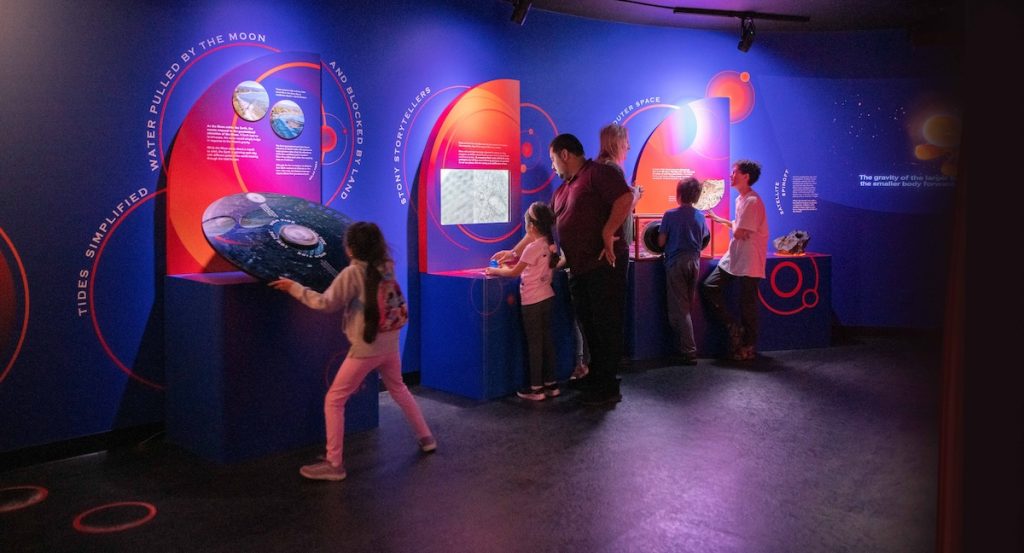
The reason for the Space Sciences update was simple: the museum wanted to bring the exhibit’s content up to date. That meant incorporating the latest scientific theories, including the current understanding of the Moon’s formation – that it was once part of Earth.
The microscope station illustrates this updated scientific concept, where visitors can observe a mineral that is chemically identical to one found on the Moon. Although its appearance is slightly different due to Earth’s climate and environmental factors, it demonstrates its shared elemental composition.
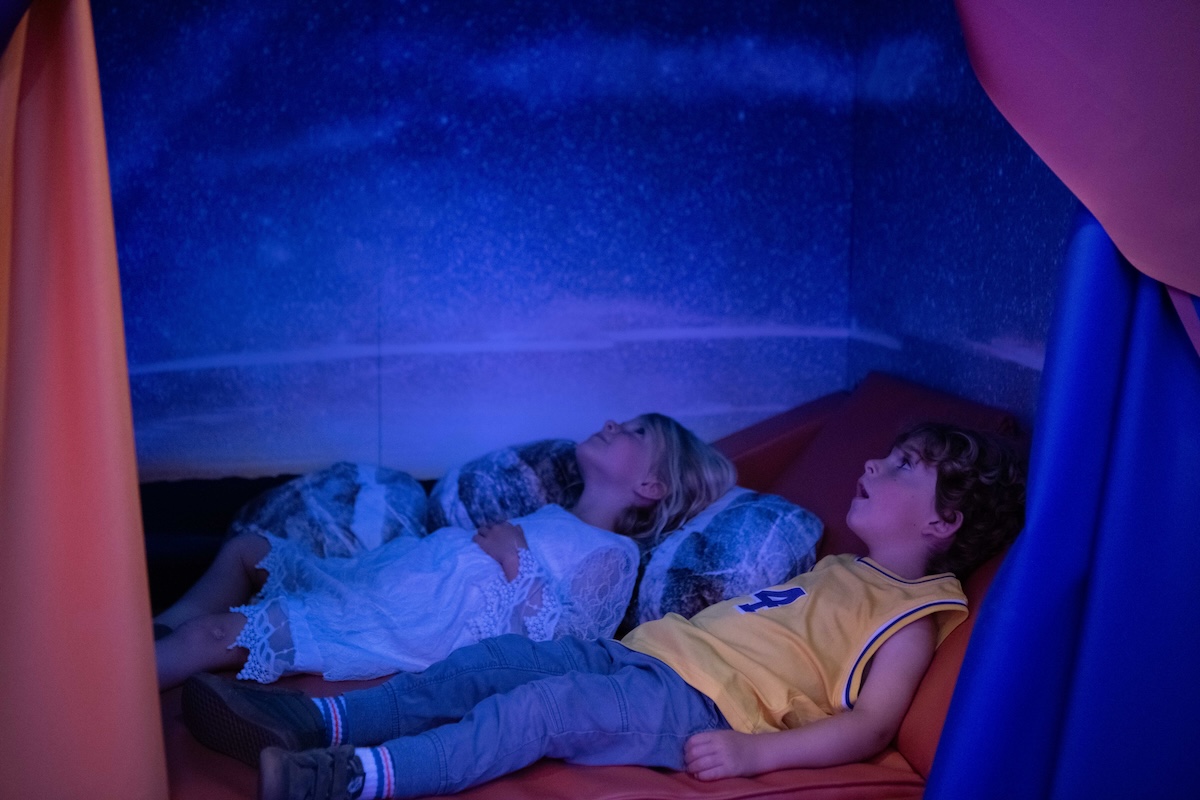
In the second room, you’re met with scale models that illustrate the dramatic size differences between the rocky planets and the gas and ice giants. Visitors can even crawl into a tent to view constellations visible from Santa Barbara. There are also various listening stations, including one where you can hear the sonification of a black hole.
The true star of the show, however, is the rocket launcher, which can help children, or visitors of any age, understand the interrelationship between Earth and space exploration. By shooting off rockets, it demonstrates an object’s position at different elevations and how it might escape Earth’s gravity.
The rocket launcher is a tall, see-through tube – about 16 feet high – designed so you can watch every moment of your rocket’s flight. You start by pumping air into the launcher, building up pressure. Once you’ve stored enough, you press a button to release that energy, and your small foam or plastic rocket shoots straight up inside the clear column. As it rises, you can track how high it goes, almost like a vertical race against yourself
or friends.
Along with some new knowledge about rockets, Morgan-Stowell hopes that guests will leave the exhibit with an appreciation for the planet’s uniqueness and a desire to preserve it. “What I would love them to do is value our planet, as we are so unique and so fragile and so beautiful.”
You might also be interested in...




You must be logged in to post a comment.