
The Paris Protests: “More Manuals, Less Emmanuel”
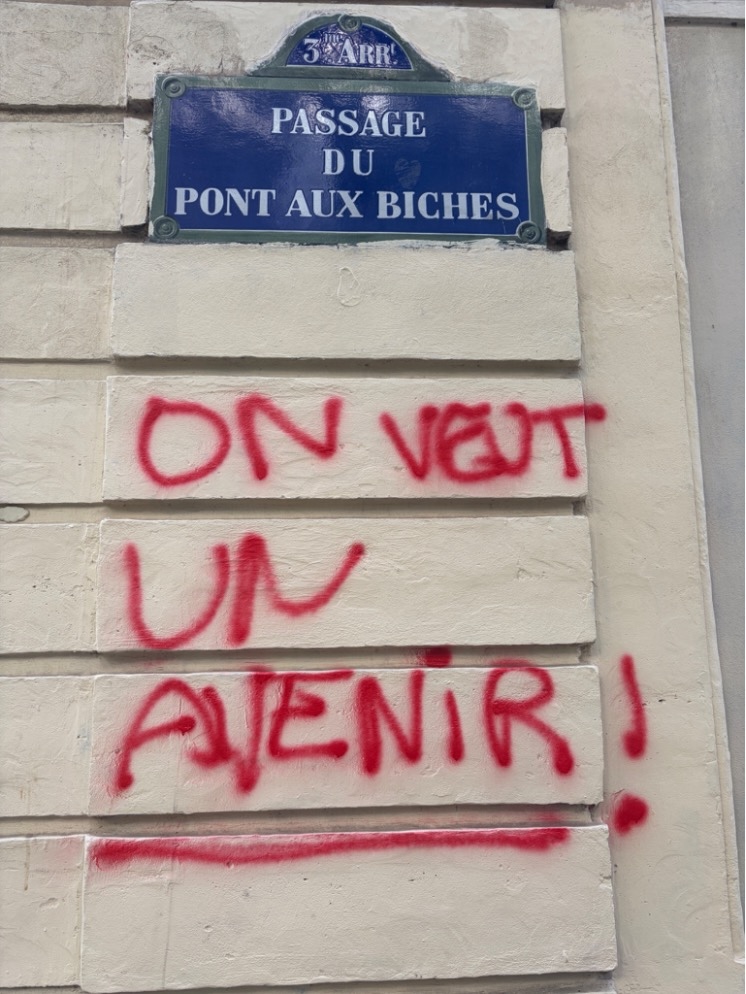
It’s 1:30 pm in Paris, I stand on the sidewalk in the 3rd arrondissement, an area known for its trendy cafés and fashion week pop-ups. There’s an electricity in the air today, a feeling of anticipation. For the past two weeks, people have been organizing protests for today, October 17th.
In September, high school students around the country began to protest the conditions in their schools. A lack of desks and chairs, a lack of heating in the winter and fans in the summer heatwaves, a lack of staff, and a lack of working bathrooms are just some of the complaints that have been made by students and faculty. Since September, the movement has expanded beyond deteriorating school conditions to reflect widespread anger over France’s rising cost of living.
October 17th was chosen as the date of mass protest for a specific reason – On October 17th, 1961, hundreds of Algerians were killed by Paris police during a peaceful protest against a daily curfew imposed on them.
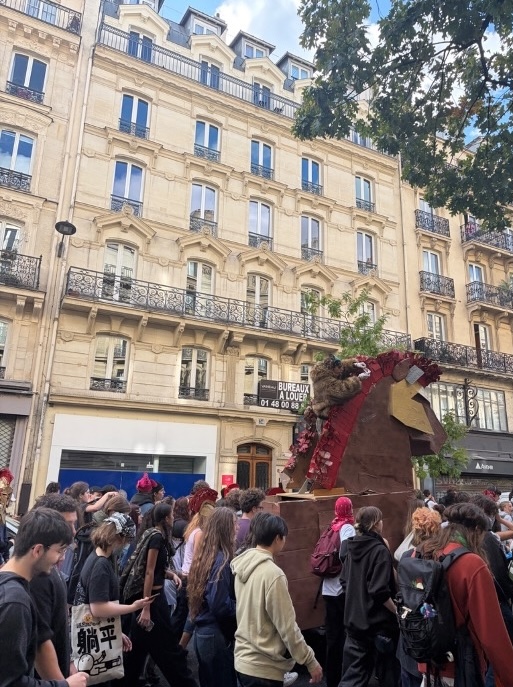
Today, some stores are exceptionally closed, and the ATMs on the street have been covered. It is now 1:45 pm and the street is alive with a stream of protesters marching towards Place de la République, the usual gathering place for protests in Paris. A large group from an art school passes by, clad in cardboard Greek military helmets with a giant Trojan horse float (this group would have fit in perfectly at the SB solstice parade). The crowd breaks out into song, singing happy birthday in French before chanting “ACAB.”
Two young girls run past me, clutching a clarinet and a trumpet. A few minutes later I see them again, this time they are playing their instruments alongside an entire marching band. Across the street, another girl is spray painting a caricature of current French president Emmanuel Macron on an electricity box.
Honestly – it’s a good vibe, it feels hopeful yet angry. I’m not the only spectator watching from the sidewalk; there are plenty of people going about their daily business, including families with small children and tourists. A bike whizzes by, its rider wearing a French flag as a cape.
Watching the procession of protestors, I realize that its participants are people of all ages: old ladies hunched over, high schoolers, nurses in their scrubs, cancer patients, teachers, train conductors, and plenty clad in hi-vis yellow vests (aka les Gilets jaune).
Gen Z culture is deeply intertwined in the protest, shaping its energy. I see teens in Spiderman masks, and others waving flags with the skull-and-crossbones pirate logo of the anime series One Piece. One guy is wearing a pink unicorn onesie with a keffiyeh. Of course, there are plenty of signs with internet memes on them, such as “Generation 67 refait mai 68,” referencing the nonsensical “six-seven” meme as well as the May 1968 student revolt in France. Police vans roll by in their dozens and the group of high schoolers huddled beside me on the sidewalk begins to sing the empire’s song from Star Wars. Although there is a strong dislike for the police, there is a deep respect for firefighters, and each time a fire truck needs to pass, the crowd quickly parts to make way, and even offers applause for the firemen. I’ve never seen a protest this big, it feels like there are protesters on almost every street I pass. My boyfriend, GoPro in hand, nudges me, asking if we can go see whatever is unfolding at Place De La République. I nervously agree and we continue walking.
We are nearly a street away when suddenly tear gas stings my nostrils and eyes. Police vans are blocking the road and police officers in full riot gear yell at people to turn around and go the way they came. To my right, a boy with down syndrome is sitting on the sidewalk, rubbing his eyes as his father comforts him. This is where we decide to turn around and walk home, invigorated and hoping for positive change.
Sofia Fouroohi-Martin
You might also be interested in...




You must be logged in to post a comment.