
Chinese Rattan Bride Basket
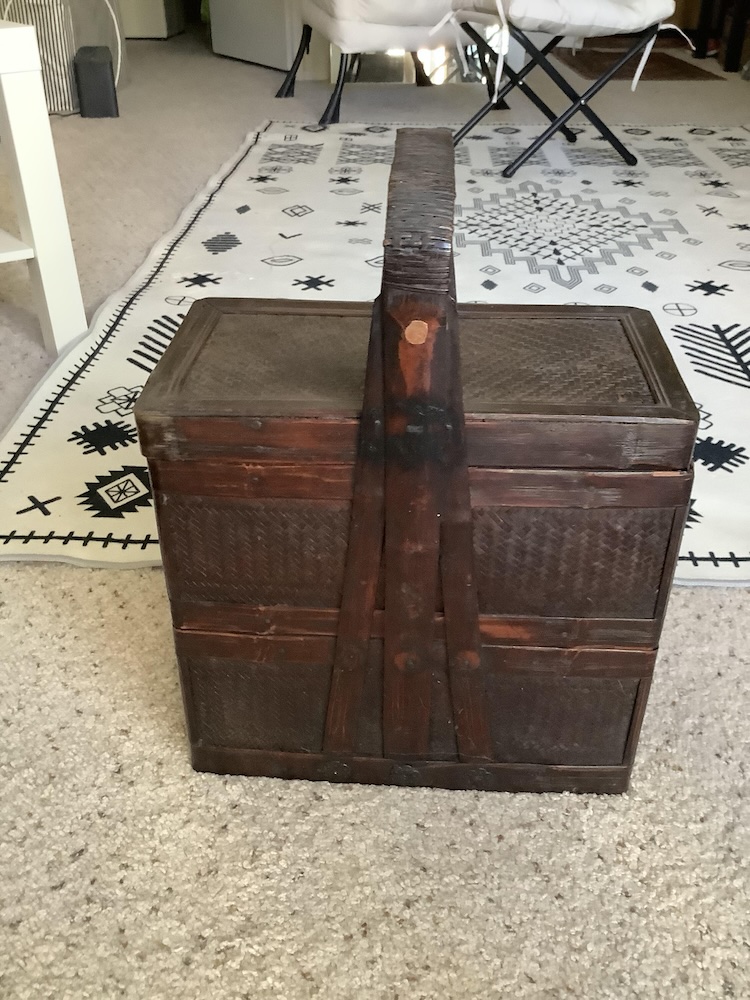
JW has a tall, rectangular, two-tiered rattan Chinese basket circa 1900. She was inspired to write me because of my previous article on Victorian Bride’s Baskets. Her Chinese basket is ALSO a bride’s basket traditionally given in the Guo Da Li pre-wedding processional during the betrothal or engagement period, a gift from the groom’s family to the bride’s family. Though the Guo Da Li pre-wedding ceremony dates to the Zhou Dynasty about three thousand years ago, the traditional Chinese bridal or betrothal basket – often known as “come home” baskets or wedding baskets – emerged as a formalized tradition around the turn of the 20th century. The baskets became a popular export from China to England and the U.S. from 1880-1930s, advertised as tea or sewing baskets from Canton.
The content and composition of the basket was, in the 19th century, meant to show the financial status of the groom’s family, and the festive delivery of the basket to the bride’s family was a show of respect. Wedding baskets are not to be confused with fine Chinese lunch baskets, which will usually have a layer of insulation inside. These betrothal baskets symbolized the bride’s transition into her new family, as she will soon move into her husband’s family home, serve his parents, honor his ancestors, and become a member of his household and his relative’s households in the patrilinear tradition. The third day after the wedding, the bride and groom would return to the bride’s home where she would be treated as a guest, signifying a break with her natal family. Thus the wedding basket festival was a bittersweet event.
The content and composition of the basket was, in the 19th century, meant to show the financial status of the groom’s family, and the festive delivery of the basket to the bride’s family was a show of respect.
JW’s basket is just one of the traditional styles of wedding baskets: hers is hand woven rattan with a bamboo structure and a bamboo arched handle which is wrapped with rattan. It is about 18” high and is in two parts; each a rectangular container, with the top rectangle having a lid. This was evidently a basket given by a family of lesser means. A wealthier family might have offered the bride’s family a basket made of Shandong Elm, of a box shape of two squares, or a bamboo tub-shaped basket with a band of auspicious enameled flowers and dragons around the girdle. The finest had calligraphy of the names of the families and poems offering both good wishes and the hope of many offspring. The best baskets were completely lacquered (called a bakul siah) in tones of amber and red. The color red is considered a lucky color symbolizing prosperity, joy, and vitality.
The baskets contained gifts, but not just any gift; the objects carried in these baskets were symbols of the couple’s future lives together. The first category of gifts were dowry items: food, jewelry, and clothing. A procession complete with music might carry more than one of these baskets. If the family had money, a second basket might contain special objects of red – for instance red wine, packets of red containing coconut, or dragon or phoenix shaped candles. Accents of red and gold symbolize wealth, beauty, and good beginnings. The Four Treasures were often carried in these baskets: gold, dried fruit, dried seafood, pig’s feet (today canned or tinned pig trotters are used), abalone for abundance and wealth, fat choy for prosperity and good fortune.
A basket like JW’s might have been painted in 1900 or accented with live peony beds and blooms symbolizing fertility and prosperity.
The tradition of gifting pre-wedding baskets is strong today. “Gift Hampers Hong Kong,” creates lavish wedding baskets, “Chinese Pre Wedding Hampers” filled with symbolic favors. Baskets may be presented by any well-wisher and are not specifically from the groom’s family to the bride’s family.
The correct contents recommended by Gift Hampers Hong Kong for modern-day Wedding Hampers are baskets with lucky fruits, such as jujubes for wealth prosperity and fertility; peanuts for health, longevity, life, growth, and flourishing love; and mandarin oranges for wealth and prosperity. Longans might also be included for good luck, lotus seeds for prosperity and offspring, and grapes with seeds – thought to bring prosperity and offspring.
Painted features include dragon and phoenix images for a fruitful and loving marriage, successful endeavors, and offspring. Well-wishers can order a four, six, or an eight-hamper package for the pre wedding Guo Da Li ceremony. The four-hamper package includes gourmet delicacies, wine, gifts, fruit and golden coconut. All packages contain Hang Heung, the Chinese Bridal cake. Benefactors can order six or eight hampers of dried seafood and six to eight hampers of dried and fresh fruit. The most expensive series of eight hampers will cost $1,800.
JW’s vintage 1900 wedding basket contents were simpler, and the gifts contained only what this one basket could hold. Afterwards, the basket was kept during the couple’s marriage in the home and contained sewing implements. Today it is valued at $400.
You might also be interested in...




You must be logged in to post a comment.