
High Misery Index
Before we left for Southern Patagonia, our South American travel agent insisted, “The most important thing to remember is you must go with a driver and a guide. The roads are terrible, and each hotel is isolated. There are no gas stations between hotels, and no place to stay if you cannot reach the next hotel.”
“What about just a driver? Do we need a guide also?” I bargained.
“Yes, of course you need a guide. The drivers speak Spanish. They don’t speak English. The guide will be your interpreter. Plus, the hiking places are not easy to find, and you need so much information.”
Admitting defeat, I said, “Okay, don’t worry. We’ll use both a guide and a driver.”

To reach Patagonia, we would first fly to Santiago, Chile’s capital and largest city. Chile, sandwiched between the Pacific Ocean and the Andes Mountains, is the longest and skinniest country in the world. Santiago sits about the midway point along the length. Changing planes in Santiago, we would then fly south 2,000 miles to Coyhaique. From the airport in Coyhaique, we would begin a three-week road trip through Patagonia.
Patagonia is vast, extending over 400,000 square miles. With a population density of just five people per square mile, it is one of the most sparsely inhabited areas in the world. It encompasses fjords on the west coast, expansive grasslands with rolling hills to the east, and the snow-capped Andes Mountains separating the two.
On our journey from the north to the south, we would drive through both Chile and Argentina, covering three to four hours each day, mostly on dirt roads, with a three-day stay in almost all locations. Finally, we would drop off the rental car in Punta Arenas and continue to Antarctica.
That night, Geoff received a package from Amazon: The Lonely Planet Guide to Patagonia.
“Hey, honey, look! The trip the travel agent planned is exactly the same as in this book. I thought it was uniquely designed for us. Wait, here are the hotels we are staying in. And there’s driving instruction. We don’t need a driver. We can drive there ourselves.”
A few minutes later, he told me: “We can rent a truck one way from Coyhaique to Punta Arenas. There is a manual four-wheel-drive Mitsubishi. They do not allow extra gas cans, but this truck was specifically designed for Patagonia. We can go 400 miles without refueling.”
Here is why I agreed to go against professional advice and drive, without a guide, a four-wheel-drive pick-up on dirt roads in one of the most remote areas in the world. On Geoff’s list of things he wanted to do before he died was drive from the southern tip of South America to the United States. I agreed to the Patagonia trip since we’d only be going a fraction of that distance. Besides, I was a travel writer and needed a good story.
A travel website (LandTravel.com), describes Chile’s 7,770 unpaved miles as a way to explore wild Patagonia. “Its current configuration is an incongruous jumble of driftable gravel, flour-fine dust, potholed tarmac, and perfect concrete. Road materials can change three times within a mile, demanding concentration.” I found this to be accurate, except for the perfect concrete.
The first road we took out of the airport was Ruta 7. It was brain-rattling and dusty, with a surprising number of cars and bicyclists. Each time a vehicle passed, a cloud of dust obscured the road, potentially causing a head-on collision. But it was the cyclists that worried me. They rode on the single-car track with the least gravel and bumps. They carried heavy loads of camping equipment up steep hills while facing a serious headwind. Because of the traffic, they were also breathing the dust of the passing cars. The wind was blowing so hard that we saw one bicyclist get nearly blown over when they stopped to take cover.
Periodically, when the driving was rough, I said, “At least we aren’t on a bicycle.”
The drive on Ruta 7 to our first stop, Puerto Rio Tranquilo, took an excruciatingly long four hours. We were indeed rewarded with tranquility when we found our small hostel, El Puesto. The atmosphere balanced rustic and chic.
After Puerto Rio Tranquilo, we stayed mainly at two Explora lodges: Valle Chacabuco and Torres del Paine. They are known for all-inclusive, guided exploration programs from remote national park locations. Walking along the path to our first room, we saw herds of guanaco, the Chilean version of llamas, casually grazing on the lawn, safe from the pumas, the local mountain lions.
The Explora lodge in Valle Chacabuco was once the original ranch of the American Douglas Tompkins. Tompkins was best known as the founder of North Face, the outdoor gear company. As the story goes, he visited Patagonia to rock climb in the early 1990s. He thought the place was so beautiful that he decided to protect it.
He bought many ranches and gave them to the Chilean government, with the stipulation that they be either preserved or restored to their natural state. After lengthy negotiations, the government established the Patagonia National Park in 2018, which included Valle Chacabuco. The rangeland, which once was pasture for sheep, was now home to puma, guanaco, and fox. As a side note, Tompkins died in the freezing waters of Lake General Carrera when the wind blew his kayak over. It turned out that Patagonia was both beautiful and deadly.
Our travel agent was right: two people were needed to drive through Patagonia. One person steered the truck, and the other navigated through the minefields of potholes, cars passing on curves, and guanaco herds alongside the road. The potholes embedded in the endless ruts were deep, frequent, and capable of taking out a muffler. The person sitting shotgun shouted, “Guanaco herd to the left,” “Stay right going over this hill,” “Truck approaching.” Other times, the road was flat, the scenery blank, and the only sound was our pickup bouncing along rutty, jerky dirt roads.
The winds of Southern Patagonia were as legendary as its beauty. When we hiked, it was always with us, either helping or hampering. Sometimes a wind gust carried a cloud of dirt, with slivers of rock that hurt. When we pulled into one motel, a dust hurricane blew us through the front door. An apologetic receptionist greeted us. “This is not normal,” she said. I was not sure I believed her.
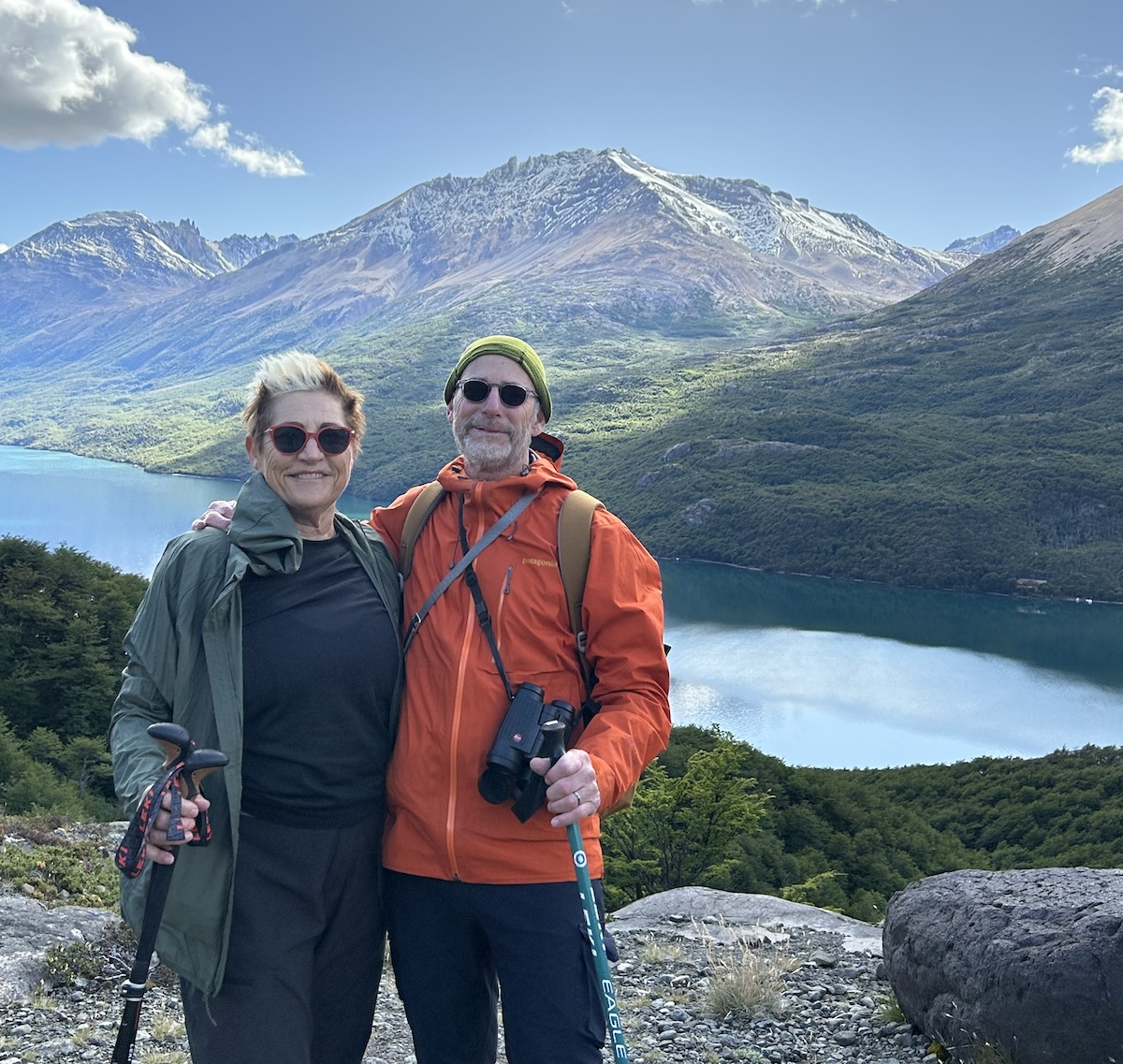
Despite the wind, dust, and potholes, the scenery was as beautiful as the photo books showed. We spent days gazing at mountain lakes, surrounded by endless forest and brilliant white glaciers. We were lucky to be part of the elite group that visited southern Patagonia.
In nine days of driving, we covered 1,500 miles. Two-thirds of that time was spent on bumpy dirt roads. Was the torment of the road trip worth it? Looking back, it was. Would I recommend it to my friends? Absolutely. Even though the misery index was too high for anyone over thirty.
The beauty of remote southern Patagonia taught me a monumental life lesson. I was sick of looking at scenery. I never wanted to see another snow-capped mountain, sparkling glacier, or clear, deep blue lake again. Of course, that didn’t stop me from heading to Antarctica for more scenery, only this time, the never-ending view would be of snow, ice, and penguins.
The end.
On Saturday, February 21, from 3-4 pm, Tecolote Book Shop is hosting a book signing with Dale Zurawski, author of The Travel Bitch: Bouncing Across the Globe on a Bipolar High. With equal parts humor and honesty, this bold and captivating travel memoir takes readers on an exhilarating journey around the world.
You might also be interested in...




You must be logged in to post a comment.