
Spirit Homes & Curio Cabinets
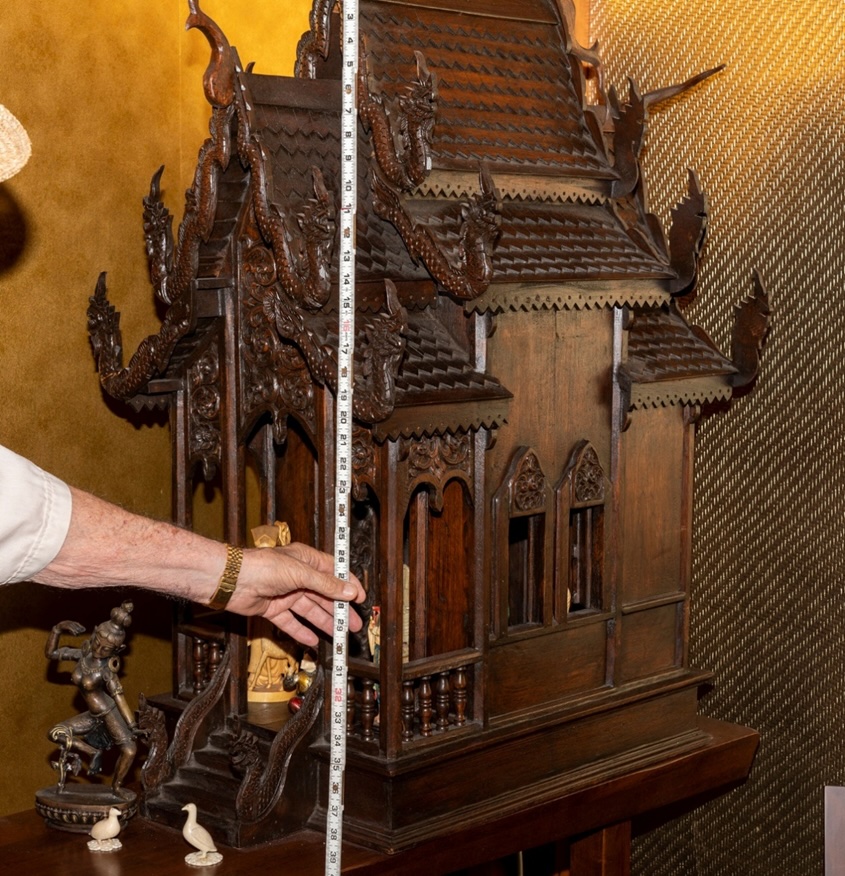
Spurred on by the other week’s article about the scorned lover who broke up a birdhouse with a claw hammer, and her successful donation of the hammer to the Zagreb Museum of Broken Relationships, GG has a miniature haunted spirit house that he wants to donate.
But where?
I suggested the Museum of Jurassic Technology on Venice Blvd. in Culver City, a museum dedicated to “incongruity in the face of unfathomable phenomena,” as stated on their website.
Do they accept objects as donations? Submit a proposal in writing to the curatorial staff, who seek small unique curios and specialized dioramas. GG will write a compelling narrative, a provenance, and references, the more obscure the better, tongue-in-cheekily scientific and scholarly.
You have concluded that the Museum of Jurassic Technology is not the kind of museum you expect. It is not a mainstream institution with a huge public presence. It is a hole in the wall Culver City storefront where truth, illusion, and collecting mania is on display. A favorite spot: when I brought my mother Elinor, her mathematician’s logical brain exploded with annoyance. “This isn’t real; none of this is true – and this is supposed to be a Museum. It is not rational, it makes no sense!” she said of the display of Horned Ants, the display of tiny wizards’ hats, and 10th century ossified tears.
GG’s haunted spirit house might fit in well: a hand carved teak san phra phum, a miniature temple in which reside good spirits who come out to battle the bad spirits. The good spirits are fed with flowers and sweets; propitiated, they will protect. The dragons on the multitiered roof come to life at night – hear them roar – but of course they are not “real,” hauntings are not truth. Or are they? What is the truth? Is it fluid, subjective? What is a ‘real’ presentation? And in fact, what is a spirit, and what is a museum?
The Museum might sell the house in the Jurassic Technology Museum Shop, which is unlike any other. It is an extension of the museum, in all its absurdity and scientific jargon. Objects for purchase are couched in premodern alchemical terms: strange and beautiful, eerie and absurd. You can choose from the shop’s collection of books of eclectic creators, unheard-of artists, pseudo-scientists, “real” people who never made the mainstream; idiosyncratic and defying categorization. The gift shop has works created by the founder of the museum David Hildebrand Wilson. Pick up a brilliant book, Lawrence Weschler’s finalist for the Pulitzer Prize: Mr. Wilson’s Cabinet of Wonder: Pronged Ants, Horned Humans, Mice on Toast, and other Marvels of Jurassic Technology.
GG’s question is simple: “What is Jurassic Technology? Wasn’t the Jurassic period about 200 to 175 million years ago?” The time when dinosaurs and places like the Colorado Plateau of Southeastern Utah were forming? The Museum website unabashedly states the institution is dedicated to relics from the LOWER Jurassic eras, those of curious and unusual technological qualities, significant to the scholar and to the general public. The emphasis, as I read it, is on an ancient mythical time before categories, before the world was a composite of systems separating science from art, imagination from fact. Here’s an example: The website states that the theme for the museum is the most complete museum of natural history the world has ever seen, and invokes not only Noah’s Ark, but the reputed First Museum, a 3rd century BCE “great institution” and community of scholars, whose compound included apartments, a botanical garden, zoological park, astronomical observatory, and of course the famed Library of Alexandria itself (as if a storefront museum in
Culver City is second only to Alexandria! And that Noah’s Ark not only existed but is itself a museum).
It is true (if we can use that word) that in the 16th and 17th century wealthy men built Wunderkammer – cabinets to house curios and strange objects gathered to impress, or baffle, or amuse: the world’s first museums. These wonder cabinets were absorbed in the new concept of a public institution to promulgate truth in nature. Artist Charles Willson Peale established the famous Philadelphia Museum out of his family home in 1784, calling it “A Repository for Natural Curiosities.” This was the Nation’s first natural history museum. Peale was a follower of Jean-Jacques Rousseau (1712-1778), but by the 20th century, noble ideas such as those which founded Peale’s museum culminated in American tawdriness, such as the displays of tattooed ladies and Tom Thumbs by PT Barnum.
Thus, we have found a home for the Thai Spirit house: a donation value of $2,000 for this work which is neither spirit nor matter. Visit the Museum of Jurassic Technology: do not bring your logical mother. (Reader, I can always help with a donation, for which I can write a valuation to take “against” your income taxes, in many cases.)
You might also be interested in...




You must be logged in to post a comment.