
From the Sublime to the Souvenir

My client, a collector of authentic Hermès Carré Foulard 90 cm silk twill, hand-colored scarves, frames many of them on her walls. Those not on display are kept in their distinctive slim orange boxes. By the mid-20th century, Hermès scarves were favored by figures such as Queen Elizabeth II, Jacqueline Bouvier Kennedy, and Grace Kelly. When my client recently sent me a photograph of a themed, not-so-politically-correct 1950s Tijuana souvenir scarf, she asked about the history of themed scarves.
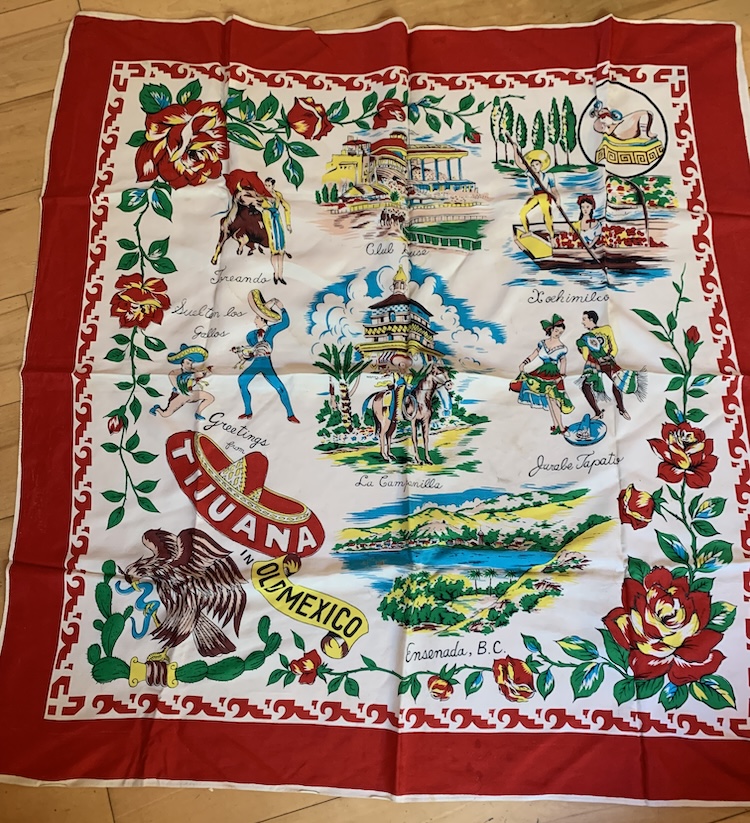
While Hermès represents the crown jewel of her collection, my client is also a devoted collector of vintage souvenir scarves. Pictured here is her 1950s rayon example from Tijuana, embellished with raised glitter. From the sublime to the ridiculous.
I married a Brit in 1979, and as a wedding shower gift my very posh British mother-in-law, who always wore a silk square knotted beneath her chin, gave me a Jacqmar silk scarf featuring a Toulouse-Lautrec Moulin Rouge image. Until researching this piece, I did not realize that early 20th-century Londoners Jack and Mary Lyons, known as Jac-Mar, were responsible for wartime British political advertising, propaganda, and souvenir scarves. Their influence stemmed in part from their association with Clementine Churchill, Winston Churchill’s wife, for whom they designed a World War II Royal Air Force scarf titled Happy Landings.
Jacqmar propaganda scarves quickly gained popularity. By 1942, British Vogue depicted slogan scarves as a fashionable wartime staple among prominent figures. France, long the leader in luxury accessories since Hermès introduced its first silk scarf in 1937, was occupied by Nazi forces beginning in June 1940. This disruption created space for a British design alternative. Jacqmar scarves featured wartime slogans such as “Salvage Your Rubber!,” “Switch Off That Light!,” “Free France,” and “Welcome American Forces in London.”
Jacqmar sourced silk from repurposed wartime parachutes. When silk was scarce, headscarves were produced in crepe or rayon and accented with metallic glitter, as seen in the postwar Tijuana souvenir scarf. Instead of fine hand-rolled hems, these more affordable scarves were machine-hemmed and sold as colorful, inexpensive advertising pieces, distinct from the costly and finely finished Jacqmar silk scarves.
During the 1940s and early 1950s, silk scarves became symbols of female solidarity and frugality. Campaigns such as Rosie the Riveter prominently featured headscarves worn by women working in factories. “Cover Your Hair” functioned as a propaganda message, since long hair posed a danger around machinery and women were urgently needed on the shop floor.
What we often think of as a World War II fashion phenomenon, the themed scarf has in fact existed for thousands of years. Queen Nefertiti was depicted wearing a scarf around her slender neck. Greek portraits from 500 BC show men draped in scarves known in Latin as sudarium, cloths used to wipe perspiration. These garments were close relatives of the modern necktie, with an important detour through 17th-century Croatia, where officers wore silk scarves denoting rank. Croatian mercenaries brought the style to France in the 18th century, where it became known as the cravate, derived from the French word for “Croat.”

During the French Revolution, patriots wore tricolor scarves. On his Egyptian campaign from 1798 to 1801, Napoleon Bonaparte collected silk Egyptian scarves for Josephine. Meanwhile, in the Scottish town of Paisley, weavers adapted Middle Eastern motifs into wool scarves for British women. These designs were exported throughout Europe and the United States in the late 19th century.
Scarves have also served as important liturgical vestments and academic insignia, as well as themed accessories for Oddfellows and Foresters, football fans, and Boy Scouts.
The modern world of themed scarves was transformed by a landmark Hermès design, Jeu des Omnibus et Dames Blanches, introduced in 1937 by the second generation of the Hermès family. Founder Thierry Hermès, born in 1801 and deceased in 1878, was a saddler and harness maker serving the courts of Napoleon III and Queen Victoria. The company later expanded into equipage, including trunks, bags, jockey silks, and handbags with patented zipper clasps. Under the second generation, colorful jockey blouses evolved into women’s scarf squares. Subsequent designs depicted French soldiers on horseback or in military dress, printed on China silk using as many as 43 screens, one for each color, to achieve their remarkable palette.
I am proud to say I own half a dozen Hermès scarves acquired from thrift stores. Hermès International has remained under family control and, since 2013, has been led by sixth-generation Executive Chairman Axel Dumas.
My client’s Mexican souvenir scarf is valued at approximately $40 on the nostalgia market. A fine vintage Hermès scarf, by contrast, can command prices in the thousands.
You might also be interested in...




You must be logged in to post a comment.