
Supervisor Capps’ Re-election Campaign, Victories, and the Road Ahead
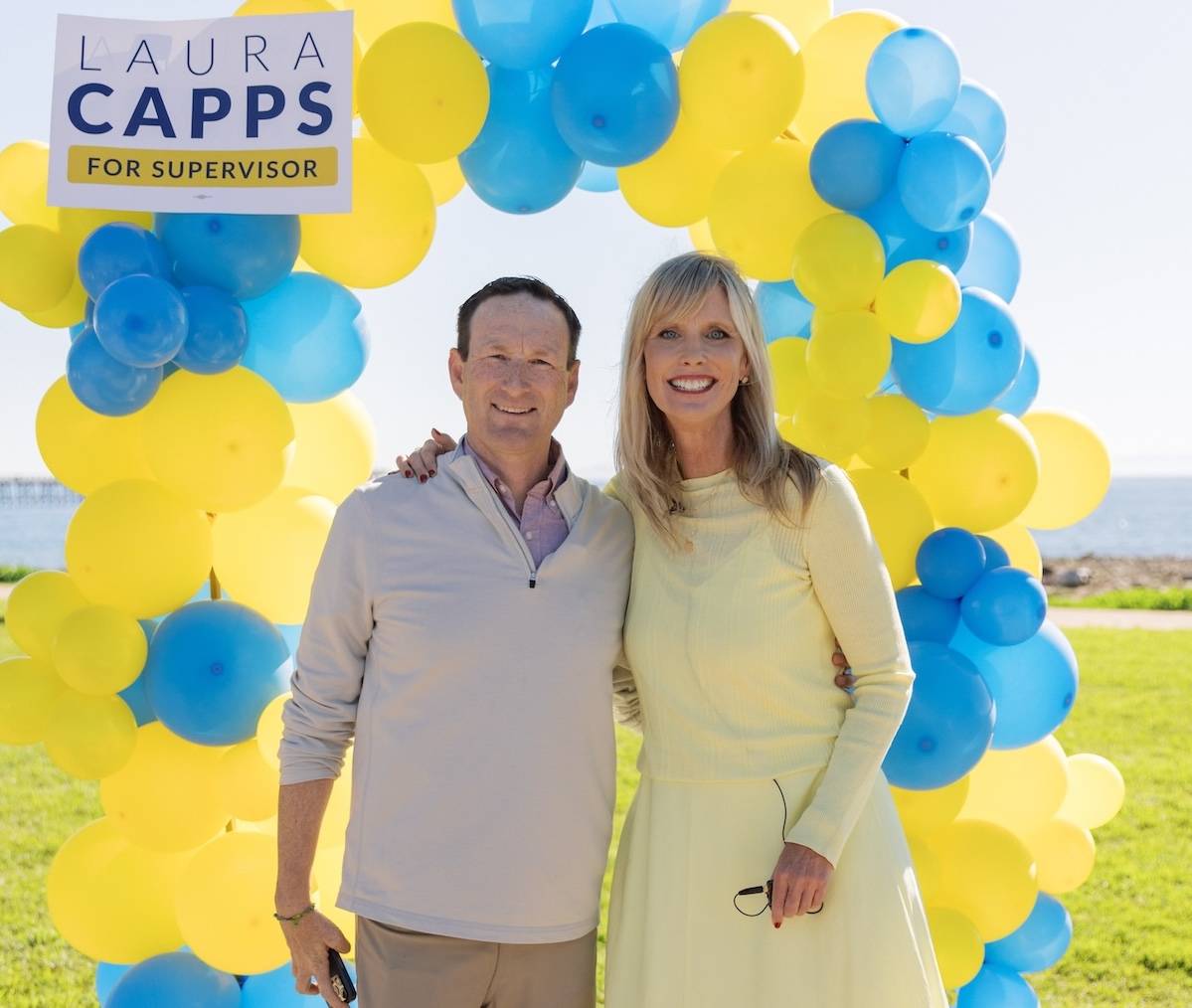
It’s hard to believe it’s been six years since then Santa Barbara School Board Member Laura Capps threw her hat in the ring to challenge then 1st District County Supervisor Das Williams for his seat on the Santa Barbara Board of Supervisors. Laura didn’t win, but she came a lot closer to defeating her veteran opponent than many believed she could, proving that she was, indeed, a contender. Two years later, in 2022, Capps stepped up once again, this time to run for the 2nd District Board of Supervisor seat, and the rest, as they say, is history.
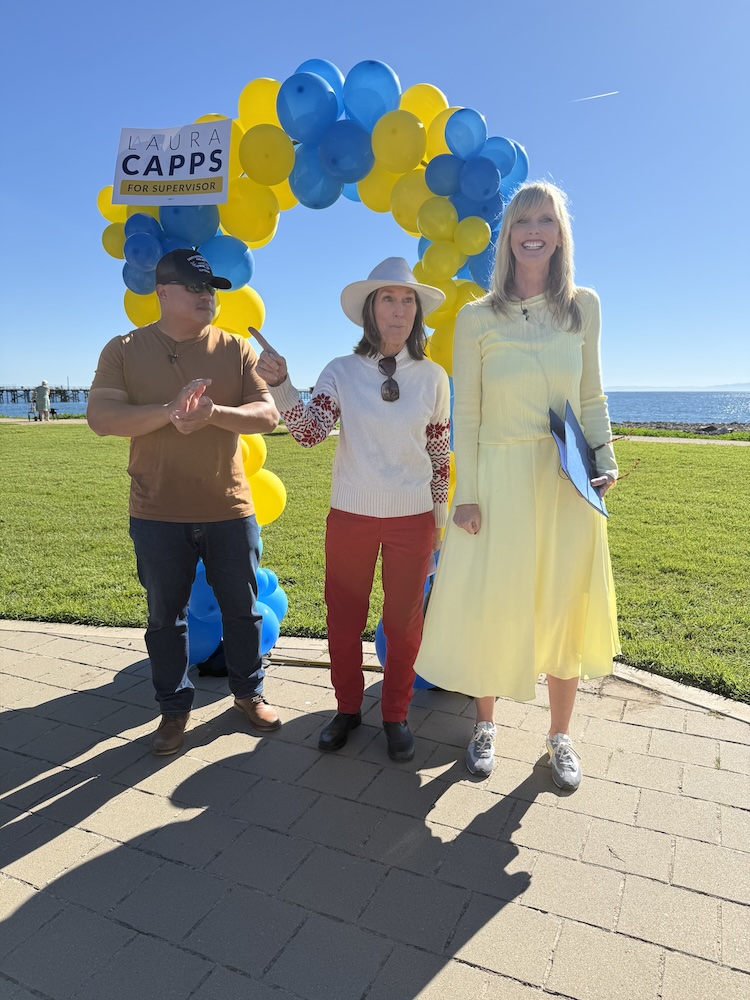
Last week, at a well-populated Goleta Beach event, 2nd District County Supervisor and current Board Chair Laura Capps announced that she is running for reelection. Joined by many local officials, including her two most closely aligned Board colleagues, 1st District Supervisor Roy Lee and 3rdDistrict County Supervisor Joan Hartmann, Capps addressed an audience of 75 plus supporters. The event was outside and still it felt like a room filled with energy, enthusiasm and whole lot of hope – something that seems to be in short supply these days.
Before her announcement, I sat down with Supervisor Capps at a picnic table to talk with her about her first Supervisorial term, and her decision to run for a second term. It’s true that on that day the weather at Goleta Beach could not have been more perfect, but still, what I felt I was mostly basking in was the glow of Capps’ enthusiasm for a job one could argue she was born to do. Here is our conversation.
Gwyn Lurie: Today is your kickoff for your re-election campaign. Four years go by fast.
County Supervisor Laura Capps: Definitely. It has been a lot of activity, of engagement. So many good issues. And so much more to do and my excitement only grows the more I dive into this work.
Your job as a County Supervisor is not an easy role, because on the one hand you’re being elected to use your best judgment. On the other hand, it’s important to listen to everybody and you’re not going to make everybody happy. How has that gone for you?
That part hasn’t been that challenging because almost always what I am hearing from folks is where I end up being. On a rare occasion, it’s not aligned, but it’s generally aligned thanks to a lot of shared values here in Santa Barbara County. But there’s of course that tension, and that’s where I just have to stay true to my inner core. And maybe it’s my age, maybe it’s my wisdom, maybe it’s all the things I’ve done that have led me to this, and why it isn’t too challenging for me to know, when I am at those crossroads, what to do. Ultimately, the hardest part really is being faced with a series of tough decisions and how to make some bad situations better.
Can you give an example of what some of those tough decisions are?
Yeah, here we are in Goleta right now and prior to me becoming supervisor, a decision was made that the area of the Eastern Goleta Valley would receive 75% of all the new housing coming from the state mandate. That’s a ton of impact. We need the housing for sure, but 75% of it going to one area of our county is not fair. So I ended up voting against the plan because I didn’t think that the concentration was fair, but I tried to make it better and we did make it a lot better, even though I ended up voting against the architect of the plan, I pushed and we were able to get over 50% of those homes to be affordable or for moderate income people making under $120,000. So that’s a great example because we’re in Goleta, the home of lemons, and we were trying to take lemons and turn it into lemonade. And that’s a huge multi-generational decision that I had to make very new into my term. Again, the die was cast prior to me getting here that my allotment as district two supervisor, I literally was given a number, oh, you’re going to get 4,653 units. What are you going to do with them? City Council of Goleta was not happy. That was a big one. But there’s small issues all the time of just: here’s a bad set of circumstances and how do you as a leader try to make the best scenario? And it doesn’t always translate well to the page or to a soundbite or to when you’re in the supermarket and someone stops you and says, what do you think about X, Y, Z? But as much as it’s hard, I really enjoy trying to figure out that best solution.
“I’m proud of what we’ve accomplished, but ultimately we’ve got a long way to go. We need more affordable housing here. It’s too expensive to live here. I think that’s our number one challenge.”
It seems like one of the challenges of being an elected official is that you are so deep in the weeds on the details and sometimes you’re going to vote against something that you believe is a bad bill even if in the big picture you agree with the spirit of the bill. So, you end up looking like you’re voting against more housing when in fact you just want a fairer distribution.
Exactly. And what I did was just push the developers up here; and we’re focused a lot right now on downtown Santa Barbara and they’re pushing to get 10% affordable housing. We are getting out of these projects that I’m talking about, in some cases 35% affordable, because I just kept saying no. And my no vote in a sense helped up the ante on these developers. I’m proud of what we’ve accomplished, but ultimately we’ve got a long way to go. We need more affordable housing here. It’s too expensive to live here. I think that’s our number one challenge.”
Looking back on the last four years, what stands out to you as the high point, the things you’re the proudest of, and on the other hand, the low point.
Well, the way these elections work, it’s been just three years. And I am proud of how much we’ve been able to do, me and my office, in a short period of time. I made a list of things I ran on, and we’ve done them all. And I attribute that to our office, to my sense of how to accomplish things. I attribute it to the job. Being a county supervisor working on the local level is awesome because you have immediate impact. You get to see the fruits of your labor. And I also attribute it to the community. The community is receptive. I think to be a local leader in 2025 is a blessing. It’s something I take very seriously. I am so grateful. I find it cathartic to watch the headlines – to not get to see the dysfunction in Washington – and to be able to translate my angst, translate my complete despair and frustration into local action, and be able to do something about it.
I mean, here we are in a park that has been transformed. People are doing yoga and exercising and sitting with a guitar and swimming and you’ve got the university in the midst. We have such an amazing community of people who really care. And sure, we have a lot of problems in Santa Barbara County – poverty, affordability, all the things. But we also have so many solutions and people that are willing to do it. And as a supervisor, I get to be the vessel of a lot of those solutions. I get to amplify them. I get to add some firepower to those solutions on a daily basis. And I don’t think in Washington you get to do that.
You said you’ve done everything on your preliminary list. What was on that list?
Well, first, I mean one of the top things was to make government or county government more responsive. And one of the issues that I ran on eight years ago was a broken cannabis ordinance that people were really upset about, justifiably; neighbors were not being heard. They were suffering from odor issues, particularly in Carpinteria. And that was one of the first things that I was able to do this year as board chair. That was high on my list. That doesn’t encompass everything, but I put it in the bucket of a responsive government because I think that, especially on the local level, when people are trying year after year after year – and I’m talking seven years of trying to get answers – trying to get responsiveness and that’s not working, that’s not right. And so we were able to right that wrong, especially with Roy Lee coming in.
Another thing was more affordable housing, even though I don’t think we’re feeling it yet, there is a solution. There is a light at the end of the tunnel. Again, Santa Barbara’s always going to be a hard place to afford to live, just given the immense beauty of where we are. So I’m not saying we’re going to fix it a hundred percent, but it hasn’t been addressed for a generation and it is being addressed. It’s not just rhetoric, it’s the actual reality of affordable housing being built that I’m really proud of. One example is that I’ve taken a very innovative solution that I learned elsewhere – which I try to do all the time, borrow great ideas – in this case taking underutilized government land, because the government owns a lot of land, and turning that into affordable housing. And we’re doing it to the tune of an RFPA proposal already going out for 80 units in downtown Santa Barbara on Carrillo Street between Anacapa and Santa Barbara streets, that 80 families or single people could live in, work in, in probably three years.
That kind of speed doesn’t happen on other levels of government, to have an idea that I heard about two years ago in a conference and to act on this quickly and to have a board that works well together to have a community of advocates, of housing advocates that are receptive to move. So I’m really excited about taking government land and turning it into affordable housing.
Then there’s climate change. Again, very daunting. What’s happening on the federal level is so depressing. It’s hard to even think about, but we took a historic vote, Supervisor Hartmann and I really led the charge for this. Thanks again to advocates like the Sierra Club, Katie Davis, Leah Stokes… We banned onshore oil and gas operations and we’re phasing out existing ones. I wouldn’t have thought we could even do that a year ago, but we did thanks to the state legislature giving counties more jurisdiction to make choices like that. That wasn’t even on my list. I didn’t even know it was possible.
We’re also making the county buildings more sustainable. That was something I did as a school board member that was on my list because the county, our buildings were not as innovative when it comes to efficiency; but now we just doubled our solar, which will save $40 million [over a 20 year period] of taxpayer money. And I pushed for that. We had some internal hiccups, and we pushed through those. So that was on my list.
“I love this board. I will hold it up against any, I mean, we get
along really well and that’s great for us. But what does that mean
for the public? It means that we deliberate… Even on the most contentious issues, even dealing with something like oil, which is
so cultural in our county, or immigration, or ICE raids. That has
been tough in our board hearing room, and yet we’ve maintained
a level of civility. As board chair I’ve been honored to try to
manage those hearings and set a tone of respect.”
Are there any obstacles you’ve encountered that you didn’t expect?
Sure. Always. I mean, there’s always staff. Just bureaucratic challenges, always. I love working with government, people who choose government service. I have such respect for, but there’s always going to be bureaucratic challenges, but yet I still would prefer to work with people who’ve decided to spend their lives serving their community even on my most frustrated day. But yeah, absolutely. And this is my full-time job, which is great. I mean, school board was volunteer basically. And so to be able to do this all day long is wonderful, just to have more velocity, more time, more bandwidth. But that also means that there tends to be some more roadblocks that I run into on a regular basis.
You’ve chaired the board for your one-year rotation. From your helicopter perspective, what’s your observation about this board versus other boards that you’ve witnessed, even from the outside?
I love this board. I will hold it up against any, I mean, we get along really well and that’s great for us. But what does that mean for the public? It means that we deliberate. There’s a moment up there often in our board hearings where the chemistry changes and we sort of sit back a little bit and we do what bodies of government are supposed to do, which is deliberate. And sometimes that results in a change of vote. It always results in a change of perspective, which is what we should be doing, which is what we are elected to do. We’re not all the same. We’re not monolithic. If we were, it would be very boring and it wouldn’t be productive, and government would not be what I think our founders envisioned. We come from very different backgrounds. We come from different ideologies. We come from different geographies of the county. Orcutt is different than Summerland. Hope Ranch is different than Guadalupe. There’s big differences in the county and I really enjoy learning from my colleagues and thinking in a different way and learning from their experience. And that’s sincere and I’m just grateful. Especially now, you look across the country and you can’t say that about local government right now. I mean, you could just do a YouTube search where security guards are having to be hired, things being thrown. And it’s a hard time in our electorate. People are taking out their anger at their government officials and I just am grateful that that’s not happening in our boardroom. And it’s also not happening amongst the people that come to our supervisor meetings. They’re very respectful. Even on the most contentious issues, even dealing with something like oil, which is so cultural in our county, or immigration, or ICE raids. That has been tough in our board hearing room, and yet we’ve maintained a level of civility. As board chair I’ve been honored to try to manage those hearings and set a tone of respect. Even when during a Sable [Oil] hearing, we had a record number of public comments, 168, very passionate. This took seven hours. I let everybody speak for the full three minutes, and by and large, it was a model of what our democracy should be.
This is a complicated moment for constituents, not just here but across the country. What would you like to communicate that you’d like for people to be thinking about at this moment?
Just to not give up, and that our local level is a place that we still can come together, and all of the potential is right here on the ground in Santa Barbara County. And to just channel some of that despair that we’re all feeling, we’re exhausted, but to keep going. We are going to get through this dark time in our history and there’s places to go with that feeling and so many amazing organizations, nonprofits that are just desperate for that energy, to try to channel that. And from my vantage point, reach out to your elected official if you’re not sure what to do, because we can tell you where to channel that because there’s so much to do between now and frankly, the end of this administration’s term.
You might also be interested in...




You must be logged in to post a comment.