
Body Reset Montecito: Stimulating Your Muscles into Shape
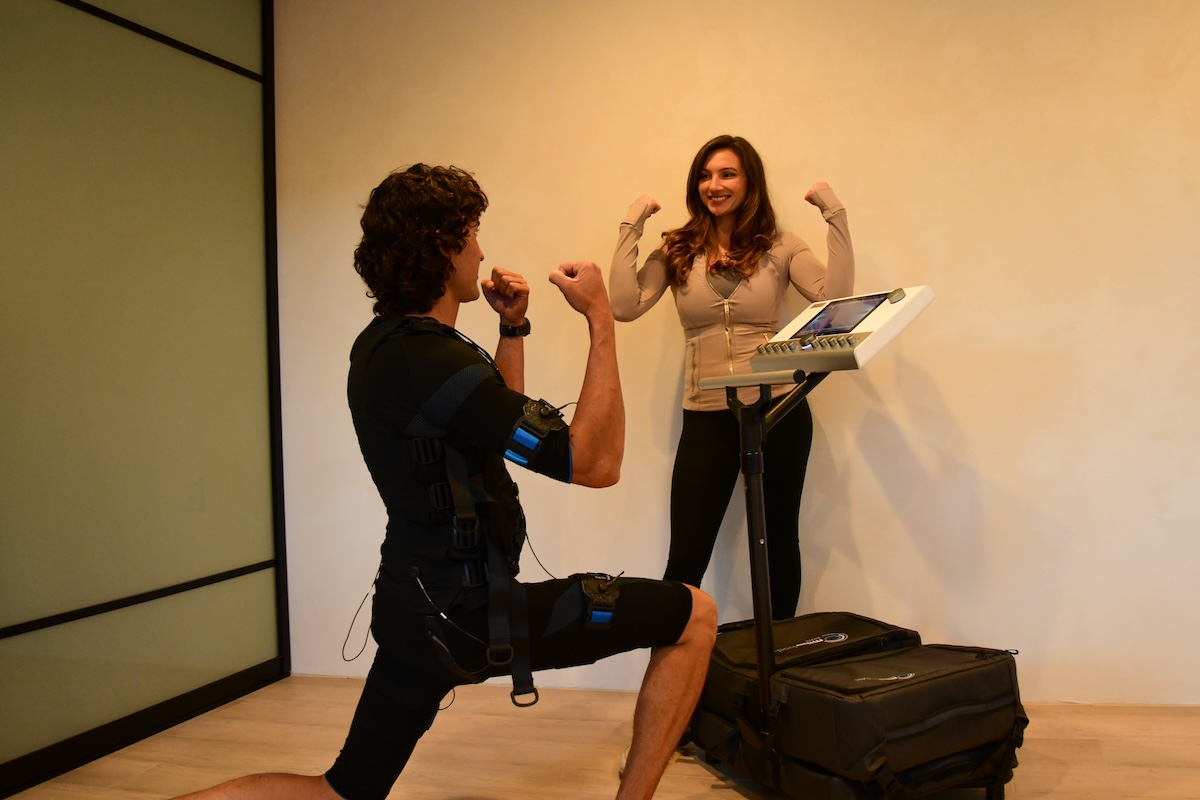
As they placed the electrodes onto my hosed down vest (to help the electrical current conduct more efficiently), images of every spy movie I had ever seen flashed before my eyes. My host and local resident, Jillian Muller, gleefully shouted at me to fire up my glutes and to crank it up. And fired up my glutes were. As I followed an avatar on the $25,000 machine in front of me, I lunged and planked my way through a 20-minute circuit purported to give the benefits of a 90-minute workout. Days later I was still feeling the burn.
Welcome to EMS. Electrical Muscle Stimulation; the core offering behind the new studio set to open in January. Co-founders Jillian Muller and Paige Duncan (who is also the wellness director) met when Muller experienced EMS with her for the first time. She was so impressed that she offered to partner with Duncan, and the rest is history in the making.
Along with Ashley McNary, who will be director of studio operations, they plan to offer both membership options and single-use fees for the $200 per-session experience. Body Reset Montecito will also offer lymphatic drainage massage and Red Light Therapy (RLT); but the star of the show is the EMS itself.
While using EMS as a workout supplement is a relatively new development, the concept of using electrical currents for muscle stimulation has been around for millennia, with evidence pointing to the ancient Egyptians as first using electric eels for pain relief. However, it wasn’t until the 1990s that EMS as we currently know it was used to train athletes both for performance and recovery.
So what is it really? Electrodes are placed over the muscle area that is to be stimulated. Impulses are then sent to the muscles telling them to contract, mimicking the body’s natural nerve signals.
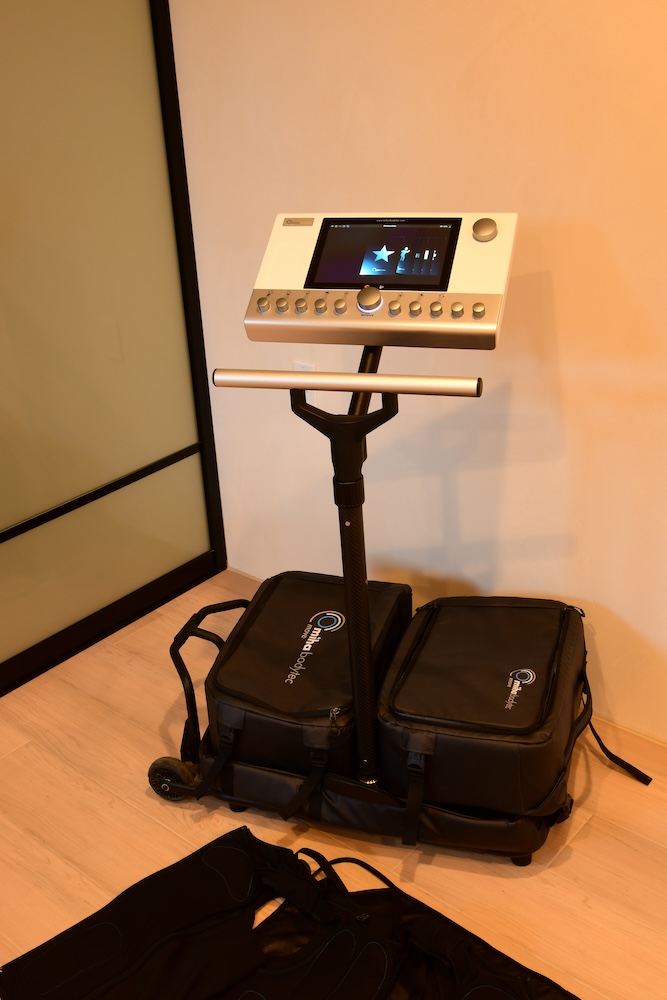
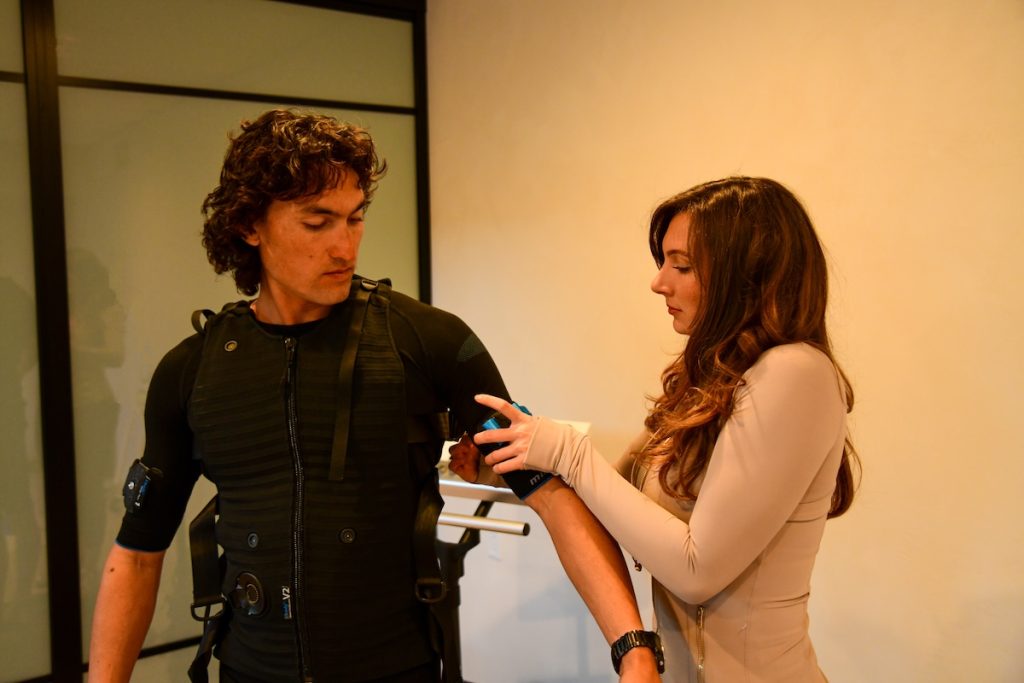
But before you get stimulated (what?), you first put on a base layer (with no undergarments on in order to allow for maximum contact between the impulses and your body), then you are tightly fitted with a vest that has been dampened. Next, the electrodes are placed on various contact points all over the vest; arms, back, waist, glutes, etc. Finally, the battery cable is attached making you feel like some sort of middle-aged, barefoot Transformer. Once you are connected, the Miha Bodytec – the same machine used at The Mayo Clinic – starts its magic. The vibration starts as a fuzzy tickle and as your captors gradually crank up the intensity the tickle becomes less funny. It doesn’t hurt, it just reminds you who is boss. Because it is. You aren’t doing the heavy lifting either literally or figuratively. You can help it along, of course; the more you contract the muscles being stimulated the more benefits you will receive. After my second session, however, I started to get the hang of it and remembered how to move my own body.
But the most surprising part for me about this multi-part experience, was just how incredibly sore I was. You really can’t quite comprehend it until you experience it firsthand. This machine is seriously stimulating your muscles. I couldn’t tie my shoes or cross one leg over the other without wincing for almost six days. I haven’t been this sore since I went on the Indiana Jones ride at Disneyland. And yet, despite the pain, I was strangely looking forward to going back. Why is that, I wondered. It turns out that even though you aren’t instructing your muscles to contract, you are still getting the benefit of the endorphin release that happens when you do. This is one of the reasons EMS has also been historically used for pain relief and helping to prevent muscle atrophy in people who are bedridden.
I asked Duncan about how she got into this field. “I began with yoga and assisted stretching, which became the foundation for everything I do now and shaped my understanding of the need for balance between strength and recovery. From there, I trained in Brazilian lymphatic drainage through Detox by Rebecca, working closely with clients on detoxification, circulation, and recovery.
As my practice evolved, it felt natural to move toward a more well-rounded approach, bringing together recovery, mobility, and strength, which ultimately led me to integrate EMS as part of a complete wellness practice.”
I wondered if this was the Ozempic of workouts. Will people try to replace the blood, sweat and tears of exercise with a machine that does the work for you? I asked Duncan for her thoughts. “Frequency depends on the individual and their goals, but EMS is typically used one to two times per week due to its intensity and efficiency. Rather than stacking it on top of an already demanding routine, EMS is often used to rebalance training volume.
Many clients adjust their existing workouts, keeping the movement and strength practices they enjoy – such as Pilates, weight training, or walking – while using EMS to support muscle activation and help tone the body. This approach allows for effective stimulation while respecting the body’s need for adequate recovery, which is essential for long-term results.”
As Muller’s trainer, Will Schweizer (owner of Warrior Soul Combat kickboxing gym), told me, you still have to do your own cardio and a few workouts each week, but on the day of an EMS session you really don’t want to do any other workout. And I found out why firsthand. Within four hours of my first session, I was already sore.
Strangely, even on the way home I rubbed my arm, and it felt a bit superhero-ish. Was that a sculpted muscle emerging, I wondered? I could have been gaslighting myself of course, as it typically takes around 3-4 weeks to see results. However, from my own experience I did see and feel results after just two sessions.
But what about the risks? The side effects? The downside? As my very wise sister used to tell her kids when they wanted to drink diet soda, “You either pay now, or you pay later.” I know what she meant, but out of fear of spewing Ted Lasso-esque platitudes I will refrain from explaining her wise aphorism further.
In addition to soreness, the user is cautioned about potential skin irritation and headaches, of which I had none. So who shouldn’t use EMS? Anyone with active implants such as a pacemaker, people who experience seizures, and anyone who is or might be pregnant. Having aired those cautionary notes, the benefits seem to be bountiful. In the Mayo Clinic study, they found that in addition to “…increased muscle mass and improved functional capacity in sedentary adults” (NIH Jan 15, 2024), it was also shown to “reduce cardiovascular risk in healthy adults.”
One of the key benefits is how much time it can save you. As Muller put it, “Everybody has 20 minutes!” And like all forms of exercise, you need to keep up the workouts in order to continue to reap the rewards.
I asked Duncan how they will set themselves apart from others in town offering similar experiences, and this is what she shared. “One of the biggest things that sets us apart is our equipment. We use Miha Bodytec, the top-of-the-line EMS technology worldwide. It delivers unmatched precision and muscle activation, which really raises the bar for the results clients can expect.”
Body Reset Montecito is coming to you in the New Year at 1225 Coast Village Rd, Unit K. Visit www.sbbodyreset.com, call (760) 223-0068, or email [email protected] for more information.
You might also be interested in...




You must be logged in to post a comment.