
Cubism, Fish, and Ceramics
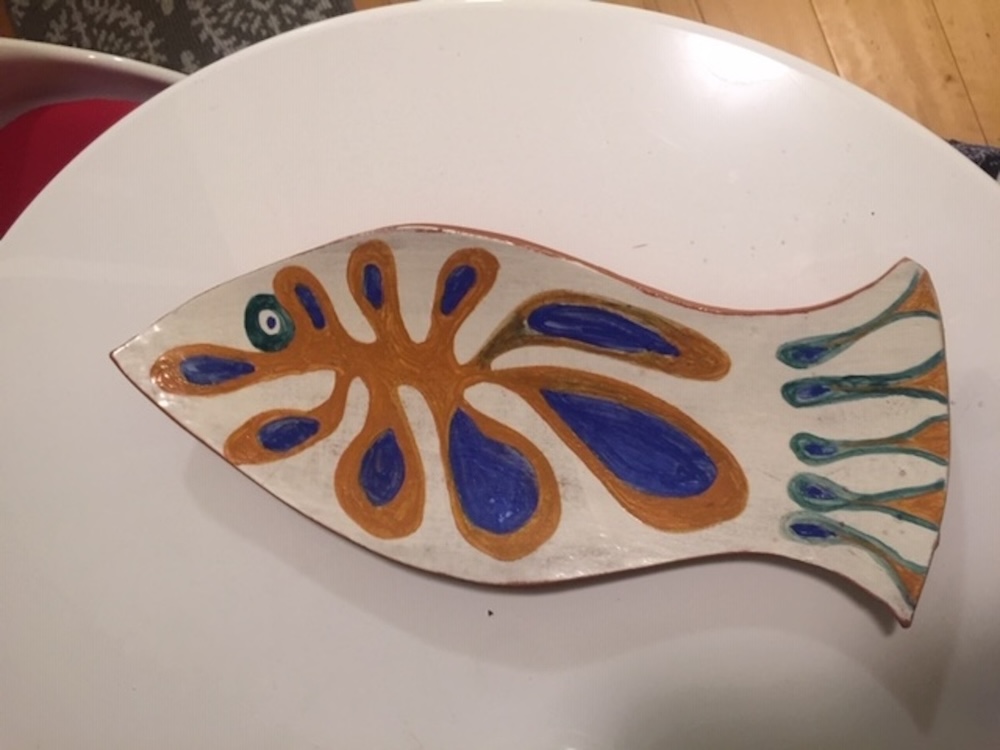
FT snatched up this ceramic fish plate at Destined for Grace in Goleta because she thought it was a Pablo Picasso creation. She was almost right. Picasso did a series of fish related ceramics, riffing off an ancient Greek tradition from Southern Italy and Attica: the ancient Greeks had terracotta red and black serving plates with painted sea life for decoration.
Picasso’s ceramics were designed in and stamped Madoura, (for example “Edition 34 d’Apres Picasso Madoura”), denoting the acclaimed ceramics workshop in the town of Vallauris on the French Riviera. When FT got the fish plate home from Goleta she found the impressed marking on the back: “Jampots Pottery, Montville.” Could it be a Picasso with a fake marking?

Montville pottery (1966-1998) was located in Montville, Sunshine Coast, Queensland, Australia. The Pottery Montville was the first craft endeavor on the Sunshine Coast, founded by English immigrants David and Audrey Everett in 1966. The couple were a brave pair of British counterculture hippies with a dream. Imagine leaving England as a young couple and starting a pottery kiln in the hinterlands of Queensland, Australia! Over time, other free spirited hippie artists joined David and Audrey.
How did a work so genuinely like a Picasso ceramic come to be made by a bunch of hippies in the ‘60s in the Sunshine Coast Hinterland? The story goes…through the intrepid explorer colonist Captain James Cook.
Picasso might have been proud of the reference to his work by the young hippie potters, as the Jampots fish plate from the hinterland was also inspired by an ancient people’s craft traditions. These Sunshine Coast Hinterlands are the traditional lands of the Aboriginal Gubbi Gubbi People. The area’s first European “discoverer” was controversial explorer Captain Cook (1728-1779), in 1770. As he surveyed the distant mountain range from his ship The Endeavor, he noticed peaks that stood up like the glass house furnace chimneys of England against the barren Australian landscape.
Ironically, the elements that make for good clay are found in certain rock formations both in England and in the Sunshine Coast Hinterland from magma intrusions, formed 25 million years ago. Although Captain Cook named this range “Glass House” it had a name well before 1770; “daki comon” in the Aboriginal language, “stone standing up.”
Picasso used tribal and ancient themes, images, and element; remember the nudes with tribal mask faces featured in Picasso’s revolutionary Les Demoiselles d‘Avignon, (1907). Likewise, in the early 1960s those hippie potters in the Sunshine Coast Hinterland also saw images though the lens of ancient patterns and cultures.
The Sunshine Coast Hinterland is comprised of the Pacific Ocean views, rainforests, the Glass House Mountains, and the towns of Flaxton, Mapleton, Maleny, and Montville. There’s not a lot of information out there about the Pottery Montville, but I did find a few facts.
Since the 1960s the little Pottery had many artists selling to tourists, and each had their own brand of Terre de faience, terracotta with colorful high glaze that ‘sits’ on the surface of the pottery. In the 1998 it was decided to demolish the Montville Pottery compound, and to build a complex of artist’s studios to attract visitors to Artists’ Community Block craft complex called The Pottery Building.
Picasso’s favorite expression was “Every act of creation is, first of all, an act of destruction” – and so I have to destroy a dream, FT. The fish shaped earthenware and faience dish is NOT by Picasso. It is made by some very talented Sunshine Coast Hinterland artists in the 1960s who were channeling the spirit of the painter/avatar who had a tremendous impact on 20th century modern art. Picasso was associated with the Cubist movement through his friend Georges Braque, and profoundly influenced Surrealism, Neoclassism, and Expressionism. Picasso deconstructed our way of looking at the world. Picasso did create 20,000 works of art, so I understand that FT was hopeful that she had something by this great artist.
The values of the Montville ceramic and the Picasso originals are indicative of FT’s interest. She questioned: was this Australian lookalike from Montville a Picasso piece of Madoura? Let us compare values: going for $137,000, a Picasso original, made of Earthenware clay, with a faience glaze, a dinner service by Picasso (1988) listed in the Catalogue of the Edited Ceramic Works of Picasso 1947-1971. Going for $58,000, a Picasso Unique Plat Poisson Ceramic, a little 1952 platter not unlike FT’s found in Goleta, 1952, selling for $58,000.
Here is the merging of cultures and traditions in a little Australian fish-shaped 1960s colorful ceramic: Australian First Peoples, Ancient Greek, Hippie, and Great Artist. The Jampots 1960s fish plate’s value is $300.
You might also be interested in...




You must be logged in to post a comment.