
The Meandering Midwestern Eyes
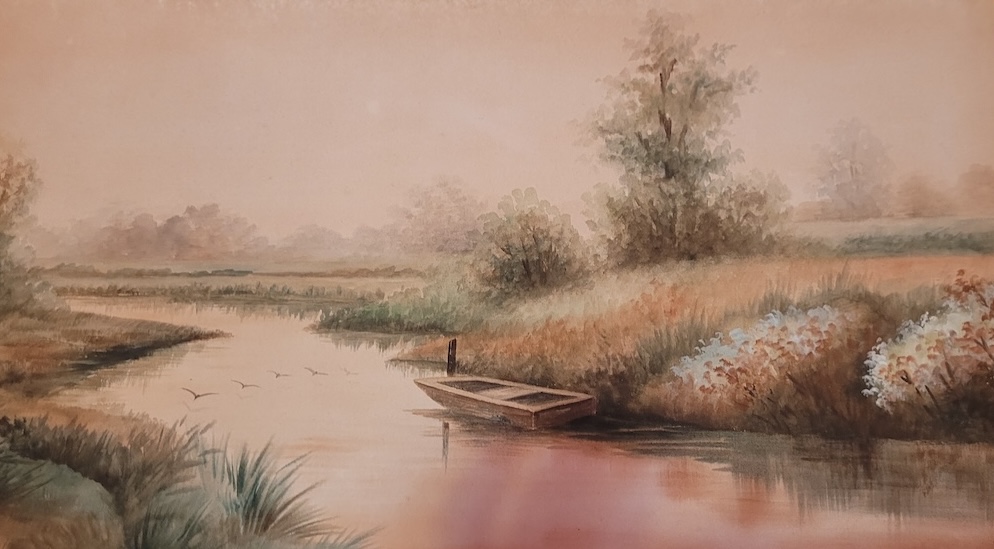
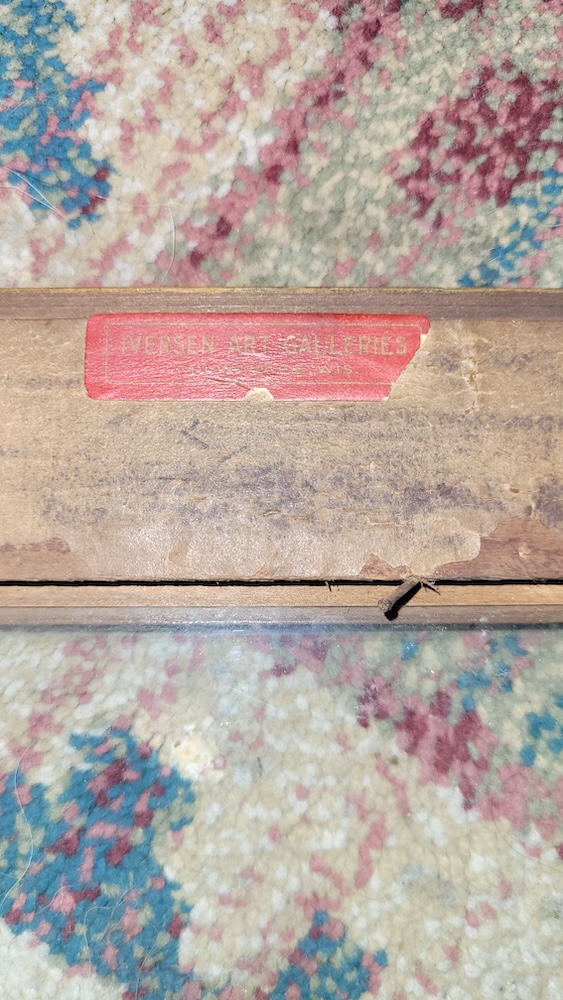
A picker with a good eye, AC got lucky and found a small late 19th century watercolor landscape featuring a meandering Midwestern (to my Illinois-bred Midwestern eye) river and a skiff tied to the underbrush. A framer’s label on the back of the simple oak frame tells a great story, almost better than the generic watercolor itself.
When researching a painting, pay close attention to the framer’s label. It can tell you not only the once-upon-a-time economic level of the buyer of work it surrounds, but also the history of the work. (For example, in the late 19th century, if you had a mansion and money, you would have had a gold gilded frame. This frame is plain oak…) The framer’s label reads: Iverson Art Galleries, Milwaukee. From this little label, we can date the art, the social class of the owner, the status of the framer’s shop (the type of clientèle he serviced), and the place and taste of the time and people that enjoyed the art in his shop. All of which – as we will see from this little framed watercolor – is something straight out of The Music Man Broadway show (Gary, Indiana?) a place full of civic pride, and an American Midwestern Anglo-Germanic brand of conservatism and propriety. The story of a frame…
So A, as a picker, found a work of art which is worth about $100, but (as they say), if this work of art could speak, we’d have a $500 story on our hands. John C. Iverson, the founder of the business, manufactured picture frames, cabinets, mirrors, and moldings, and delved into carpentry used for undertaking. His shop is pictured on the “Urban Milwaukee” website as it appeared in 1879, shot in that day by a certain H.H. Bennett, a purveyor of stereographs (more about him later). The imposing late 19th century Beaux-Arts style storefront was located on Water Steet south of Mason Street. Behind its 12-foot tall plate glass windows, one can see works of art which place the aesthetic taste of the shop owner as straightforwardly conservative (no nudes, “modern” art, or art photos in his shop).
Iverson was a major Milwaukee civic leader: he formed a committee of businessmen who single-handedly brought a professional ball club to the city in 1880; the Milwaukee Brewers were born in 1884.
Iverson was a big booster for the newfangled process called photography, and he befriended a photographer from the Wisconsin Dells – the aforementioned H.H. Bennett who, as mentioned, produced tourist stereographs. For over 10 years the two men sold shots of “exotic” Wisconsin to collectors of stereographic view cards, those near identical photographs paired side by side to produce, when properly viewed, the illusion of a 3-D image. Many American middle-class families could afford these cards, and avidly collected views of their vacation spots, as well as places in the world they would never visit. The exotic Wisconsin views would include the Dells, and the city of Baraboo – nicknamed “Circus City”due to the Ringling Brothers having settled in Baraboo in 1875 and performed their first show in nearby Mazomanie, WI in 1882. By the 1930s the Ringling Brothers Circus would be the largest and most famous circus in the world.
I visited the Ringling Brothers Circus Museum when I was 11 with my three siblings and mom, and upon a visit to Albert Ringling’s Romanesque Revival Mansion (1906), we kids stood in a line listening to the loud old circus calliope, brought there by the eldest of the five famous Ringling Brothers.
Back to the Iverson Company, which in 1880 sold a middle-class Wisconsinite the little watercolor. Iverson, as we have said, saw the earning potential in the new art form of photography, and around 1885 published a collection of 100 photogravures of notable Milwaukee sites and buildings called “Milwaukee Illustrated.” How did Iverson find 100 imposing Milwaukee sites in a city that in 1885 boasted a population of 120,000 souls?
The book cost Iversen some cash to create, as well as the helpful boosterism of the higher caste Milwaukeeans. The photogravure process is a “fancy,” specialized, high-craft process featuring etching baths and a copper plate press and is more exacting and expensive than the comparatively simple silver gelatin photo processing. In photogravure, a photo is etched onto a copper plate, which is then burned with acid and inked to press onto paper. This creates a high contrast rich tonal range from the deepest black to the white of the paper.
ACs frame – worth a bunch of good stories, and encompassing a watercolor that handily exemplifies the nice conservative Milwaukee taste of 1885 – is valued today at $100.
You might also be interested in...




You must be logged in to post a comment.