
Communication
One of my most popular epigrams says, “When all other means of Communication fail, try Words.” And it is illustrated with an image of Shakespeare. Scholars are still debating how anyone with so provincial a background could have had such a mastery of verbal expression as Shakespeare had (or whoever wrote the vast body of works attributed to him).
But incredibly outstanding genius seems sometimes to emanate from more than education, or even heredity. How else can we account for the kind of extremely youthful talent which is demonstrated by the phenomenon of the “child prodigy?” One example was Mozart, who, at the age of five, was already so capable and creative musically that his father took him on a tour of Europe, so that he might be seen by various Royal courts.
The story of modern Communication is to me quite a thrilling one. Back in the 18th Century, it was discovered that, if people were sitting in a circle, with joined hands, an electric current induced in one person would go around the entire group almost instantaneously. But it took practically another whole century before that knowledge was usefully applied. The big breakthrough came with the discovery that such electric impulses could travel through the medium of a wire. It was still a long way from transmitting actual words, since all that could be sent was a series of “Ons” and “Offs.” Some kind of code had to be devised to make them meaningful. For this, we have to thank a man named Samuel Morse, who turned them into “dots” and “dashes,” which in turn could represent letters or words. That invention became known as a “Telegraph.”
According to legend (which in this case may very well be true) in 1844, when the first public demonstration of this new wonder was about to be demonstrated by Morse himself – sending a message both ways between Washington and Baltimore – it was a little girl (whose education must have included Bible Studies) who suggested the four-word passage from the King James version of the Old Testament Book of Numbers. Her suggested verse was indeed used, and was arguably well-suited to the occasion. “WHAT HATH GOD WROUGHT.”
Of course, it was sent as a series of dots and dashes. Not until the invention of the telephone in 1876 was it possible to send actual voices by wire.
But wires were still necessary – and that is why the story of communication across the American West is such an exciting one. It is inextricably bound up with the development of railroads. The West Coast, and particularly San Francisco, had already been settled before any lines of communication between the American East and the West had been established. But attempts to remedy this gap were still in progress, pushing from each direction, at the time of the Civil War.
That situation is what makes the saga of the Pony Express so remarkable. It existed for only 18 months, beginning in 1860, but during that time it was the fastest means of carrying mail between St. Joseph on the Mississippi and San Francisco on the West Coast. It required a series of stations, at which riders and mail could change horses – or sometimes the riders would remain, and just the mail would continue on with another horse and rider. The riders were required to be young and slim, so their slight frames would not add appreciably to the weight of the mail. And they were expert riders.
The men who established this system were businessmen, and naturally hoped that it would be a money-making enterprise. Unfortunately for them, it was not. That fact – and the introduction of the transcontinental telegraph system – is why the Pony Express existed only briefly. But from the time it was in operation to today, it absolutely captured the public imagination, becoming an indelible part of American history and legend, not least because it was so emblematic of the “rugged individualism” that characterized the American citizen.
The story of Morse Code is itself full of drama, especially when ships at sea were involved. One misperception is that “S.O.S.” means something like “Save Our Ship.” Actually, it was chosen as an international distress signal just because it happens to be an easy message to rapidly tap out on any telegraph keyboard. Equally misunderstood is the idea that “May Day” as a voice message has a connection with the first day of May. It is actually a transliteration of the French expression “M’aidez!” meaning “Help Me!”
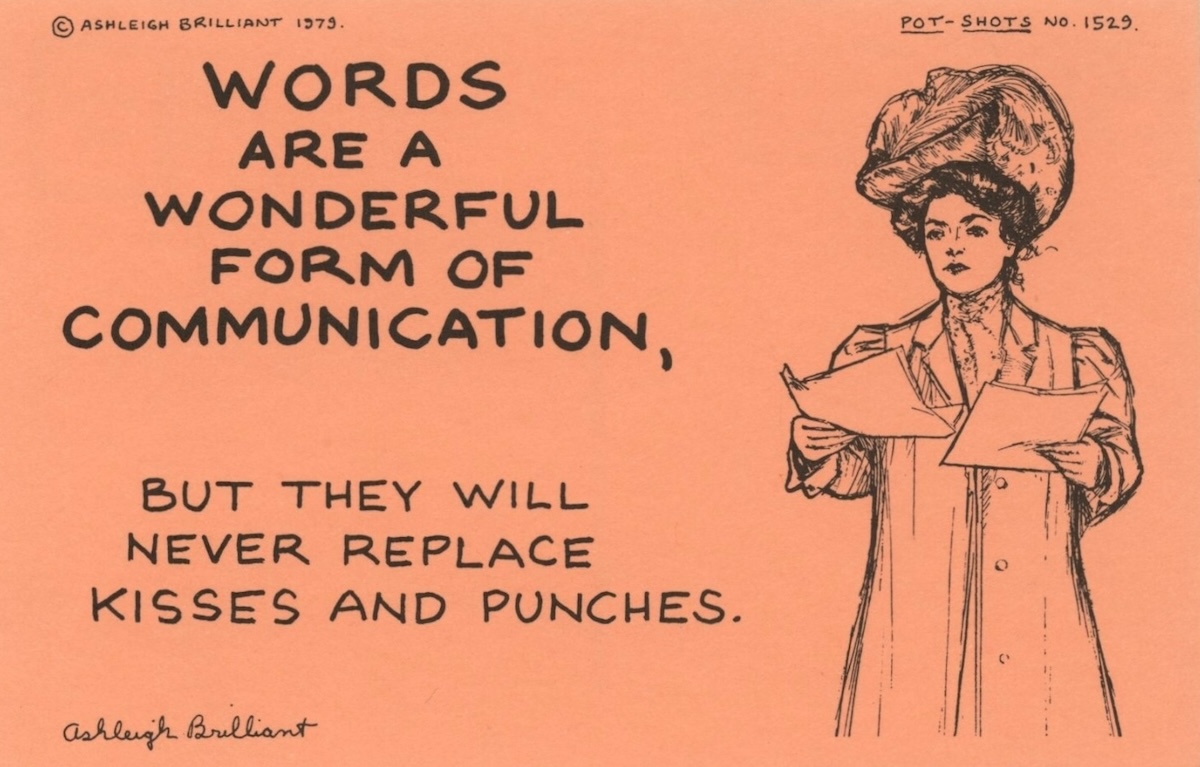
Replying to the Thought I started with, allow me to conclude with another:
“Words are a wonderful form of Communication –
But they will never replace Kisses and Punches.”
You might also be interested in...



