
The SBMA Art Revolution
This week’s Society Edit is full-on-art! Are you watching Paris Fashion Week’s SS26 and pining for the Impressionism that came out of SS25? Are you recalling Women’s Wear Daily and Artnet presenting Impressionist artists Monet, Manet, Vincent van Gogh, and Pissaro in the couture designer fashion books, and that art literally printed on the fabrics?
You are in luck! The Santa Barbara Museum of Art in collaboration with the Dallas Museum of Art (DMA) are opening their dual exhibitions on the Impressionist period starting October 5. The show, titled The Impressionist Revolution: Monet to Matisse,is organized by the DMA and curated by Nicole R. Myers, PhD – chief curatorial and research officer and The Barbara Thomas Lemmon senior curator of European Art at the Dallas Museum of Art. The SBMA show, titled Encore: 19th-Century French Art, is curated by James Glisson, SBMA chief curator with Andrew Witte, SBMA curatorial assistant for Photography and New Media, and Charles Wylie, Former SBMA curator of Photography and New Media.
Be adorned readers! Prior to the public opening, attend the intimate champagne soirée to tour the full exhibit on Saturday, October 4, from 5:30-7:30 pm titled, “Paris by Night”! This fundraising event for the exhibit features music and photo ops. Can you just feel the vibe right now?! Almost sold out is DMA Curator Myers’ presentation at the SBMA Mary Craig Auditorium, Sunday, October 5, 12-1:30 pm. Coming up are art learning labs, wine-art-music events, an adult art studio class at Lotusland, and more.
I met with Amada Cruz – SBMA Eichholz Foundation director – and SBMA’s curator of Contemporary Art, James Glisson, on Thursday, September 25 at Cruz’s office for the finer details. Lindsay Garrison, SBMA director of communications and marketing joined.
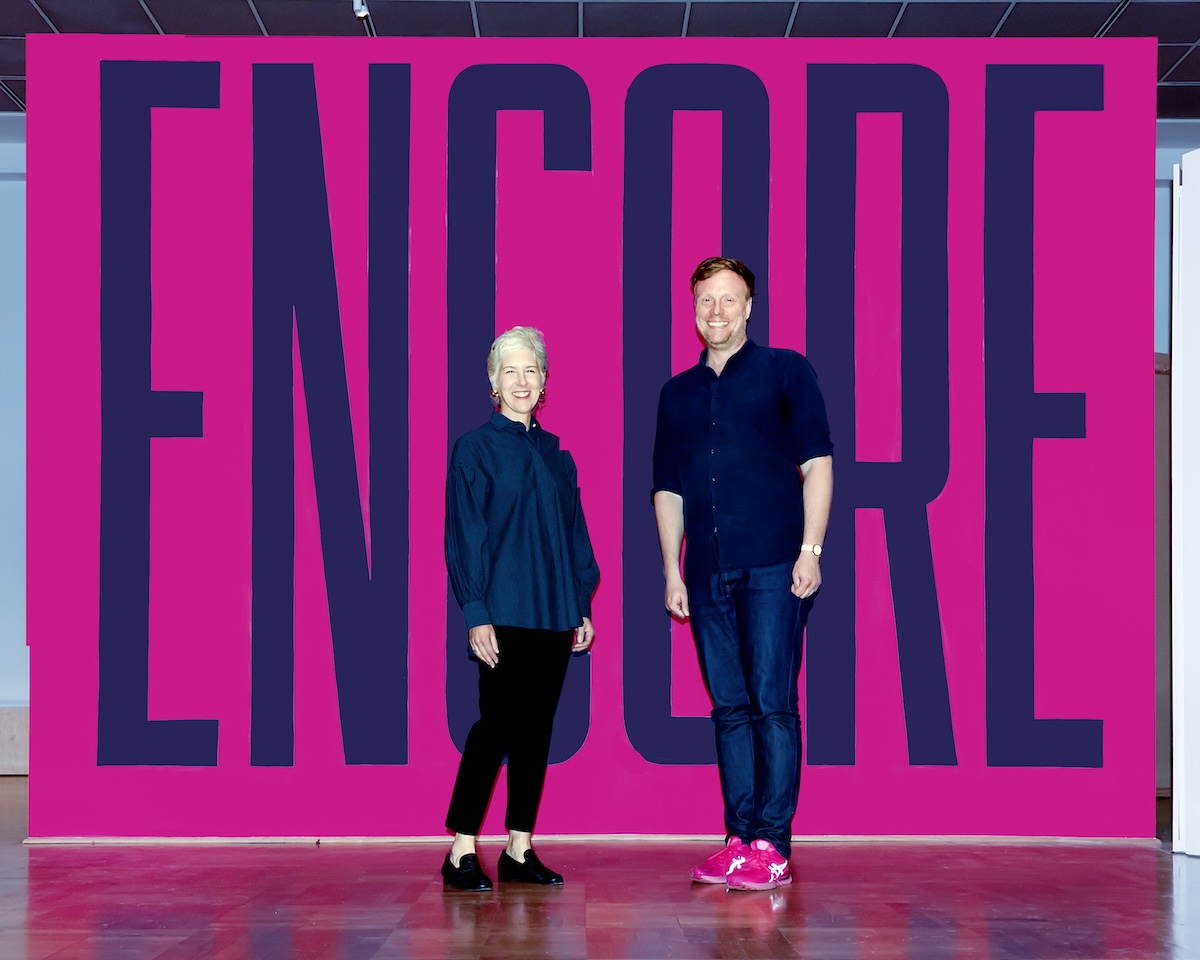
Glisson limited his spoiler alerts saying, “I can’t give it all away! The museum’s outside front entrance stairs will have the signature color theme of blue for the DMA exhibit and magenta for the SBMA exhibit with bold graphics to show the revolutionary aspect of the art; there is a build-out [faux walls] for the entrance to the Encore Exhibit, where you first go into the film screening room and proceed to the show, which includes a section called “Weird Science” about the discoveries of how vision works and paint colors used by impressionist artists. There is also an area with a lounge, a place for kids, and a French Market pop-up art store.”
This exquisite dual exhibit has 47 paintings and two sculptures from the DMA, and 54 SBMA works (25 paintings, nine photographs, 15 prints and drawings, two books) and a six-minute film containing 102 works of art by 49 artists from the SBMA’s collection.
Joanne A Calitri [JAC]. How does this exhibit relate to the mission of
the SBMA?
Amada Cruz [AC]. I’m very committed to having a balanced exhibition program. We’ve done a lot in the contemporary art realm because I felt that was a growth area and now is a big part of what we are doing. It is important to me that we are balancing our exhibitions, and we are honoring the legacy of all the people that have given us incredible works of art, and the French 19th century works we have is extraordinary. It’s a fantastic opportunity for us to showcase that within the context of another exhibition of world-class French Impressionism from the DMA.
JAC. How does 19th art influence the 21st century – today and in the future?
James Glisson [JG]. What I would say is it is less about content or execution, it’s more of the idea that when artists feel they have something to say, they can figure out how to say that and share it with an audience without having institutional approval. The thing the Impressionists did is, they were not being recognized by the current salons, so they made their own salon. That anti-institutional spirit continues. Often that happens today via social media and Instagram. Many artists get their start by working with their friends in DYI project spaces.
JAC. What are the top innovative techniques the Impressionist artists gave us?
JG (James Glisson). That’s hard. A few thoughts: First, although art is about what we see in the visual world, it does not have to mimic the world exactly. Second is that even when artists don’t seem to be engaging in technology, they are anyway, the case in point for that is the pigments the impressionist artists used, new colors, chromium pigments, etc.
AC. I hope we can get across how revolutionary these art works and artists are. We are so accustomed to seeing these as beautiful paintings, but these works were horrifying to the academic painters and audiences of the day.
JAC. Were the paintings in this show cleaned or repainted?
JG. The DMA had many of the paintings cleaned. What that means is that the old varnish that yellows over time was removed and a new synthetic varnish that is more stable has been added, so the colors are much more accurate.
JAC. So, the colors will be as intense as they were when originally painted?!
JG.How I would answer that is that we are so accustomed to seeing colors on computers and phones that are much more intense than what is the actual color of it in the world. For the people living in the age of the Impressionists, the paint colors by these artists were intense. For us, it will feel very contemporary because it is like what we see every day on our screens. There are electric colors in most paintings, no real neutrals, parts of a painting may look brown, but look closer, it has reds and yellows. The core of the show is Impressionist paintings and then the aftermath of that, what gets carried forward. We start with Impressionism, Post-Impressionism, things get more abstract, the colors get more unconnected to reality, and by the end of the exhibit, we arrive at André Derain’s Fishing Boats at L’Estaque (1906) and works by Matisse in 1925.
JAC. How did the dual exhibition come about?
JG. The genesis of the dual show was Charlie Wylie [before he moved to Texas] who brought the idea to us. It resonated with us because it was a serious show, a wonderful lesson in art history. The work is really beautiful, and we felt it would connect with a broad audience.
AC. The museum world is small. Many of us on staff and the former SBMA Director [Larry J. Feinberg] had connections with the DMA. It was a nice confluence of these relationships. I like to bring in shows that have some relationship to the collections we already have. One of our strengths is 19th century French art. I’m not sure we’re able to do this again because these are very precious objects and a big undertaking for the museum. The two shows are counterpoints; one is a very classical exhibition, very beautiful with art in gold frames on white walls, hoping people will slow down and spend time with it. And our exhibit is more lively, with paintings, a film and more surprises.
JAC. Let’s talk about the Encore exhibit…
JG. Many of the works for Encore exhibit are not going to be up again for a long time.
The premise of the SBMA show is location. As we started to sort things, we realized that we could talk about location, where things were made or what was being pictured in them. We open the show with a large map of Paris and artworks that are geolocated – such as the Eiffel Tower and the Galerie Georges Petit [leading art gallery for French Impressionism and later Matisse]. We found a lot of art of the same place by different artists at different times. We start out with a Monet and Montmartre in the 1880s, as it is the birthplace of modern art and was the place for artists to live. Next, we go to the Louvre – the spiritual home for artists; and we then shift to Matisse’s studio with views of Île de la Cité and the Pont Saint-Michel. We follow the Seine River upstream and downstream to rural outer reaches of Paris – to Brittany, and the beaches of Normandy during the summer. We conclude with a London pairing where Monet visited many times.
Notes & Pieces
While we conversed, the museum staff were busy with the five-gallery installation – the DMA art is in the Gail Wasserman and Family, McCormick, Von Romberg, and Emmons Galleries; and the SBMA art is in the Davidson Gallery.
Noted from SBMA are Henri Matisse’s Pont Saint-Michel, 1901, oil on canvasand William C. Odiorne’s Jardin des Tuileries, Bromide print ca.1920s, gift of Margaret W. Weston; Claude Monet’s Waterloo Bridge, 1900 and Charing Cross Bridge, 1899 both bequest of Katharine Dexter McCormick; works from the Lord and Lady Ridley-Tree collection and other major SBMA donors.
Noted from DMA are Monet’s Valle Buona, Near Bordighera, 1884, gift of the Meadows Foundation; Pissarro’s Apple Harvest (La récolte des pommes à Éragny), 1888, Munger Fund 1955; Van Gogh’s Sheaves of Wheat, July 1890, The Wendy and Emery Reves Collection 1985; Signac’s Mont Saint-Michel, Setting Sun, 1897 and Andre Derain, Fishing Boats at L’Estaque, 1906 both The Eugene and Margaret McDermott Art Fund Inc bequest of Mrs. Eugene McDermott, 2019.
Immerse yourself in the paintings where even the shadows have color. Be inspired by Monet’s words painted on a museum wall; “What I am painting is the light around an object.” Feel supported by artists who were willing to be different and show us life is art.
411: www.sbma.net, On view through January 25, 2026.
And that’s a wrap till next week! Do email me if you have society news or an experience we can do together! Xx JAC
You might also be interested in...



